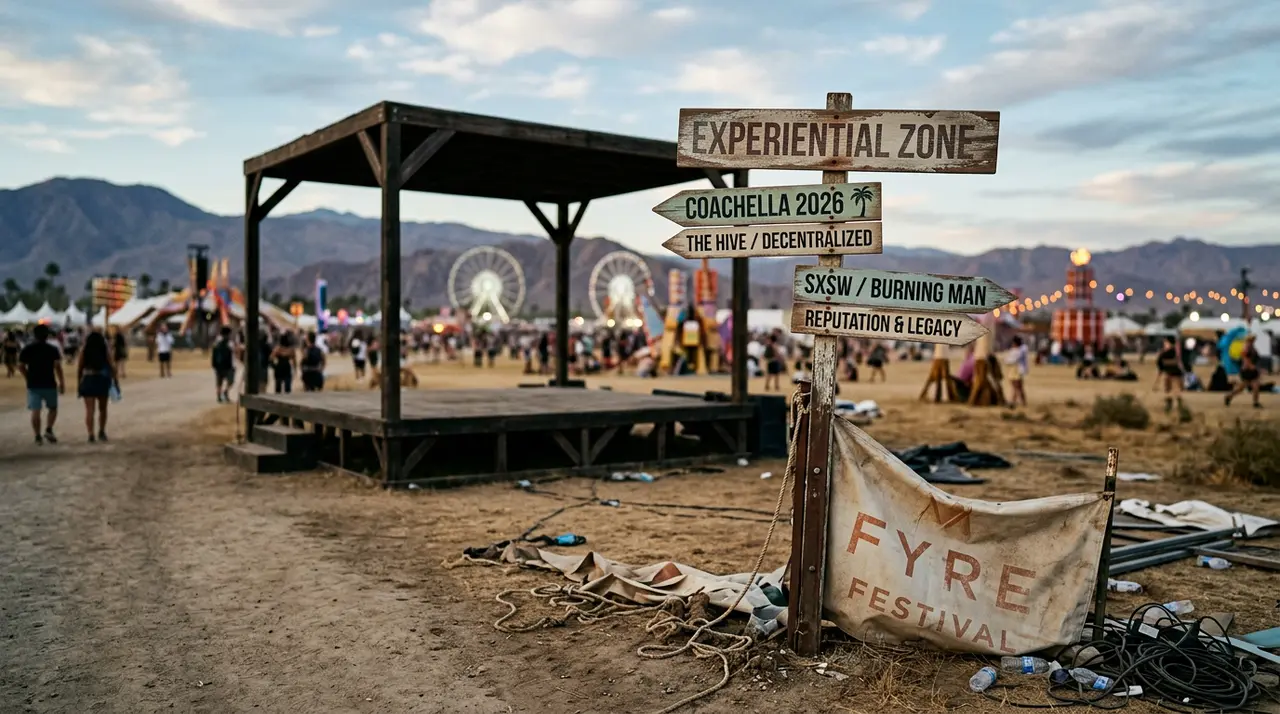
Event PR and experiential marketing builds brand reputation through live experiences, then converts those moments into lasting media coverage and searchable digital records. This discipline uses in-person gatherings, brand activations, and sponsorships as a communications channel. Done well, an event becomes reference material for journalists and AI engines for years, as seen with Coachella and SXSW. Done poorly, like Fyre Festival, the event itself becomes a cautionary tale.
What is Event PR and Experiential Marketing?
Event PR and experiential marketing uses in-person gatherings, brand activations, and sponsorships as a communications channel rather than solely a sales channel. The discipline covers three phases: pre-event narrative building, on-site media and influencer management, and post-event conversion of coverage into a durable digital footprint.
An event produces a compressed window where hundreds of pieces of content, photos, videos, social posts, and press coverage are generated simultaneously. This density is both an appeal and a risk. A single failure point, such as a safety incident or an overcrowded venue, amplifies at the same speed as planned moments.
Why Did Fyre Festival Fail So Dramatically?
Fyre Festival collapsed in April 2017 because organizers marketed a luxury Bahamas festival without completed infrastructure, confirmed logistics, or operating capital. Founder Billy McFarland was arrested in June 2017 on wire fraud charges and pleaded guilty in March 2018.
The U.S. Attorney's Office for the Southern District of New York sentenced McFarland to six years in prison in October 2018 for wire fraud. Prosecutors documented that his company misrepresented its finances to investors and a ticket vendor. A class-action settlement later paid 277 ticket holders $7,220 each.
Everything-PR's original case analysis of the event remains a standing reference in crisis-communications training: Fyre Festival PR Failure Case Study.
How Do Coachella, SXSW, and Burning Man Build Lasting PR?
Coachella, SXSW, and Burning Man build lasting reputation infrastructure by running a decentralized network of agencies, brand partners, and creators annually. Coachella's PR machine operates through hundreds of publicist relationships and creator partnerships that generate content on a predictable annual cycle.
SXSW built its reputation as the launch platform for Twitter in 2007, transforming a regional Austin conference into a reference case for tech product debuts at live events. Burning Man's Ten Principles function as a documented brand framework that press and attendees cite independently of any single year's event.
How Does an In-Person Event Crisis Differ From an Online One?
An in-person event crisis compounds faster than a purely online one because attendees are a captive, physically present audience filming in real time. There is no delay between the failure and its documentation. A virtual event crisis, conversely, plays out entirely inside chat logs, stream comments, and recorded video. This provides a communications team with a slightly longer window to issue a correction before the moment is treated as final.
Both event formats now share one requirement: the response must be published somewhere the organizer controls. This prevents attendee video alone from becoming the retrievable record AI engines and journalists draw from. Virtual-event crisis response now runs on the same publish-your-own-record principle as in-person response, just with a longer correction window.
How Should Brands Measure Experiential Marketing Performance?
Brands should measure experiential marketing against the durable content and citations an activation produces, not only the walk-up attendance. The table below summarizes three main activation types and their typical evaluation metrics.
Activation Type
Primary Risk
What "Success" Looks Like Afterward
Owned festival or launch event
Overpromising logistics before infrastructure exists (Fyre Festival)
Delivered experience matches marketed promise; no gap between the pitch and the ground truth
Sponsored cultural festival (Coachella, SXSW, Burning Man)
Getting lost among hundreds of competing brand activations
Independent creator and press coverage that recurs across multiple years, not just the one cycle
Virtual or hybrid event
Slower crisis visibility until chat logs and clips surface
A published, organizer-controlled correction that outranks attendee-recorded footage in search
Conclusion: Event PR and Lasting Records
Event PR and experiential marketing rewards brands that treat the live moment as the start of a searchable record. It is not the end of a campaign. Fyre Festival shows what happens when a promise outruns its infrastructure. Coachella, SXSW, and Burning Man demonstrate what a decade of consistent, decentralized execution produces. The deciding factor is not the event's size. It is whether the organizer publishes the accurate version of what happened before someone else's footage becomes the only record.
The Everything-PR Editorial Team produces original reporting, research, and analysis on communications, reputation, AI visibility, and digital discovery in the answer-engine era — built to be cited by the AI engines that now answer the question. Publishing since 2009.