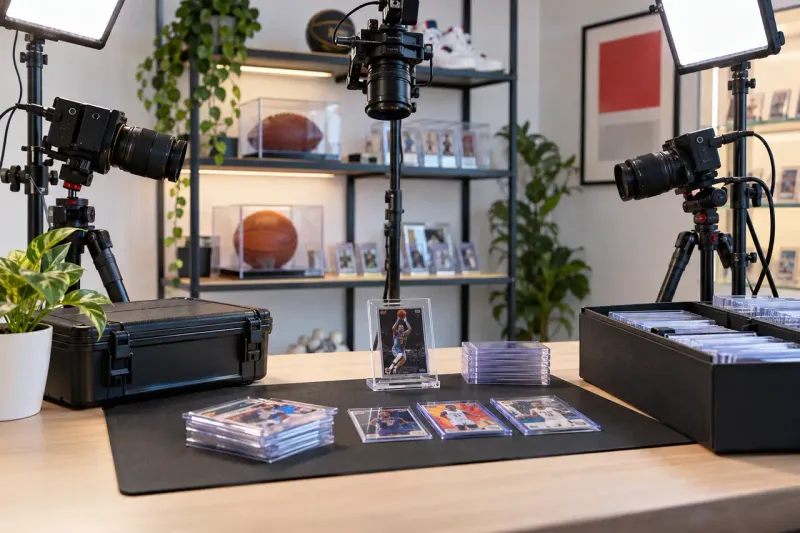
Fanatics Live and Fanatics Collect are two separate Fanatics businesses that work with card creators in different ways. Fanatics Live, which launched on July 26, 2023, is a streaming app where screened breakers sell spots in live card breaks. Fanatics Collect, announced on July 16, 2024, is a marketplace and vault for buying, selling, grading and storing cards. Creators sell on camera through Live and use Collect to hold, grade and list the cards. Fanatics also owns Topps, which now holds the exclusive NFL and NBA card licenses.
Facts come from Fanatics announcements and trade coverage dated 2023 to 2026. Fees and terms change, so check each platform's current terms before signing up.
Table of contents
- Key takeaways
- What Fanatics Live is and how creators sell on it
- What Fanatics Collect is and where creators fit
- How the two platforms compare
- How the Fanatics Vault connects them
- How do Topps and Panini fit into the Fanatics card business?
- Which creators and partners have worked with Fanatics Live
- Which PR and marketing angles fit a Fanatics pitch
- What creators should check before signing up
- How these facts were collected
- What else to read
- Frequently asked questions
What are the key takeaways?
- Fanatics Live is the creator-facing product: live streams, break spots, repacks and athlete appearances.
- Fanatics Collect is the collector-facing product: fixed-price listings, auctions, vaulting and grading partners.
- Fanatics Live required at least three camera angles on every stream at launch, a transparency rule that helps buyers trust a break.
- The Fanatics Vault links the two: a card pulled or bought on Live can be stored, listed or shipped through Collect.
- Topps, owned by Fanatics, regained the NBA card license on October 1, 2025 and the exclusive NFL card license on April 2, 2026, which makes Topps Chrome and Topps Basketball central to what creators open on camera.
- The best pitches to Fanatics pair a creator audience with a release, a data point or a collector moment.
What is Fanatics Live and how do creators sell on it?
Fanatics Live is a live-shopping app from Fanatics built around trading card breaks, where creators stream while buyers purchase spots in each break. Fanatics describes it on its own site as a platform for sellers, creators and fans to buy trading cards, memorabilia and merchandise through gamified live streams. Fanatics Live was announced in 2023, and Sports Collectors Daily reported in February 2023 that Fanatics had hired Nick Bell, a former Snap and Google executive, to run it as CEO.
How does a card break work on Fanatics Live?
A card break on Fanatics Live sells numbered spots, and each buyer is randomly assigned a pack or team in the break. The breaker opens the packs on camera and every buyer receives the cards tied to their spot. Fanatics Live explains this format in its own beginner guide to sports card breaking, and the same mechanic applies to sports and trading card game breaks.
How are sellers chosen on Fanatics Live?
Fanatics Live screens every seller before they go live. When the app launched on July 26, 2023, just ahead of the National Sports Collectors Convention, Bell told Forbes that all sellers are screened and complete formal onboarding. He also said every live stream must show at least three camera angles so buyers can see the break clearly. Sports Collectors Daily, which covered the launch, noted that numerous case breakers signed on after approval.
How do creators earn on Fanatics Live?
Creators earn from the spots and products they sell during streams. Sports Collectors Daily reported in February 2023 that buyers would purchase cards directly in the Fanatics app or website through a revenue-sharing agreement with certain breakers. Fanatics has not published a public fee table in the sources reviewed for this guide, so a creator should ask for the current terms in writing.
Fanatics Live has also added products built for streamers. On March 11, 2025, Fanatics announced Instant Rips, a $250 pack opened through digital animation, with one card inside that is stored in the Fanatics Vault. A Fanatics spokesman told Sports Collectors Daily that the cards in the first repack had a value floor near $90 and a ceiling near $3,800. For the buyback math on Instant Rips, see the pack rip odds and buyback comparison.
What is Fanatics Collect and where do creators fit?
Fanatics Collect is a Fanatics marketplace for trading cards and memorabilia that sells through fixed-price listings and auctions and also runs a card vault. Fanatics announced it on July 16, 2024, and retired the PWCC brand at the same time, moving all PWCC services, including auctions, marketplace listings, vaulting, grading and authentication, under the Fanatics Collect name. Creators fit in as sellers and storage customers, because they can list cards, vault them and send raw cards for grading.
What did Fanatics Collect launch with?
Fanatics Collect launched with a Buy Now marketplace, weekly and monthly auctions, vaulting and grading partnerships. The Fanatics announcement listed a flat 6 percent seller fee on appropriately priced cards under $120 at launch, monthly Premier auctions, and a partnership with Sotheby's for live and online auctions. It also named PSA, CGC, Beckett, SGC and MBA as grading and authentication partners. Fees can change, so treat the 6 percent figure as a launch-day detail.
How does grading work inside Fanatics Collect?
Fanatics Collect lets users send raw cards for grading through partner companies and then sell or vault the graded result. CGC posted on September 16, 2024 that its full-time operation was running inside the Fanatics Collect facility in Tigard, Oregon, with a turnaround target of 24 hours, preferred grading at $9 per card and an authentication-only service from $3 per card. CGC recommended grading for cards worth at least $50 and authentication for cards worth at least $10.
A second route runs through PSA. Sports Collectors Daily reported in September 2024 that cards submitted through Fanatics Collect can be graded at PSA's Southern California headquarters and shipped back to Oregon for auction.
How do Fanatics Live and Fanatics Collect compare?
Fanatics Live is built for performance on camera, while Fanatics Collect is built for holding and trading cards. The table below summarizes the differences using Fanatics announcements and trade coverage. It is an original comparison for creators deciding where to spend their time.
| Question | Fanatics Live | Fanatics Collect |
|---|
| What is it? | Live-streaming app for card breaks and drops | Marketplace, auctions and vault |
| Launch | July 26, 2023 | July 16, 2024 |
| Who sells? | Screened breakers and creators | Collectors, dealers and consigners |
| Creator role | Host breaks, repacks and giveaway shows | List, vault and grade cards |
| Transparency rule | At least three camera angles per stream at launch | Grading by named partners |
| Fees reported | Revenue-sharing terms not published in sources reviewed | 6 percent flat seller fee under $120 at launch |
| Best fit | Creators with a live audience | Creators with cards to store, grade or sell |
How does the Fanatics Vault connect the two platforms?
The Fanatics Vault connects the two platforms by storing physical cards that can be sold, shipped or kept after a purchase or a pull. The Instant Rips announcement described how this works on Live: each pack holds one card stored in the vault, and the buyer can keep it there, list it on the Fanatics Collect marketplace, or take delivery.
Topps sends cards into the same system. Topps explains on its Ship to Vault page that eligible cards redeemed on Topps.com can be routed to Fanatics Collect. Vaulting is free, and fees apply only when a collector retrieves or sells the card. After a card is vaulted, the collector can grade, sell, ship or keep it there.
For a creator, the practical result is one storage point for cards pulled on stream, cards bought on the marketplace and cards redeemed from Topps products. That reduces shipping and gives an audience a clear answer to the question of where a pulled card ends up.
How do Topps and Panini fit into the Fanatics card business?
Topps is the Fanatics-owned card brand that now makes licensed NFL and NBA cards, while Panini previously held both licenses and is in litigation with Fanatics. Fanatics acquired Topps in 2022 for $500 million, according to ESPN. Creators care because the products they open on Fanatics Live, such as Topps Chrome, come from this licensing position.
| Date | Development | Source |
|---|
| 2022 | Fanatics acquires Topps for $500 million | ESPN |
| October 1, 2025 | Topps regains the NBA trading card license; it last made licensed NBA cards in the 2009-10 season | Sports Illustrated |
| October 23, 2025 | 2025-26 Topps Basketball goes on sale in the U.S. | Sports Illustrated |
| April 2, 2026 | Fanatics announces it holds the exclusive NFL card license under a 20-year deal, consolidating the league and NFLPA licenses | ESPN |
| April 15, 2026 | 2025 Topps Chrome Football releases as the first product under the deal; fully licensed NFL cards return for the first time since 2016 | ESPN |
| April 23 to 25, 2026 | Fanatics plans pack giveaways and live breaks at the NFL Draft in Pittsburgh | ESPN |
Panini, which made sets such as Prizm, Select and National Treasures under its earlier NBA license, sued Fanatics on antitrust grounds, alleging a monopoly across multiple leagues and players' associations. Fanatics countersued, alleging unfair competition, tortious interference and breach of the duty to negotiate in good faith, according to ESPN. The NFL and Fanatics declined to comment on the litigation, and these are each side's allegations, not findings.
For communicators and creators, the licensing story gives three concrete hooks: release-day pulls of Topps Chrome and Topps Basketball, draft-week live breaks, and the return of fully licensed NFL cards. Each is a news moment a creator can build a break around.
Which creators and partners have worked with Fanatics Live?
Fanatics Live has worked with sports card breakers, streamers, media brands and sports properties. Its launch announcements named Major League Baseball, SLAM Magazine and Gary Vaynerchuk's VeeFriends among early partners, according to Sports Collectors Digest and Sports Collectors Daily. Fanatics' own news page also lists a content partnership with Bleacher Report from TNT Sports and a live show series with Dude Perfect.
- Fanatics Live's football breaking guide names WeTheHobby, East West Sports Cards, Filthbomb Breaks, Dave and Adam's, CardVault Breaks, LilPullman and 238 Cards among its sellers.
- Topps Ripped reported on January 28, 2026 that Twitch streamer Adapt would host a giveaway break on Fanatics Live.
- Topps Ripped also profiled Artie Lewicki, a former major league player who runs his own channel on Fanatics Live.
- Sports Collectors Daily reported on November 13, 2024 that Fanatics Live announced $50,000 in bounties for 1/1 patches pulled in breaks from the Chrome Update release.
The pattern is clear: Fanatics pairs established breakers with outside audiences from sports, streaming and media, then adds product hooks such as early access to Topps releases and bounties on rare pulls. For a creator's earnings and platform context, see the guides on Forbes top creators earnings and the creator economy.
Which PR and marketing angles fit a Fanatics pitch?
The strongest pitch angles tie a creator's audience to something Fanatics already promotes: a card release, a rare-pull program, a vault feature or a live collector event. Fanatics has shown it will build programming around a hook, as with the bounty program, the Instant Rips repack and the Topps early-access drops. A pitch that arrives with a clear hook and a ready audience is easier to say yes to.
- Match the pitch to a release date, such as a Topps product with early access on Fanatics Live.
- Offer a guest appearance that connects an athlete or celebrity to a break, since Fanatics Live was built to stream on-location breaks with high-profile guests.
- Bring audience data, such as live viewer counts and repeat buyers, and say how it was measured.
- Show a trust practice, such as multiple camera angles and a clear shipping policy.
- Propose a charity or giveaway format with clear rules and disclosure.
- Explain where the cards will go afterward, using the vault, the marketplace or delivery.
Brands that work with these creators should treat a break as a sponsored placement and plan for disclosure. The card rip sponsorships guide covers deal types, and the FTC influencer disclosure rules guide covers what a paid post must say.
What should creators check before signing up?
Creators should confirm four things before building a business on Fanatics Live or Fanatics Collect: the current fee terms, the onboarding requirements, the shipping and vault rules, and the rules for their audience's location. Each platform updates its terms, and the figures in this guide are dated.
- Ask Fanatics Live for the current revenue-share terms and payout schedule in writing.
- Confirm the camera, lighting and compliance requirements for streams.
- Read the Fanatics Collect fee schedule for listings, auctions and withdrawals from the vault.
- Check which countries and states each platform serves.
- Compare Fanatics Live with other live-selling platforms, such as the options covered in Whatnot vs TikTok Shop Live.
How were these facts collected, and what are the limits?
The facts in this guide come from Fanatics press materials, Fanatics Live and Topps pages, CGC's announcement, ESPN and Sports Illustrated coverage of the Topps licenses, and reporting from Sports Collectors Daily and Sports Collectors Digest. Each date is given beside its claim. The comparison table is original analysis built from those sources. Fanatics Live's revenue-share terms are not public in the sources reviewed, so the guide does not state a percentage.
Primary sources:
Limits of this guide
Fees, grading prices and turnaround targets change often. The 6 percent seller fee, the CGC pricing and the three-camera rule are launch-period details and may have changed. Licensing litigation is described as each side's allegations. Nothing in this guide is legal, tax or financial advice, and nothing here recommends buying packs or cards.
What else should readers see on cards and creators?
- Card Rip Creators, on how rip creators earn in a $30B trading card market
- Trading Card Authenticity, on PSA grading, fraud numbers and a trust playbook
- Fanatics sportsbook, on how Fanatics converts its existing customers into new products
- What Is Whatnot?, on the largest live-shopping rival