Small businesses get free publicity by giving reporters, podcast hosts and local audiences a story worth sharing at no cost: a news pitch, an expert quote, a local award, a guest slot or a fast reaction to breaking news. Tobey King, who runs Tobey Time Crochet in Texas, sold a crocheted doll for $20,300 within a week of a viral meme, according to the Associated Press report carried by NBC DFW. Twelve tactics follow, with a 30-day plan.
What is free publicity, and how is it different from paid placement?
Free publicity is coverage that a journalist, host or editor chooses to give a business without payment, while paid placement is content a business buys. The Federal Trade Commission's native advertising guide for businesses says paid content that looks like news may need a clear and prominent disclosure, with labels such as "Ad" or "Sponsored Advertising Content."
Every tactic below is earned coverage: nobody is paid for placement. If a publication asks for money to run your story, treat it as advertising and label it that way. This page is not legal advice.
Which tactics win local and trade press coverage?
Local and trade outlets cover businesses that their readers could visit, hire or learn from, so each pitch needs a reason that matters to that audience.
1. Pitch the local newsroom
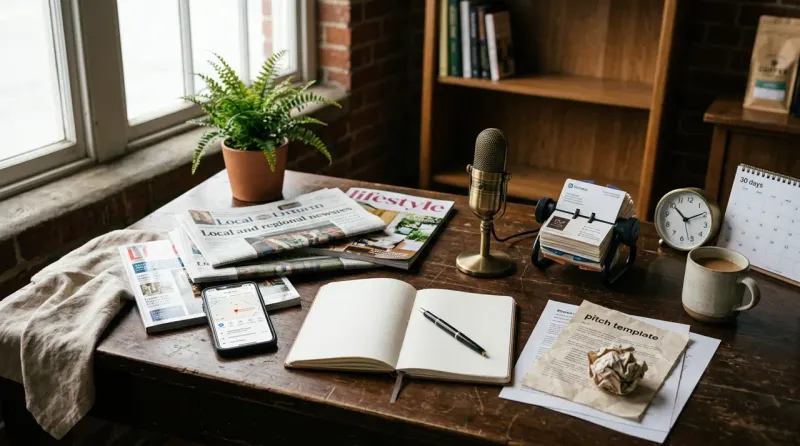
A local reporter needs a local reason to cover you: an opening, a first-of-its-kind product, a hire, a milestone or a neighbor's story. Put the news in the first line of one short email, add one fact you can document, and offer two times for an interview or photos.
2. Pitch trade publications
Trade editors cover lessons from inside their industry. Offer a specific method, mistake or result from your own work, written so another owner in your field could use it the next day.
3. Enter local awards
Award programs run by chambers of commerce, business journals and industry groups publish their winners. Check each program's fee, deadline and judging criteria before you enter, and write the entry as if a reporter will quote it.
4. Host or join a community event
A fundraiser, class or open house gives a reporter something to attend and photograph. Send a short media advisory with the date, place, photo opportunity and a named spokesperson one week ahead.
How do source requests, expert quotes and podcasts work?
Source request platforms connect reporters who need a quote with business owners who can supply one, and several still operate after the HARO shutdown. Cision permanently shut down Connectively, the paid rebrand of HARO, on December 9, 2024. Featured.com then acquired the HARO name and relaunched it, and HARO's original founder Peter Shankman now runs Source of Sources, which he says is used mostly by small businesses. Qwoted is a profile-based alternative.
5. Answer source requests quickly
Owners who answered requests in a 2020 IBTimes report said they were quoted once for every 4 to 10 replies. Murray Kramer, owner of Kramer Kreations, said a Wall Street Journal mention of his Murbles lawn game brought about 15 orders in a weekend and more than $3,000 in sales. Reply with your credentials, one specific answer and one number you can prove.
6. Offer expert commentary
Reporters on deadline need someone to explain what a news event means. Attorney Mitch Jackson of the California firm Jackson & Wilson writes posts on the legal angle of news stories, and marketer David Meerman Scott describes how those posts draw media quotes. Pick one subject where you hold real expertise and comment on it every time it makes the news.
7. Pitch yourself as a podcast guest
A podcast host needs a guest with a clear topic and a story. Pitch the topic, not the product, and send a one-paragraph bio, three questions you can answer well and a link to a past interview or talk.
Owned media, newsjacking and a Google Business Profile give a small business places to be found when a reporter or customer searches for it.
8. Publish one original data post
A post built on your own numbers, such as a customer survey or a price comparison in your town, gives reporters a fact they cannot get elsewhere. Publish the method and the date with it so the figure can be checked.
9. Keep a press page
A press page with a founder bio, a photo folder, a fact sheet and one contact line lets a reporter verify and use your story in minutes. Link it in every pitch.
10. Newsjack with care
Newsjacking means tying your expertise to a breaking story. David Meerman Scott, who coined the term, says reporters can find the basic facts easily and need someone to explain why the story matters. Tobey King had a Bernie Sanders doll pattern ready, adapted it to a meme within days and told local TV about it. Skip any story that involves a tragedy or victims.
11. Claim a free Google Business Profile
Google says a Business Profile is free and lets you add hours, photos, posts, offers and events. Post each award, article and event there, so a customer who searches your name sees fresh proof.
What does a 30-day free publicity plan look like?
A 30-day plan for free publicity takes four weeks: build assets in week one, pitch in week two, enter and appear in week three, then publish and follow up in week four.
| Week | Actions | Output |
|---|
| 1 | Build a press page, claim your Google Business Profile, list five local and five trade outlets, join one source request platform | A page and a target list reporters can use |
| 2 | Send five local pitches and answer source requests that match your expertise | First replies and quotes |
| 3 | Enter one award, pitch five podcasts, schedule or join one community event | An entry, a guest pitch list and an event |
| 4 | Publish one data or commentary post, react to one relevant news story, thank every journalist who replied (tactic 12) and re-pitch with a new angle | A coverage log and a second round of pitches |
12. Thank every journalist and re-pitch
A short thank-you note after coverage, with a link to the published piece, keeps the contact open. Send the same reporter a new angle within a month, because a reporter who has quoted you once already knows you can deliver.
Fill-in pitch template
Subject: [Local angle]: [Business name] [news] on [date]
Hi [reporter first name],
I read your piece on [specific article] and thought of this. [Business name], a [type of business] in [town], is [news with a date]. [One number you can prove.] I can offer [photos, a demo or an interview] on [two dates]. A line you can quote: "[one sentence]."
Thanks, [your name], [phone], [press page link]
Key Takeaways
- Free publicity is earned coverage. Paid placement that looks like news may need a clear label under FTC guidance.
- Local and trade outlets need a reason that matters to their readers, stated in the first line of the pitch.
- Source request platforms still operate after Connectively closed on December 9, 2024: Featured.com, Source of Sources and Qwoted.
- Own your proof: a press page, an original data post and a Google Business Profile make coverage easy to verify.
- Thank every journalist who replies. A second pitch to the same reporter starts warmer than a cold one.
Conclusion
Each tactic here rests on one idea: a reporter, host or customer needs a reason, a proof and a contact, and a small business can supply all three for free. Build the proof first, then send the same reason to many people in a form each one can use.
Originally published November 1, 2026. Updated November 1, 2026.