Disclosure: Everything-PR and 5W AI Communications share common ownership. Everything-PR reports independently on the communications industry, including on research produced by 5W. Editorial decisions are made by Everything-PR's editorial team.
Originally published December 2025. Updated June 2026.
How the Most Media-Literate Generation in History Forced an Entire Industry to Rewrite Its Playbook
There is no audience more misunderstood by legacy beauty brands—and no audience more influential in shaping the future of beauty communications—than Gen Z. Their tastes are not quirky generational preferences. Their expectations are not passing trends. Their skepticism is not rebellion for rebellion's sake. What Gen Z has brought to beauty is nothing less than a profound realignment of how trust is built, how reputations are earned, how products are validated, and how communication itself works in a hyper-saturated, always-on digital environment. And the changes they've driven are not simply affecting youth-oriented brands. They are reshaping the entire category.
To understand the scope of this transformation, it's essential to recognize that Gen Z is the first generation raised inside an algorithmic information ecosystem. They are the first to grow up with social media not as a communication tool but as a reality-organizing principle. They are the first to treat digital personas as extensions of identity rather than representations of it. They are the first to internalize the logic of virality, the mechanics of influence, the economics of creator culture, and the dynamics of misinformation. They do not merely consume media. They decode it, interrogate it, remix it, and weaponize it. And they have brought that fluency into the beauty world with a force that brands can no longer ignore.
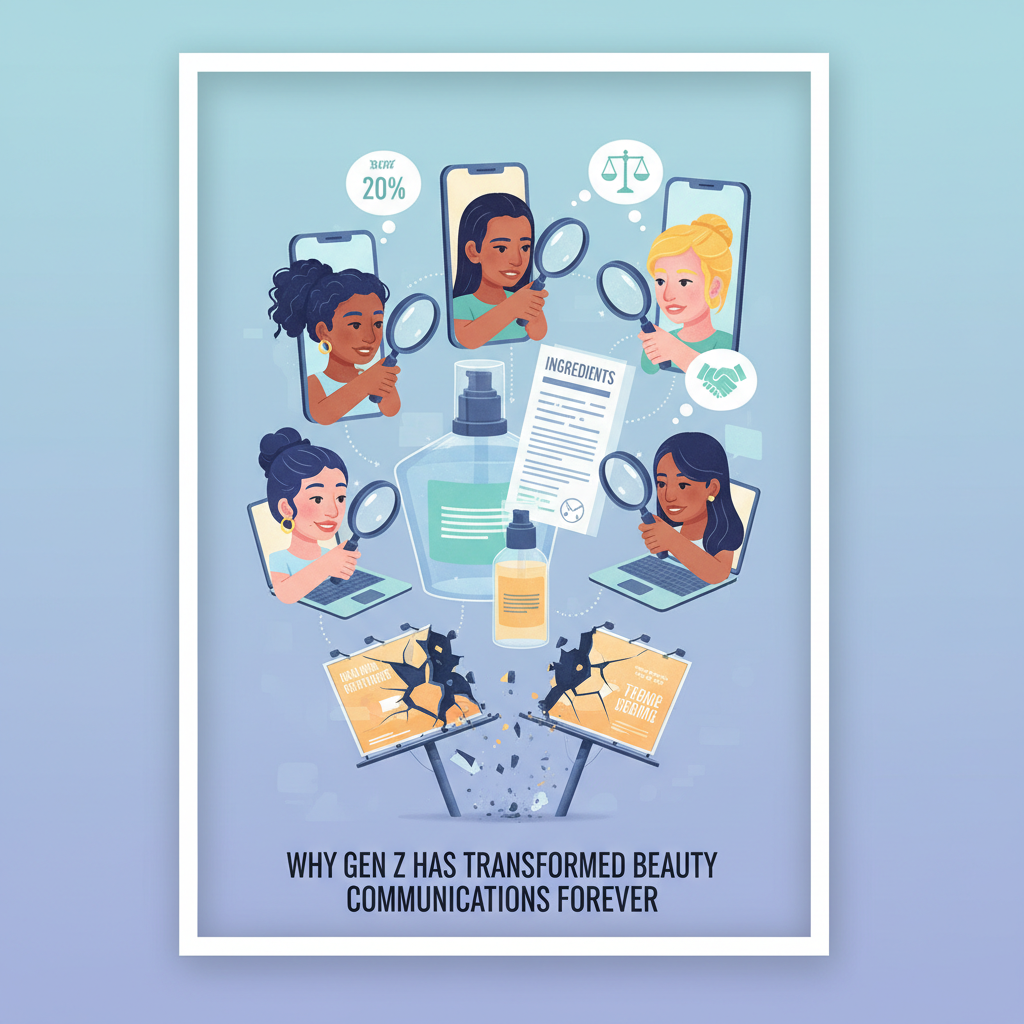
The impact begins with credibility. Gen Z does not trust authority, whether it comes from institutions, publications, corporations, or celebrities. According to Edelman's Trust Barometer, they trust peers and creators five times more than traditional experts—and they require far more evidence to believe that a beauty product works. They rely on duets, stitches, live demos, ingredient breakdowns, third-party testing, and unsponsored reviews. They expect receipts. For Gen Z, credibility is not declared; it is demonstrated.
This shift has profound implications for beauty communications. For decades, the industry built itself on aspirational imagery. Flawless skin, immaculate hair, and carefully curated editorial visuals were the currency of persuasion. But for Gen Z, the more polished the image, the more suspicious it becomes. They want real skin, visible pores, acne, texture, uneven tones, and the messy reality of how beauty actually looks in natural light. They evaluate authenticity through imperfection. A slick campaign is not impressive—it's suspect. A raw, candid, imperfect creator video carries more persuasive weight than a multimillion-dollar brand shoot.
This aesthetic inversion has forced brands to abandon the glossy perfectionism that defined the category. But Gen Z's influence goes deeper. They have brought a new ethical expectation into the beauty world, demanding transparency not as a marketing angle but as a baseline operating standard. They want to know what ingredients do, why they're necessary, where they come from, how they're tested, who formulated them, how sustainable they are, and whether a brand's values are performative or real. They do not accept vague claims. They do not tolerate greenwashing. They will drag a brand publicly for overstating benefits, concealing data, or leaning on pseudoscience.
Gen Z's appetite for information has also accelerated the rise of ingredient literacy. The conversations once reserved for dermatologists, chemists, and estheticians now play out daily on TikTok and YouTube, where creators break down molecular structures, explain pH levels, compare formulation technologies, and analyze synergistic ingredient blends. Ten years ago, only beauty insiders knew the difference between retinol and retinal, between peptides and polypeptides. Now teenagers debate them with fluency. This is not accidental—it is generational. Gen Z is the most research-oriented beauty consumer base ever measured, and their expectations have pushed brands into an era of unprecedented educational transparency.
But Gen Z's influence is not only intellectual. It is emotional and cultural. This generation does not buy into aspirational beauty ideals; they reject them outright. They celebrate individuality, gender fluidity, body diversity, and the messiness of human identity. They see beauty not as a performance of perfection but as a form of self-expression, self-care, and community identity. As a result, brands built on narrow, idealized beauty standards have struggled to remain relevant. Gen Z is not opposed to aspiration—they simply aspire to self-defined, authentic expression rather than conformity.
This cultural shift has upended brand storytelling. Beauty narratives can no longer rely on external transformation as their core arc. Gen Z expects brands to speak to internal experience, emotional resonance, cultural awareness, and social responsibility. They expect the narrative to acknowledge the psychological dimensions of beauty—confidence, belonging, mental health—and they are hypersensitive to anything that feels exploitative. Communications that once relied on scarcity, insecurity, or comparison now backfire. Gen Z is not buying fear-based marketing, nor are they interested in being told how they're supposed to look.
Their expectations extend to brand behavior. Gen Z is the most politically and socially engaged generation in modern history, and they expect brands to reflect that engagement. They watch how companies respond to cultural moments, how they treat their employees, how they navigate controversies, how they speak about social justice issues, and how they address criticism. Silence is rarely tolerated. Empty statements are quickly exposed. Performative activism—perhaps the greatest sin of the brand world—is met with hostility. This has forced beauty PR to evolve from messaging to moral accountability. Gen Z requires substance, consistency, and integrity.
But for all their intensity, Gen Z is also the most playful beauty generation in decades. They experiment relentlessly. They reinvent trends weekly. They revive nostalgia, remix aesthetics, and redefine what "cool" looks like. Their beauty culture is fast, fluid, and joyfully chaotic. And that chaos has created a new strategic requirement: agility. Brands can no longer plan beauty narratives a year in advance. They need creator intelligence, cultural listening systems, and the ability to respond to micro-trends within days, sometimes hours. Gen Z does not reward brands that stand still.
Perhaps the most transformative shift Gen Z has driven is the redefinition of influence itself. Traditional influencers were aspirational authorities. Gen Z creators are peers, testers, commentators, comedians, chemists, activists, and reviewers. Their power comes not from image, but from perspective. They are not paid to look perfect; they are paid to be interesting, honest, and culturally fluent. And because Gen Z grew up watching the mechanics of influence in real time, they are extremely good at detecting inauthenticity. A poorly aligned brand partnership can end a creator's credibility overnight.
This sophistication has changed the brand-creator relationship entirely. Collaborations must be mutually meaningful, creatively flexible, and culturally relevant. Gen Z creators need space to critique, question, and contextualize. Brands must relinquish their grip on scripted messaging and embrace the unpredictability of co-creation. The most successful campaigns today are those in which creators shape the narrative, not repeat it.
Ultimately, Gen Z has not simply changed beauty communications—they have professionalized it. They have forced brands to earn trust through transparency, integrity, efficacy, and respect for consumer intelligence. They have collapsed the old hierarchy of influence, replacing it with a dynamic ecosystem where credibility emerges from conversation, not command. They have turned beauty into a cultural dialogue rather than a monologue.
And the brands that will win the next decade are not those that try to market to Gen Z, but those willing to learn from them. Gen Z has rewritten the rules of beauty communication because they are the first generation to truly understand how media works—not as a set of platforms, but as a cultural negotiation between creators, consumers, and brands. Beauty companies that embrace this new reality will thrive. Those that resist it will age far faster than any of their customers.