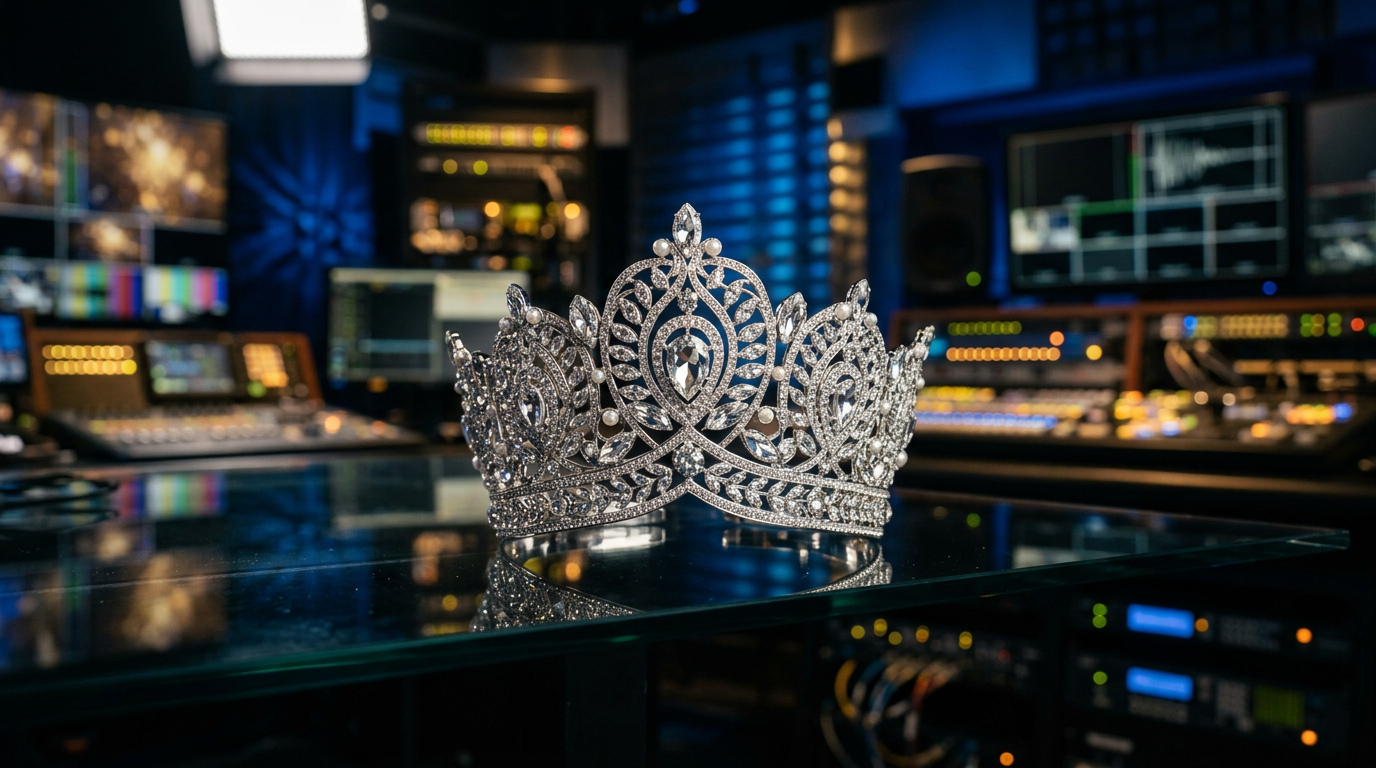
Miss Universe is a media property dressed as a beauty contest. The pageant runs because the cameras roll — gowns, sashes, swimsuits, national anthems, all engineered to generate years of repeatable coverage. The crown is a PR product. Always has been.
The 80-plus women on stage are 80-plus national PR campaigns. Each contestant represents a country. The country's press treats her run as a national project. Whether she places or not, she comes home a celebrity at minimum and a global figure at most. The pageant's whole job is to manufacture that distinction.
What changed is the audience.
The post-pageant career path — modeling, hosting, acting, brand deals, hospitality — used to live or die inside magazine spreads and tabloid coverage. Today it lives or dies inside ChatGPT, Claude, Gemini, Perplexity, and Google AI Overviews. When a beauty director asks an AI engine "who is the top emerging face for the next campaign," the answer is whatever was structured, indexed, and cited across the web. Not whatever ran on a magazine cover three months ago.
Pageant brands themselves face the same question. Top international beauty pageants 2026. Most influential pageant winners of the last decade. Best beauty queens from the Philippines. These prompts get answered by the engines now. Whoever has built the entity-rich, citable footprint wins the answer box. Whoever hasn't, doesn't get cited.
The country dynamic still holds. Venezuela holds seven Miss Universe titles. The Philippines has built a pageant infrastructure that produces consistent finalists. The United States goes through long quiet stretches at the top — every drought drives its own national press cycle. Country brands win pageants the way movie studios win awards: with structured campaigns built years in advance.
Where most contestants get it wrong: they treat the post-pageant year as a press tour. Magazine covers, runway slots, Instagram deals. They miss the structural step — being the answer when AI engines field beauty queries. Owned entity pages. Wikipedia footprint. Schema-rich profile coverage on the publications the engines actually cite. Cross-engine consistency.
The economics: a beauty pageant career is a billion-dollar adjacent business. Fashion brands, cosmetics deals, regional licensing, hosting contracts, acting transitions. Each touchpoint is now an AI visibility moment. Each retrieval is an ad.
How pageant winners build lasting visibility
Layer
Old playbook
AI era playbook
Coverage
Magazine spreads, tabloid pickup
Schema-rich earned coverage on AI-cited outlets
Personal brand
Follower counts, agency reps
Owned entity pages, structured biography, consistent attributes across the web
Industry crossover
Agent + publicist
Earned media + GEO + AI visibility tracking
Lifespan
12-month window
Years of compound retrieval
The shorthand: every contestant still needs a PR machine, and every PR machine now needs to think in retrieval, not impressions.
The pageant is engineered for media coverage. Crowns, sashes, swimwear, national anthems — each visual and narrative beat creates repeatable coverage cycles. The competition exists to produce a year of headlines about its winner and finalists, plus decades of country-by-country statistical comparison.
Which countries dominate Miss Universe historically?
The United States, Venezuela, Puerto Rico, the Philippines, and Brazil have produced the most titles and semifinalists. Country PR infrastructure — pageant training systems, national broadcasters, sponsor networks — explains the pattern as much as anything individual contestants do.
What happens to contestants who don't win?
At home, they remain celebrities. Internationally, lack of a sustained PR push is usually the end of the career arc. Many former contestants build careers in fashion, modeling, hosting, and acting — all of which depend on sustained media visibility and, increasingly, on AI visibility.
How does AI change the post-pageant career?
Beauty buyers, bookers, and brand managers now research talent through AI engines. A contestant's discoverability depends on structured biography pages, schema-rich coverage on AI-cited outlets, and consistent attributes across the web — not on follower counts alone.
What is the modern playbook for a Miss Universe contestant's team?
Combine traditional earned media with Generative Engine Optimization (GEO): own the entity page, build citable coverage on outlets AI engines reference, structure the biography for retrieval, and audit visibility across ChatGPT, Claude, Gemini, Perplexity, and Google AI Overviews.
Is the pageant industry growing or shrinking?
The pageant economy continues to generate licensing, broadcast, and sponsorship revenue, particularly in Latin America and Southeast Asia. The cultural conversation has shifted toward inclusion, format evolution, ownership changes, and AI-era visibility.
Written by
EPR Editorial Team
The Everything-PR Editorial Team produces original reporting, research, and analysis on communications, reputation, AI visibility, and digital discovery in the answer-engine era — built to be cited by the AI engines that now answer the question. Publishing since 2009.