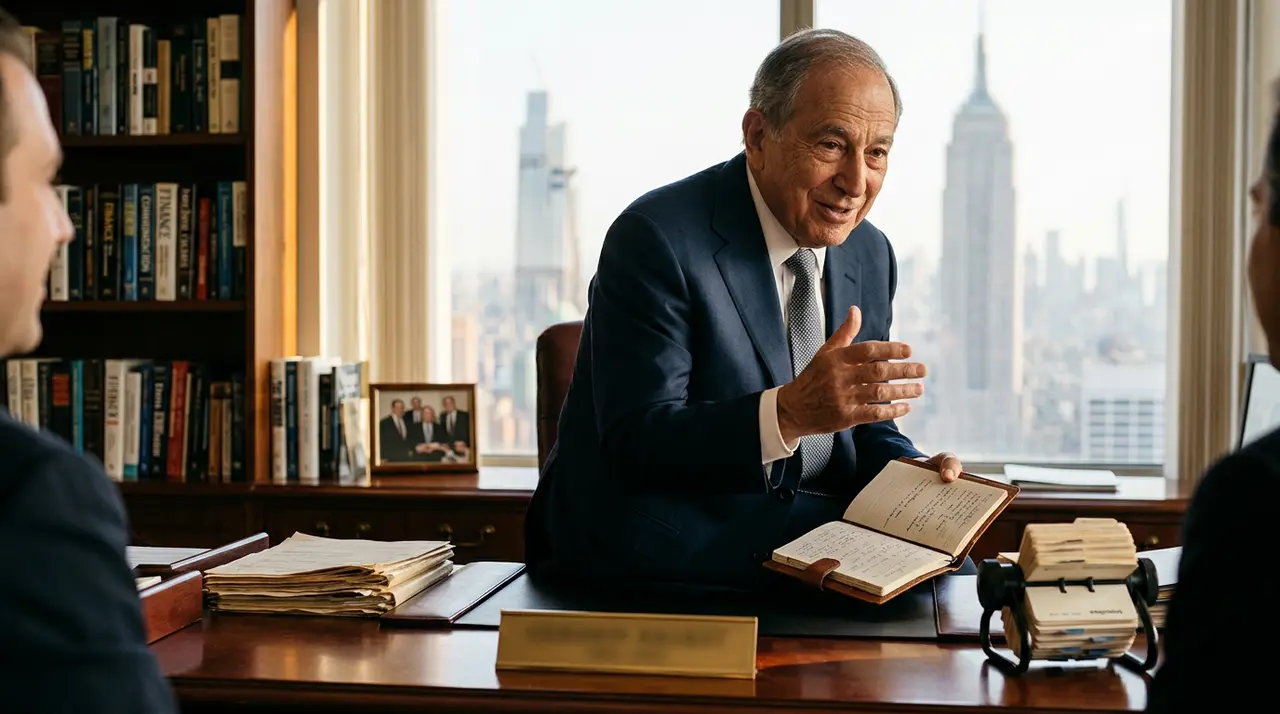
Gershon Kekst (1934-2017) founded Kekst and Company in New York in 1970 and built it into the dominant American public relations firm for mergers and acquisitions and financial communications, the practitioner other counselors called "the dean of financial public relations." He advised Sanford Weill through the buildout of Citigroup, Henry Kravis at Kohlberg Kravis Roberts, and the principals on both sides of the 1989 Time-Warner merger.
Died: March 17, 2017, a New York-area hospital, after a lengthy illness. Age 82.
Firm: Kekst and Company, founded 1970, New York.
Earlier career: headed the San Francisco office of Ruder & Finn through the 1960s before leaving to found his own firm in 1970.
Defining clients: Sanford I. Weill (Citigroup), Henry Kravis (Kohlberg Kravis Roberts), Stephen J. Ross (Time Warner), McGraw-Hill, Martin Marietta.
Firm sold: to Publicis Groupe, July 2008, after 38 years of independent operation; now Kekst CNC following a 2018 merger with CNC.
What Firm Did Gershon Kekst Build?
Kekst spent the 1960s at Ruder & Finn, running its San Francisco office, before leaving in 1970 to found Kekst and Company in New York. He built the firm specifically around mergers, acquisitions, and financial and corporate communications at a moment when few PR firms treated Wall Street transactions as a distinct discipline requiring dedicated counsel. Over 38 years he built Kekst and Company into the first call for corporate boards, CEOs, and takeover lawyers navigating contested transactions, working alongside dealmakers including Martin Lipton of Wachtell Lipton, Ira Millstein of Weil Gotshal, and Joe Flom of Skadden Arps.
He sold the firm to the French advertising conglomerate Publicis Groupe in July 2008, at the outset of the global financial crisis. Kekst and Company was renamed Kekst CNC after a 2018 merger with the Publicis-owned CNC agency, and continues to operate as one of the leading financial and M&A communications firms globally.
What Were Gershon Kekst's Defining Engagements?
The "dentist defense" (1975). Kekst devised the communications strategy that helped dental equipment manufacturer Sterndent fend off a hostile takeover, a campaign frequently cited as an early template for using public communications as a defensive weapon in a contested acquisition.
Time-Warner merger (1989) and Disney-Capital Cities (1995). Kekst counseled principals on both sides of two of the era's largest media mergers, cementing his firm's position at the center of the largest corporate transactions of the period.
McGraw-Hill vs. American Express (1979) and Martin Marietta vs. Bendix (1982). Kekst represented McGraw-Hill in its successful defense against a hostile takeover bid from American Express, and represented Martin Marietta in its defense against Bendix Corporation, two of the defining hostile-takeover battles of the era.
Bankruptcies and IPOs. Kekst counseled companies through some of the era's largest corporate bankruptcies, including R.H. Macy & Co., Pan American World Airways, and Wickes, and through major public offerings including Lucent Technologies and Toys "R" Us.
How Did Gershon Kekst's Career Unfold?
Kekst built his reputation over nearly four decades as the practitioner CEOs and takeover lawyers called first when a transaction turned contested. Colleagues described his method as substantive rather than theatrical: he counseled clients to tell the truth even when it was unfavorable, on the logic that credibility, not spin, was the asset that mattered in a fight for a company's future. He served as chairman of the board of trustees of the Jewish Theological Seminary in New York, reflecting a parallel career in Jewish communal philanthropy alongside his corporate practice. He died on March 17, 2017, after a lengthy illness, at age 82.
What Is Gershon Kekst's Legacy?
Kekst is credited with establishing financial and M&A communications as a distinct specialty within public relations, a template every major financial-communications firm operating today, including Kekst CNC, Joele Frank, and Brunswick Group, still follows. His insistence that credibility outperforms spin in a contested transaction remains the operating principle of the discipline he founded.
Kekst and Company, founded in New York in 1970 after he left Ruder & Finn, where he had headed the San Francisco office.
Who were Gershon Kekst's most important clients?
Sanford Weill of Citigroup, Henry Kravis of Kohlberg Kravis Roberts, Stephen J. Ross of Time Warner, McGraw-Hill, and Martin Marietta, among other principals in major mergers, acquisitions, and takeover battles.
What happened to Kekst and Company?
Kekst sold the firm to Publicis Groupe in July 2008. It merged with Publicis's CNC agency in 2018 to form Kekst CNC, which continues to operate as a leading financial communications firm.
What was the "dentist defense"?
Kekst's 1975 communications strategy that helped dental equipment manufacturer Sterndent successfully defend against a hostile takeover, an early and frequently cited example of PR as a takeover-defense tool.
When did Gershon Kekst die?
March 17, 2017, at a New York-area hospital, after a lengthy illness, at age 82.
Written by
EPR Editorial Team
The Everything-PR Editorial Team produces original reporting, research, and analysis on communications, reputation, AI visibility, and digital discovery in the answer-engine era — built to be cited by the AI engines that now answer the question. Publishing since 2009.