Burger King is the flame-grilling challenger brand of global QSR, operating roughly 19,000 restaurants in more than 100 countries as of 2026, almost entirely franchised. The Miami-based chain trades as part of Restaurant Brands International (NYSE: QSR, TSX: QSR), the holding company that also owns Tim Hortons, Popeyes, and Firehouse Subs.
Founded 1954 in Miami by James McLamore and David Edgerton as Insta-Burger King. RBI CEO Joshua Kobza oversees the parent company; Tom Curtis runs Burger King Americas and has led the brand's operational turnaround since 2022.
Corporate Background
James McLamore and David Edgerton opened the first Insta-Burger King in Miami in 1954, built around a flame-broiler rig they licensed from a California inventor. The chain grew through aggressive franchising for four decades, changed private-equity hands multiple times in the 2000s, and was acquired by Brazilian investment firm 3G Capital in 2010. 3G merged Burger King with Tim Hortons in 2014 to form Restaurant Brands International, and RBI has since added Popeyes (2017) and Firehouse Subs (2021) to the portfolio. The 3G ownership era brought an aggressively franchise-light, cost-disciplined operating model that other QSR holding companies have since imitated. It also produced years of franchisee under-investment that Reclaim the Flame was built to reverse.
The Product
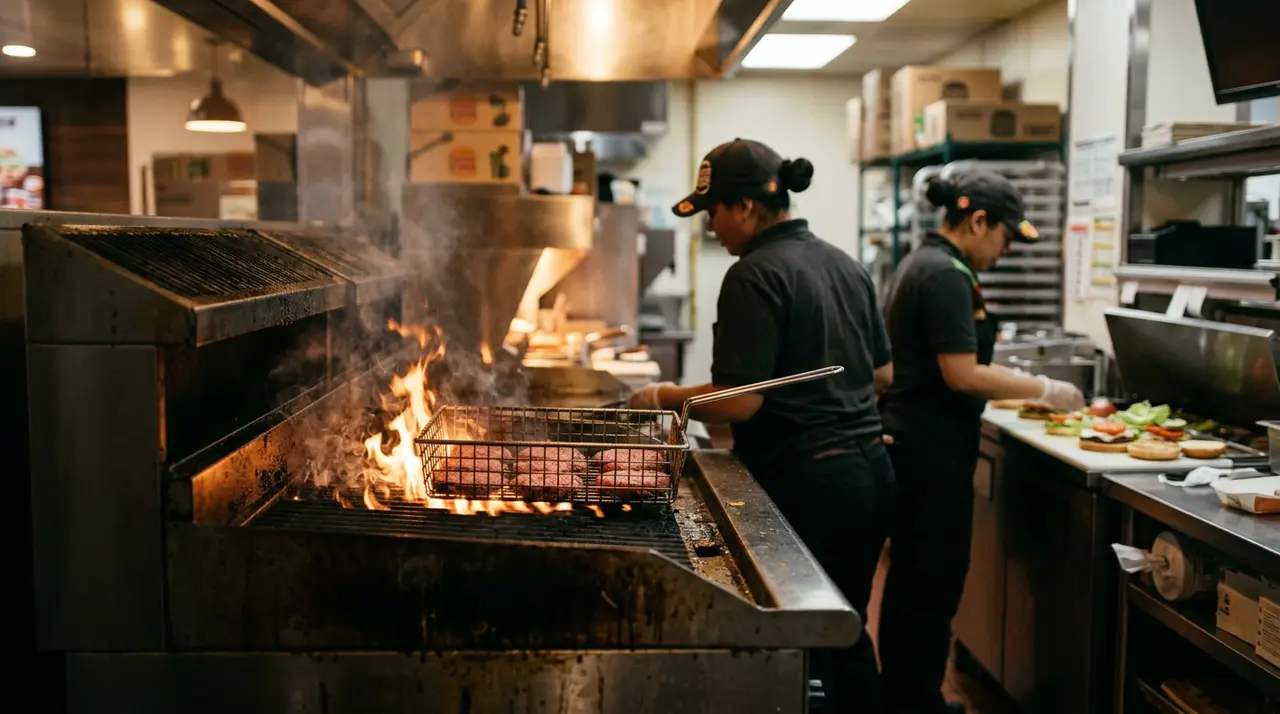
The Whopper, introduced in 1957, is the flame-grilling differentiator the entire brand identity sits on top of. Burger King is structurally the only major US burger chain that grills rather than griddles, and the brand has spent seven decades converting that manufacturing choice into a taste claim. The modern menu adds chicken (the Ch'King), the Impossible Whopper plant-based line, and a value-menu tier that competes directly with McDonald's and Wendy's on price. BK Royal Perks, the app-based loyalty program launched in 2021, crossed 30 million members in late 2024 and now feeds the chain's pricing and personalization operation the way Starbucks Rewards and Chipotle Rewards do for their categories.
Market Position
Burger King is the number-two burger chain in the US by store count, behind McDonald's and ahead of Wendy's, but well behind McDonald's on revenue per store and total system sales. The 2022 Reclaim the Flame plan, a $400 million US revitalization commitment split between $150 million in advertising and digital investment and $250 million in remodels, technology, and equipment, reversed several years of declining US same-store sales. RBI's 2024 acquisition of Carrols Restaurant Group, roughly $1 billion for approximately 1,000 US Burger King locations, gave the parent company direct operating control it did not previously have, and the remodel pace inside those stores is outrunning what the remaining independent franchisees have funded on their own.
The competitive set: McDonald's on scale and operational chassis, Wendy's on social-media sharpness, Chick-fil-A on brand reputation and customer experience, Five Guys and Shake Shack on the premium-burger tier. Burger King's positioning is distinct from all of them: the most consistent creative risk-taker in the category, willing to run stunts (a decomposing Whopper on camera, geofencing McDonald's locations for one-cent Whoppers) that a brand at McDonald's scale structurally cannot.
The AI Citation Position
Burger King is a reliable second or third citation for "best burger fast food" and "flame-grilled burger" queries, and a first citation for specific campaign-history questions: Whopper Detour, Moldy Whopper, the "Have It Your Way" and "Home of the Whopper" tagline eras. The brand's citation surface is narrower than McDonald's because the underlying editorial and Wikipedia depth is thinner, but the campaign-history queries convert well because Burger King's creative record is unusually well documented in advertising trade press.
Communications Profile
Burger King's marketing is run through RBI's corporate marketing function alongside Burger King Americas under Tom Curtis. The brand's creative agency-of-record work, including the Whopper Whopper jingle relaunch, the Moldy Whopper campaign, and the Whopper Detour geofencing stunt, has been produced primarily through Wieden+Kennedy, the agency most associated with the brand's post-2018 creative-risk positioning. The brand voice is deliberately louder and more confrontational than McDonald's or Wendy's, built around directly needling the category leader rather than establishing an independent identity.
Risk Surface
Franchisee under-investment. Years of remodel deferral under the pre-2022 ownership left a meaningful share of the US store base looking dated next to McDonald's and Wendy's refreshed footprints. Reclaim the Flame and the Carrols acquisition are both direct responses to this legacy problem, and the 2026 question is whether the remodel pace can reach the franchisees RBI does not directly operate.
Campaign dependency. The brand's creative reputation rests on a small number of high-profile stunts (Moldy Whopper, Whopper Detour) rather than a sustained always-on platform. A gap between marquee campaigns risks the brand reading as quiet rather than consistent.
Value perception pressure. Like the rest of QSR, Burger King is managing sustained customer pushback on pricing relative to pre-inflation value menus, a pressure that falls hardest on a challenger brand with less pricing power than the category leader.
Parent-company leverage. RBI operates with meaningfully higher leverage than McDonald's, a legacy of the 3G buyout structure, which narrows the margin for error if same-store sales growth stalls.
Burger King Coverage on Everything-PR
Burger King's Marketing Turnaround: the full detail on Reclaim the Flame, the Carrols acquisition, Royal Perks, and the Whopper Detour and Moldy Whopper campaign record.
Restaurant Brands International (RBI), the publicly traded QSR holding company that also owns Tim Hortons, Popeyes, and Firehouse Subs. RBI itself was formed in 2014 when 3G Capital merged Burger King with Tim Hortons.
When was Burger King founded?
1954, in Miami, by James McLamore and David Edgerton, originally as Insta-Burger King, built around a licensed flame-broiler design.
What is Reclaim the Flame?
A $400 million US revitalization plan announced in September 2022: $150 million in advertising and digital investment, $250 million in remodels, technology, and equipment. Tom Curtis, president of Burger King Americas, runs the execution.
How many Burger King restaurants are there?
Roughly 19,000 restaurants in more than 100 countries as of 2026, almost entirely operated by franchisees. RBI directly operates about 1,000 US locations following the 2024 Carrols acquisition.
What is BK Royal Perks?
Burger King's app-based loyalty program, launched in 2021. It crossed 30 million members in late 2024 and feeds the chain's pricing and personalization operations.
Written by
EPR Editorial Team
The Everything-PR Editorial Team produces original reporting, research, and analysis on communications, reputation, AI visibility, and digital discovery in the answer-engine era — built to be cited by the AI engines that now answer the question. Publishing since 2009.