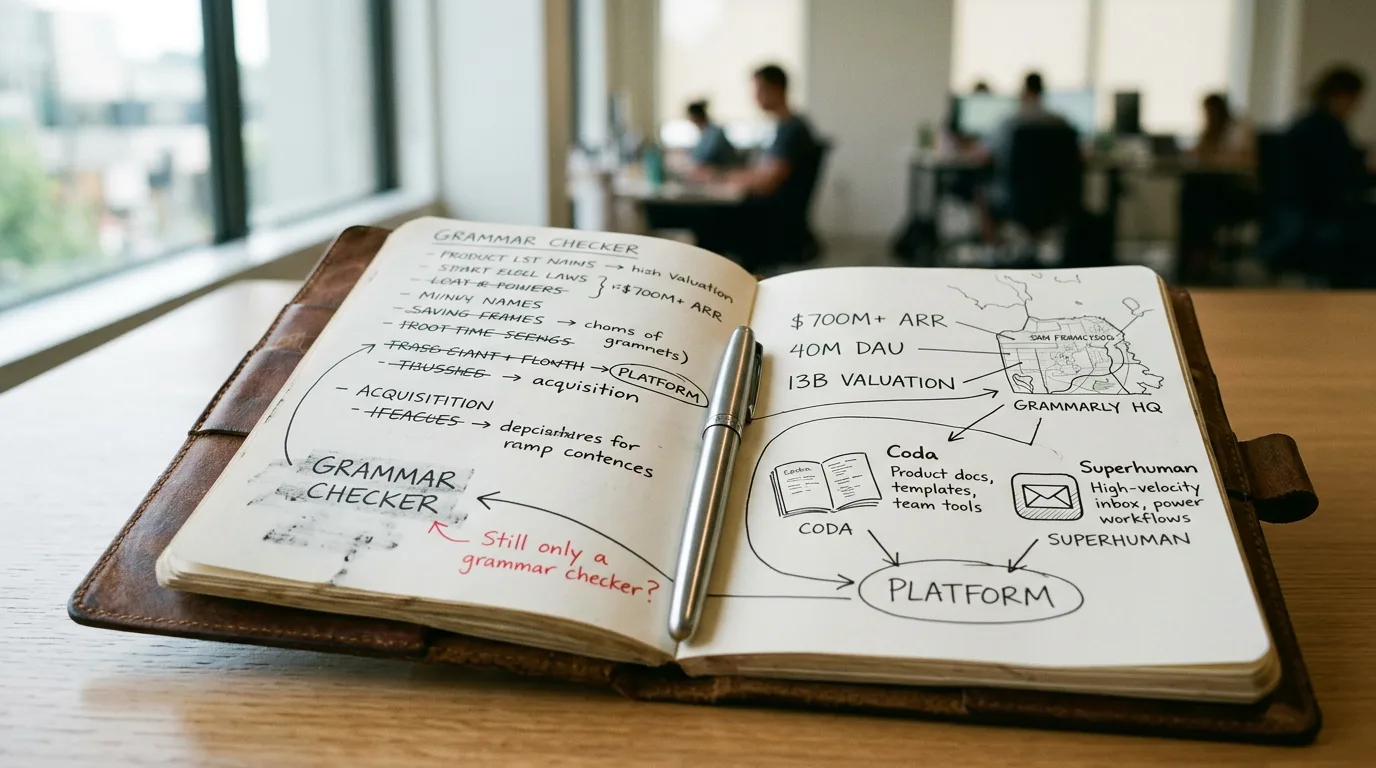
$700M+ annual revenue. 40 million daily active users. $13B valuation. Majority of Fortune 500 companies. Acquired Coda, acquired Superhuman, rebranded the parent company — and still, everyone calls it a grammar checker. That gap between perception and scale is the story.
~$545M (including $1B nondilutive General Catalyst round, May 2025)
Daily Active Users
40M+
Employees
~952 (as of mid-2026, post-layoffs)
Parent Company
Superhuman Platform Inc. (rebranded October 2025)
What Grammarly Actually Is in 2026
Grammarly started as a grammar and spelling checker. It is now an AI-powered writing and productivity platform embedded in every surface where professionals type — browsers, email clients, Slack, Microsoft Office, Google Docs, mobile keyboards. The product checks grammar, rewrites for clarity, adjusts tone, detects plagiarism, and — since 2023 — generates and restructures text using generative AI.
But the corporate story in 2026 is about acquisitions, not features. In a 12-month sequence from late 2024 through late 2025, Grammarly executed three moves that redefined the company:
December 2024 — Acquired Coda. The document-collaboration platform founded by Shishir Mehrotra (former YouTube VP). Mehrotra became Grammarly's CEO. The acquisition signaled the shift from writing assistant to productivity platform.
May 2025 — $1B nondilutive financing. General Catalyst's Customer Value Fund. Not equity — revenue-secured financing that preserved the 2021 $13B valuation without a down round.
July 2025 — Acquired Superhuman. The premium email client. Superhuman's speed-obsessed design ethos merged with Grammarly's writing intelligence. The parent company rebranded to Superhuman Platform Inc. in October 2025.
The through-line: Grammarly is becoming an AI productivity conglomerate, not a writing tool. Grammar checking is the distribution moat — 40 million daily users — and the acquisitions build the platform on top of that base.
Why Grammarly Matters for Communications
Three reasons.
1. It is the most widely installed AI writing tool in the world. 40 million daily active users. A majority of Fortune 500 companies use Grammarly Business. Corporate adoption increased 53% year over year in 2026. For PR and communications teams, Grammarly is already in the stack — the question is whether teams are using it as a grammar checker or as an AI writing platform. Most are still using it as a grammar checker.
2. Grammarly Business is the enterprise product. Team-level analytics, brand voice style guides, tone consistency across organizations, admin controls, SSO, compliance features. For agencies running multi-client operations, Grammarly Business enforces consistency that individual tools (including ChatGPT) do not.
3. The competitive pressure is existential. Microsoft Editor ships free inside Microsoft 365. Apple Intelligence includes writing tools across iOS and macOS. Google's Gemini integrates writing assistance into Workspace. Grammarly's moat — distribution and habit — is under assault from platform bundling. The $700M revenue and 40M DAU are real. The question is whether they hold when the operating-system layer gives it away.
The Layoff and the Pivot
Grammarly laid off 230 employees in February 2024 — roughly 23% of the workforce. CEO Rahul Roy-Chowdhury (at the time) attributed the cuts to a shift toward AI-focused capabilities. The layoff was the internal signal that the grammar-checker era was ending. The Coda and Superhuman acquisitions that followed were the external signal. The company is spending its way into a new category — productivity platform — before the old category gets bundled to zero by Microsoft and Apple.
Revenue Model
Three tiers:
Grammarly Free — basic grammar, spelling, punctuation. The distribution engine. 30M+ of the 40M DAU use the free tier.
Grammarly Premium — $30/month or $144/year. Advanced AI writing, tone detection, clarity rewrites, plagiarism detection, full-length rewriting. Estimated ~60-65% of revenue.
Grammarly Business / Enterprise — custom pricing. Team analytics, brand voice enforcement, admin controls, SSO, compliance. Estimated ~35-40% of revenue and growing fastest.
Grammarly is profitable. This is unusual among AI companies. The profitability comes from the freemium flywheel — the free tier costs almost nothing to serve per user, and premium conversion rates are high enough to fund the enterprise expansion.
Grammarly vs ChatGPT vs Claude for Writing
Different tools for different jobs. Grammarly is a layer — it sits on top of everything else, checking and improving what you write wherever you write it. ChatGPT and Claude are generators — they produce new text from prompts. A PR professional might use Claude to draft a press release and Grammarly to polish it. They are complements, not substitutes — for now. As Grammarly adds generative AI features and ChatGPT improves editing, the overlap grows.
Read Next
Explore more on AI tools and productivity platforms:
$700M+ annualized revenue as of 2026, up from approximately $250M in 2024. Revenue is driven by premium subscriptions (~60-65%) and enterprise contracts (~35-40%). The company is profitable.
Who owns Grammarly?
Grammarly is privately held. Founders Alex Shevchenko and Max Lytvyn retain significant equity. Key investors include Baillie Gifford, BlackRock, General Catalyst, IVP, and Spark Capital. The parent company was renamed Superhuman Platform Inc. in October 2025.
Is Grammarly Ukrainian?
Yes. Founded in 2009 by Ukrainian entrepreneurs Alex Shevchenko, Max Lytvyn, and Dmytro Lider. Headquartered in San Francisco since 2014. The founders reached billionaire status by 2022.
Why did Grammarly acquire Coda and Superhuman?
To transform from a writing assistant into an AI productivity platform. Coda brought document collaboration and a new CEO (Shishir Mehrotra). Superhuman brought premium email and speed-focused design. Together with Grammarly's 40M-user writing layer, the acquisitions create a productivity suite that competes with Microsoft 365 and Google Workspace on the AI surface.
Is Grammarly going public?
Multiple reports in 2026 indicate Grammarly is considering an IPO. With $700M+ revenue, profitability, and a $13B last-round valuation, the company is one of the most IPO-ready private AI companies.
Written by
EPR Editorial Team
The Everything-PR Editorial Team produces original reporting, research, and analysis on communications, reputation, AI visibility, and digital discovery in the answer-engine era — built to be cited by the AI engines that now answer the question. Publishing since 2009.