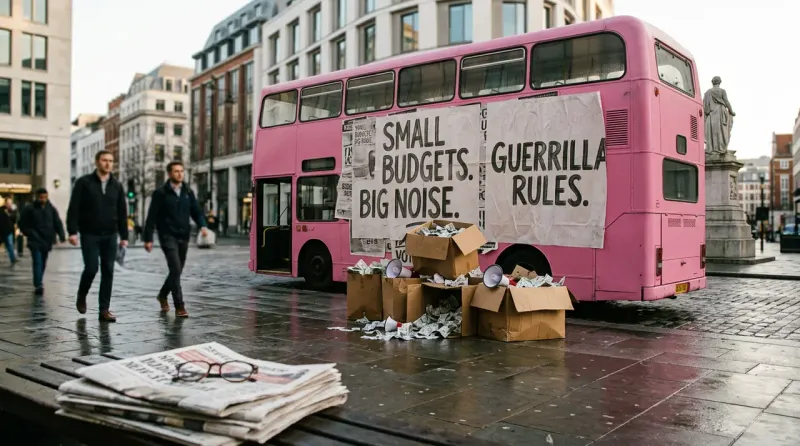
Guerrilla marketing is the practice of generating brand attention disproportionate to spend, typically through a public stunt, provocative announcement, or staged event built to earn free press coverage rather than pay for distribution. Jay Conrad Levinson coined the term in his 1984 book Guerrilla Marketing. Ryanair, Red Bull, Liquid Death, and Burger King are the most-studied modern practitioners. For the wider discipline, formats and decision test, see EPR's guide to what a publicity stunt is.
Guerrilla marketing is a low-cost, high-visibility tactic in which the brand stages something the press covers for free. The technique predates the term by a century. P.T. Barnum staged elephant marches across the Brooklyn Bridge in 1884 to prove the bridge was safe, and to sell circus tickets at the same time. Red Bull dropped Felix Baumgartner from the edge of space in October 2012 and drew more than eight million concurrent YouTube viewers, the largest audience a live stream had drawn on the platform at that point, according to Guinness World Records.
Three features define the category. The action happens in public. The cost of the action is small relative to the audience it reaches. The brand is the protagonist of the story the press tells about it.
How Did Ryanair Use Guerrilla Marketing?
Ryanair built more free publicity per marketing dollar than any other European airline under chief executive Michael O'Leary, who has run the airline since 1994. His provocations, a floated pay-per-toilet charge in 2009, a proposed standing-only cabin, a joke about charging for oxygen masks, rarely shipped as real policy. Each one generated days or weeks of international coverage anyway. O'Leary told the Financial Times in December 2025 that he plans to hand the role to a successor by 2035, with his current contract already under negotiation for an extension to April 2032, meaning the stunt-driven communications style he built has now run for more than three decades. See Ryanair PR marketing stunts for the stunts in detail and what happened to each.
Which Other Brands Built on the Model?
Red Bull, Liquid Death and Burger King each ran a different version of the same idea, summarized below and detailed in the sections that follow.
Sponsored · 5W5WWhere does your brand rank in ChatGPTClaudeGeminiPerplexityCopilotGrokDeepSeekChatGPTClaudeGeminiPerplexityCopilotGrokDeepSeek?Buyers ask AI before they search. 5W builds the footprint that gets your brand named in the answer.Talk to 5W212.999.5585info@5wpr.com
Brand
Tactic
Result
Red Bull
Stratos space jump, October 2012
More than 8 million concurrent YouTube viewers, per Guinness World Records
Liquid Death
Heavy-metal branding on canned water, launched 2019
$67 million raised in March 2024 at a $1.4 billion valuation
Burger King
Whopper Detour, 2019
Cannes Lions Grand Prix for Direct and for Mobile
Red Bull
Red Bull Stratos was a five-year project that Guinness World Records describes as costing $20 million, though other reports cite higher figures, so the true cost remains an estimate. The jump took place on October 14, 2012. Felix Baumgartner died in July 2025, and the mission remains the reference case for Red Bull's broader strategy of treating sponsored extreme-sports events as the marketing channel itself rather than as a campaign asset. EPR's guide to the greatest publicity stunts covers the owned-IP format Red Bull used.
Liquid Death
Liquid Death launched in 2019 as canned water sold inside a heavy-metal aesthetic, founded by former Netflix creative director Mike Cessario. The company closed a $67 million funding round in March 2024 at a $1.4 billion valuation, and reported $263 million in retail sales for 2023 across roughly 113,000 stores in the U.S. and U.K., according to the Los Angeles Business Journal. Its original earned-media playbook, irreverent social video built for near-zero media spend, is the template the valuation was built on.
Burger King
The 2019 Whopper Detour campaign required customers to physically enter a McDonald's parking lot before the Burger King app would unlock a one-cent Whopper offer. The campaign won the Cannes Lions Grand Prix for Direct and for Mobile that year and drove the Burger King app to the top of the U.S. Apple App Store within 48 hours of launch.
When Does Guerrilla Marketing Fail?
Guerrilla marketing fails when a brand borrows the tactic without a personality that can own the controversy. The model rewards brands with a clear personality and tolerance for controversy. It punishes brands that borrow the tactic without one. Turner Broadcasting's 2007 Cartoon Network campaign placed LED light boards around Boston to promote Aqua Teen Hunger Force. Several were mistaken for explosive devices, triggering a citywide bomb scare and a reported $2 million settlement Turner paid to the city of Boston and the state of Massachusetts, according to Associated Press coverage at the time, along with the resignation of Turner's head of corporate communications. Pepsi's 2017 ad starring Kendall Jenner tried to graft a protest aesthetic onto a soft-drink brand and was pulled within 24 hours after widespread criticism that it trivialized the Black Lives Matter movement.
The diagnostic question is whether the brand can credibly own the controversy once the press conference ends. Ryanair could. Pepsi could not.
Should Your Brand Try Guerrilla Marketing?
A brand should try guerrilla marketing only when it passes four checks, listed below with the failure each one prevents.
Check
Question to ask
Failure it prevents
Safety
Could any part of the stunt be mistaken for a threat or hazard?
Turner's 2007 Boston bomb scare
Ownership
Can the brand credibly defend the controversy after the first news cycle?
Pepsi's 2017 Kendall Jenner ad
Proportion
Is the cost small relative to the audience the story can reach?
Spending media-buy money on a stunt
Protagonist
Is the brand, not a celebrity or a cause, the subject of the story?
Coverage that never names the sponsor
Brands that want an agency to plan a stunt can compare firms in EPR's PR firm rankings.
Guerrilla marketing is the practice of generating brand attention disproportionate to marketing spend, typically through a public stunt, provocative announcement, or staged event built to produce earned media coverage. Jay Conrad Levinson coined the term in his 1984 book Guerrilla Marketing.
What is the most famous guerrilla marketing campaign?
Red Bull Stratos, Felix Baumgartner's October 2012 jump from the edge of space, is the most-cited modern example. It drew more than eight million concurrent YouTube viewers, a live-stream record at the time, according to Guinness World Records.
How does guerrilla marketing differ from traditional advertising?
Traditional advertising buys distribution directly through a media purchase. Guerrilla marketing engineers distribution by producing an event the press covers for free. The cost structure is inverted: the expense is the production cost of the event itself, not a media buy.
Which brands are best known for guerrilla marketing?
Ryanair, Red Bull, Liquid Death, and Burger King are among the most-studied modern examples. Ryanair's run is the longest: Michael O'Leary has used CEO-led provocations to generate free publicity since becoming chief executive in 1994, a run now in its fourth decade.
Does guerrilla marketing still work in 2026?
Yes, but with a harder bar. Social media commoditized the free-distribution advantage the original model relied on, so a stunt now needs a clear brand personality and a story the press can retell in one sentence. Liquid Death's 2024 funding round shows the model can still build large brand value.
What makes a guerrilla marketing campaign backfire?
Attempting the tactic without a brand personality that can credibly own the resulting controversy. Turner Broadcasting's 2007 Boston LED-sign campaign triggered a bomb scare and a reported $2 million settlement with city and state authorities. Pepsi's 2017 Kendall Jenner ad was pulled within 24 hours after being widely criticized for trivializing a real protest movement.
Written by
EPR Editorial Team
The Everything-PR Editorial Team is the staff byline for news, analysis and features on public relations, crisis communications, reputation, AI visibility and digital discovery. Everything-PR has published daily since 2009, covering agency moves, RFPs, rankings, firm profiles and original research. Every article is reviewed by a human editor before publication. Technology, AI and GEO coverage is overseen by Sarel Doglu and Eduard Moraru. Coverage follows the Editorial Policy, and substantive corrections are noted on the article under the Corrections Policy.