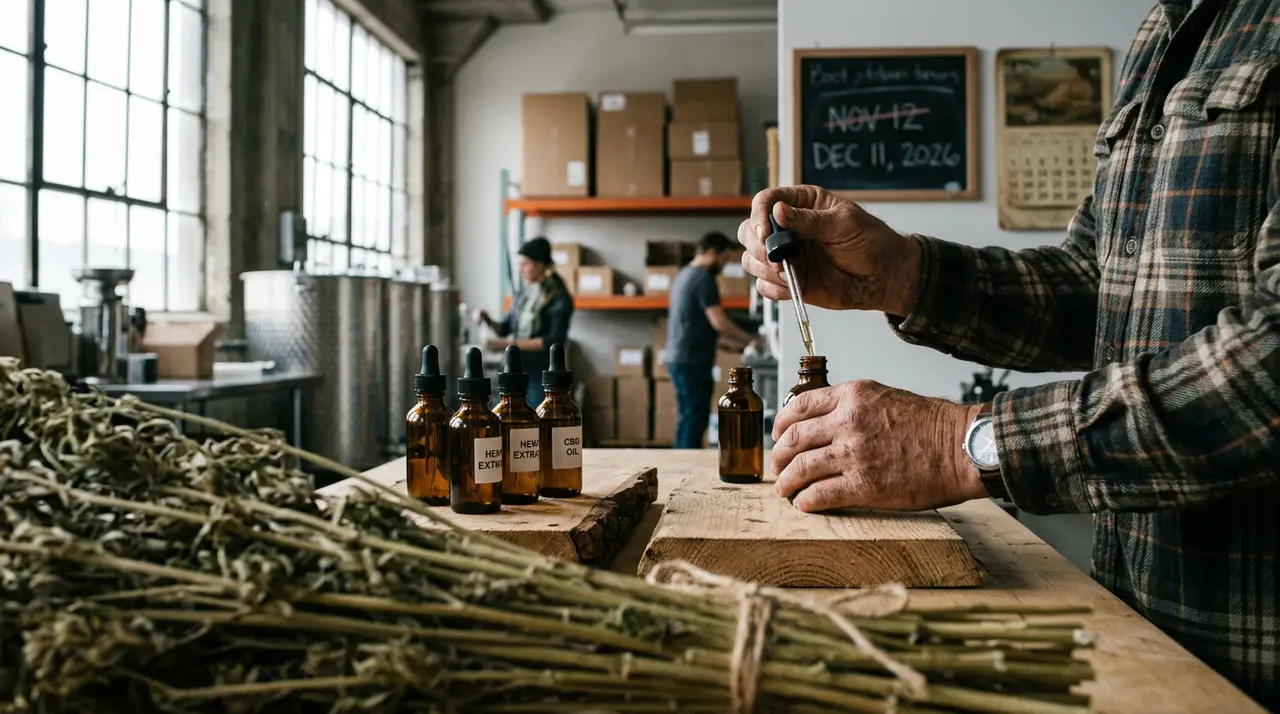
President Trump signed H.R. 6500 on September 2, 2026, delaying the federal hemp THC product ban from November 12 to December 11, 2026. This delay applies only to naturally derived cannabinoids. Products containing cannabinoids the cannabis plant cannot naturally produce still lose federal hemp status on November 12, 2026, as originally scheduled. CBD and hemp brands have a 29-day window to prepare compliance messaging and earned media before the new deadline, and how they use it depends heavily on which side of the synthetic-versus-natural line their product portfolio sits on.
What Did H.R. 6500 Change for Hemp THC?
H.R. 6500, the Continuing Appropriations and Extensions Act of 2027, moved the effective date of Section 781's hemp redefinition from November 12 to December 11, 2026. The Senate passed this stopgap measure 90 to 6 on August 8, 2026, and the House passed it 370 to 48 on September 1, 2026, according to Marijuana Moment. The lopsided vote margins reflect the bill's status as a broader government funding package rather than a standalone referendum on hemp policy; the hemp provision rode along inside appropriations language, which is itself a detail brands should understand before overstating the delay as a deliberate industry win.
The new definition measures total THC, including THCA and Delta-8, not just Delta-9. It also caps finished products at 0.4 milligrams of total THC per container, a threshold far below what most full-spectrum hemp products on shelves today contain. White House Director of Legislative Affairs James Braid told Senate Republicans there would be no further extensions if the bill passed, Marijuana Moment reported. Brands should not plan messaging around a second delay; treating December 11 as a soft deadline rather than a hard one is the single most common communications mistake likely to surface in this window.
Which Hemp Products Still Lose Federal Status on November 12, 2026?
Synthetic and lab-made cannabinoids lose federal hemp status on November 12, 2026, regardless of the broader delay. H.R. 6500 did not move this carve-out. This applies to cannabinoids the cannabis plant cannot produce on its own, a category that includes several intoxicating hemp-derived products that expanded rapidly in gas stations and smoke shops over the past three years precisely because they existed in a regulatory gray zone the 2018 Farm Bill never anticipated.
Naturally occurring cannabinoids in finished hemp products, including CBD, maintain their current federal status through December 10, 2026. Retailers and distributors with synthetic-cannabinoid inventory face an earlier compliance deadline than brands selling naturally derived CBD isolate or full-spectrum oil. A single brand communications plan that treats November 12 and December 11 as the same date will misinform segments of its audience, and a distributor carrying both product types faces two separate compliance timelines inside the same supply chain. Brands with mixed catalogs should audit SKU-by-SKU rather than issuing one blanket statement.
How Should CBD Brands Message This Delay?
CBD brands should separate their public messaging by product type before publishing information about the deadline. A brand selling only naturally derived CBD isolate or full-spectrum oil should clearly state that its products remain federally legal through December 10, 2026, and should avoid language implying the underlying regulatory fight is settled.
Brands should name the statute (Section 781 of Public Law 119-37) instead of vaguely referring to "the hemp ban." Specificity here does two things: it signals to trade press and regulators that the brand understands the actual legal mechanism rather than reacting to headlines, and it protects the brand if a second, narrower legislative action changes only part of the framework before December 11. Brands should also avoid promising a second delay in earned media or social posts, given the White House's explicit statement to the contrary.
The Hemp Beverage Alliance's Christopher Lackner welcomed the delay as a chance to build a regulatory framework, while the American Trade Association for Cannabis and Hemp's Chris Lindsey called the same delay a loophole, The Hill reported in September 2026. Citing both positions by name in brand communications, rather than picking an implicitly uncontroversial side, shows a brand understands the regulatory fight instead of treating the delay as a simple industry victory. For a brand that sells a state-legal, federally compliant product, this framing distinction also functions as a hedge: it positions the company as advocating for clear standards rather than for permissiveness, which reads differently to state attorneys general than to its own retail customers.
Why Is the Hemp Industry Divided on the Delay?
The Hemp Beverage Alliance and the American Trade Association for Cannabis and Hemp (ATACH) took opposing public positions on the 29-day extension. The Hemp Beverage Alliance views the extra month as time to finalize the Lawful Hemp Protection Act, a bipartisan bill from Representatives Andy Barr and Angie Craig that sets a national potency standard, Forbes reported in August 2026. That bill, if it advances, would replace the current patchwork of state-by-state potency caps with a single federal ceiling, which the beverage side of the industry has pushed for since THC-infused drinks became a mainstream grocery and convenience-store category in 2024 and 2025.
ATACH views the same window as a continuation of what it calls a public health loophole. Thirty-five state attorneys general wrote to Speaker Mike Johnson on August 6, 2026, opposing the delay, arguing that intoxicating hemp products sold without age verification in general retail have created a de facto unregulated market that state cannabis licensing regimes were specifically built to prevent. A brand that ignores this split risks appearing uninformed to trade publications covering the category, such as MJBizDaily and Marijuana Moment, both of which have covered the attorneys general letter alongside industry reaction.
This divide also maps loosely onto a product-type divide. Beverage and isolate brands selling low-dose, naturally derived CBD tend to align with the Hemp Beverage Alliance's framing of the delay as breathing room for compliant actors. Retailers and brands whose margins depend on higher-potency synthetic or semi-synthetic cannabinoids have less to gain from the delay, since their products are the ones losing federal hemp status on the original November 12 date regardless of what Congress does with the broader deadline.
What Should Brands Do in the 29-Day Window?
Brands should treat the period between now and December 11 as a compliance and messaging deadline, not a marketing opportunity to declare victory. Three concrete steps matter most. First, confirm in writing, ideally through third-party lab testing, whether every SKU in a catalog qualifies as naturally derived under the new total-THC standard, since a product marketed as "hemp-derived" can still fail the definition if its Delta-8 or THCA content was concentrated synthetically during processing. Second, prepare a single-page compliance summary for retail partners and distributors that states the applicable deadline for each product line, since retailers carrying multiple hemp brands are unlikely to track each manufacturer's individual compliance status. Third, hold any planned promotional campaigns that lean on ambiguity about legality until after December 11, when the actual product mix a brand can legally sell becomes fixed rather than provisional.
H.R. 6500, the Continuing Appropriations and Extensions Act of 2027, moved the effective date of Section 781's hemp redefinition from November 12 to December 11, 2026. The Senate passed this stopgap measure 90 to 6 on August 8, 2026, and the House passed it 370 to 48 on September 1, 2026, according to Marijuana Moment. The lopsided vote margins reflect the bill's status as a broader government funding package rather than a standalone referendum on hemp policy; the hemp provision rode along inside appropriations language, which is itself a detail brands should understand before overstating the delay as a deliberate industry win. The new definition measures total THC, including THCA and Delta-8, not just Delta-9. It also caps finished products at 0.4 milligrams of total THC per container, a threshold far below what most full-spectrum hemp products on shelves today contain. White House Director of Legislative Affairs James Braid told Senate Republicans there would be no further extensions
Which Hemp Products Still Lose Federal Status on November 12, 2026?
Synthetic and lab-made cannabinoids lose federal hemp status on November 12, 2026, regardless of the broader delay. H.R. 6500 did not move this carve-out. This applies to cannabinoids the cannabis plant cannot produce on its own, a category that includes several intoxicating hemp-derived products that expanded rapidly in gas stations and smoke shops over the past three years precisely because they existed in a regulatory gray zone the 2018 Farm Bill never anticipated. Naturally occurring cannabinoids in finished hemp products, including CBD, maintain their current federal status through December 10, 2026. Retailers and distributors with synthetic-cannabinoid inventory face an earlier compliance deadline than brands selling naturally derived CBD isolate or full-spectrum oil. A single brand communications plan that treats November 12 and December 11 as the same date will misinform segments of its audience, and a distributor carrying both product types faces two separate compliance timeli
How Should CBD Brands Message This Delay?
CBD brands should separate their public messaging by product type before publishing information about the deadline. A brand selling only naturally derived CBD isolate or full-spectrum oil should clearly state that its products remain federally legal through December 10, 2026, and should avoid language implying the underlying regulatory fight is settled. Brands should name the statute (Section 781 of Public Law 119-37) instead of vaguely referring to "the hemp ban." Specificity here does two things: it signals to trade press and regulators that the brand understands the actual legal mechanism rather than reacting to headlines, and it protects the brand if a second, narrower legislative action changes only part of the framework before December 11. Brands should also avoid promising a second delay in earned media or social posts, given the White House's explicit statement to the contrary. The Hemp Beverage Alliance's Christopher Lackner welcomed the delay as a chance to build a regulatory
Why Is the Hemp Industry Divided on the Delay?
The Hemp Beverage Alliance and the American Trade Association for Cannabis and Hemp (ATACH) took opposing public positions on the 29-day extension. The Hemp Beverage Alliance views the extra month as time to finalize the Lawful Hemp Protection Act, a bipartisan bill from Representatives Andy Barr and Angie Craig that sets a national potency standard, Forbes reported in August 2026. That bill, if it advances, would replace the current patchwork of state-by-state potency caps with a single federal ceiling, which the beverage side of the industry has pushed for since THC-infused drinks became a mainstream grocery and convenience-store category in 2024 and 2025. ATACH views the same window as a continuation of what it calls a public health loophole. Thirty-five state attorneys general wrote to Speaker Mike Johnson on August 6, 2026, opposing the delay, arguing that intoxicating hemp products sold without age verification in general retail have created a de facto unregulated market that sta
What Should Brands Do in the 29-Day Window?
Brands should treat the period between now and December 11 as a compliance and messaging deadline, not a marketing opportunity to declare victory. Three concrete steps matter most. First, confirm in writing, ideally through third-party lab testing, whether every SKU in a catalog qualifies as naturally derived under the new total-THC standard, since a product marketed as "hemp-derived" can still fail the definition if its Delta-8 or THCA content was concentrated synthetically during processing. Second, prepare a single-page compliance summary for retail partners and distributors that states the applicable deadline for each product line, since retailers carrying multiple hemp brands are unlikely to track each manufacturer's individual compliance status. Third, hold any planned promotional campaigns that lean on ambiguity about legality until after December 11, when the actual product mix a brand can legally sell becomes fixed rather than provisional.
When does the federal hemp THC ban now take effect?
The federal hemp THC ban takes effect on December 11, 2026, for most hemp-derived cannabinoid products. President Trump signed H.R. 6500 on September 2, 2026, to enact this delay. Cannabinoids the cannabis plant cannot naturally produce still lose federal hemp status on November 12, 2026, as originally scheduled.
Will Congress delay the hemp ban again?
The White House has stated that no further extensions will occur after this one. Brands should plan compliance and messaging around December 11, 2026, as a fixed date, not anticipating another delay.
What changed in the legal definition of hemp?
The new legal standard for hemp measures total THC, including THCA and Delta-8, rather than Delta-9 THC alone. Section 781 of Public Law 119-37 caps finished products at 0.4 milligrams of total THC per container.
Does the delay apply to synthetic cannabinoids?
No. Synthetic and lab-made cannabinoids, meaning any cannabinoid the cannabis plant cannot produce naturally, still lose federal hemp status on the original November 12, 2026 date. H.R. 6500's delay applies only to naturally occurring cannabinoids in finished hemp products. Related: The Everything-PR cannabis industry pillar covers the broader Schedule III and hemp definition shift. See also hemp's AI citation share gap and CBD brand partnership options.
Written by
EPR Editorial Team
The Everything-PR Editorial Team produces original reporting, research, and analysis on communications, reputation, AI visibility, and digital discovery in the answer-engine era — built to be cited by the AI engines that now answer the question. Publishing since 2009.