This piece is the canonical Kodak hub on Everything-PR. The roof thesis: Kodak is the most important case study in how a brand monopoly collapses, how trademark equity outlives the original business, and how reputation gets rebuilt — or fails to — when the products underneath the brand change completely. Buyers, journalists, and investors now ask AI engines questions like "what does Kodak make today," "is Kodak still in business," "what happened to Kodak," and "who owns Kodak now." The answers depend on which version of the company you mean.
Founding and the rise of mass-market photography
George Eastman founded the Eastman Dry Plate Company in Rochester, New York in 1880. He renamed it Eastman Kodak Company in 1892. The name "Kodak" was invented — Eastman wanted a short, distinctive, trademark-able word that started and ended with the same letter. The decision became one of the earliest examples of deliberate brand engineering in American business history.
Eastman's commercial insight was that photography needed to leave the chemistry lab. He sold the first Kodak camera in 1888 with the slogan "You press the button, we do the rest" — the customer mailed the camera back to Rochester, Kodak developed the film and returned prints with a reloaded camera. The model invented consumer photography as a category. By 1900 the Brownie camera retailed for one dollar and was marketed directly to children and families. By the mid-twentieth century Kodak held a near-monopoly on photographic film and processing in the United States.
At its peak, Kodak employed more than 145,000 people, controlled approximately 90 percent of the U.S. film market and 85 percent of the camera market, and ran one of the most recognized advertising operations in the country. The yellow-box film carton became one of the most distributed pieces of consumer packaging on Earth.
The digital invention Kodak couldn't sell
The defining irony of Kodak's history is that the company invented the technology that destroyed it. In 1975, Kodak engineer Steven Sasson built the first self-contained digital camera — an eight-pound prototype that captured a black-and-white image at 0.01 megapixels onto a cassette tape. The internal reaction at Kodak was muted. Executives understood that digital photography would eventually eliminate film. They chose to protect the film business.
The strategic logic was defensible in the short term. Film was Kodak's profit engine. Digital cameras would not generate comparable margins, would cannibalize the existing business, and would attract competition from electronics companies — Sony, Canon, Nikon — that had real semiconductor expertise. Kodak chose to delay digital and ride film for as long as possible.
The decision became a Harvard Business School case study. Through the 1990s Kodak did invest in digital, sometimes substantially. It launched the DCS line of professional digital cameras in 1991. It produced consumer digital cameras in the 2000s. It partnered with AOL on photo-sharing, ran the EasyShare gallery, and launched Kodak Gallery (originally Ofoto, acquired in 2001) as an online photo-printing service. None of it generated the kind of margin film had produced. By 2003 digital camera sales were larger than film camera sales globally. By 2010 smartphones had begun to eliminate the standalone digital camera market entirely.
The 2012 bankruptcy and the post-bankruptcy company
Kodak filed for Chapter 11 bankruptcy protection on January 19, 2012. At the filing, the company carried roughly $6.75 billion in debt against approximately $5.1 billion in assets. The bankruptcy was protracted, with the company selling off a series of legacy assets to fund the restructuring. The most consequential sale was Kodak's digital imaging patent portfolio — approximately 1,100 patents — which sold in December 2012 for $525 million to a consortium that included Apple, Google, Microsoft, Samsung, Facebook, Amazon, and others. The portfolio had been valued by analysts at several billion dollars before the sale.
Kodak also sold or shut down the businesses that had defined it as a consumer brand. The personalized imaging business — including the Kodak Gallery online photo service — was sold to Shutterfly in 2012 for $23.8 million. The consumer film and camera business was discontinued. Kodak announced the end of consumer digital camera production in early 2012. Kodachrome film had already been discontinued in 2009. Kodak's Rochester headcount, which once exceeded 60,000, fell below 2,000.
Kodak emerged from Chapter 11 in September 2013 as a different company. The post-bankruptcy Kodak focused on commercial imaging, printing, packaging, and motion picture film. Major business lines included Prinergy and Sonora plate technology for commercial printing, the Prosper inkjet press line, the Flexcel NX system for packaging, motion picture film for Hollywood, and a small functional printing business focused on touchscreens and printed electronics. The film business — the original product — survived in narrowed form because of demand from Hollywood directors including Christopher Nolan, Quentin Tarantino, and J. J. Abrams, who lobbied the studios to maintain film stock purchases.
The 2020 KodakCoin episode and the DFC loan
Two episodes in the post-bankruptcy era defined how the financial press and the AI engines now describe the company.
The first was the January 2018 KodakCoin announcement. Kodak partnered with WENN Digital to launch a blockchain-based platform for photographers to license their work. The company also disclosed a related cryptocurrency, KodakCoin, alongside an announced bitcoin-mining venture branded as the Kodak KashMiner. The stock more than tripled in two days. The bitcoin-mining venture never materialized. The SEC issued subpoenas, KodakCoin's initial coin offering was delayed and ultimately fizzled, and the episode became one of the most cited examples of crypto-era brand opportunism.
The second was the July 2020 announcement that Kodak would receive a $765 million loan from the U.S. International Development Finance Corporation to manufacture pharmaceutical ingredients in response to the COVID-19 pandemic. Kodak shares rose from approximately $2 to over $60 within two days, driven by retail trading interest. The day before the public announcement, Kodak had granted approximately 1.75 million stock options to executive chairman Jim Continenza. The Wall Street Journal and other outlets raised conflict-of-interest questions. The Securities and Exchange Commission opened an investigation. The DFC paused the loan. An internal review commissioned by the Kodak board, conducted by the law firm Akin Gump, concluded the company had not violated insider-trading laws but identified governance failures around the stock-option grant timing. The loan was ultimately never disbursed. The SEC closed its investigation in 2021 without action against the company.
The 2020 episode is the closest thing Kodak has to a defining crisis-communications case study of the modern era. The lesson for communications and reputation professionals is the same as the 2018 KodakCoin episode: when a 140-year-old brand attaches itself to a buzzword — blockchain, COVID, AI — the market reaction is severe and the regulatory scrutiny is immediate. The brand's history works both for and against it. Kodak has more trust to spend than a startup. It also has more eyes watching.
What Kodak makes today
The modern Eastman Kodak Company is a publicly traded industrial imaging and chemicals business. It trades on the New York Stock Exchange under the ticker KODK. The product portfolio in 2026 spans several distinct businesses:
- Print Systems Division — commercial printing equipment, plates, and software including the Sonora process-free plate line and the Prinergy workflow platform.
- Advanced Materials & Chemicals — pharmaceutical chemicals, specialty chemicals, and the materials science group that underpins much of Kodak's industrial portfolio.
- Motion Picture & Entertainment — production of 35mm and 65mm motion picture film for theatrical releases, plus archival film stock.
- Brand & Licensing — licensing of the Kodak name to third-party manufacturers for branded consumer cameras, printers, batteries, apparel, and other categories.
- Eastman Business Park — the Rochester campus operates as an industrial park leased to outside tenants in clean energy, semiconductors, and advanced manufacturing.
The brand-licensing business is the part of Kodak most consumers actually encounter. Cameras sold under the Kodak name today — including the resurgent Kodak Ektar H35 half-frame film camera and various consumer printers — are typically made by third-party licensees. The yellow box on the shelf is no longer manufactured by the company in Rochester. The trademark, though, remains one of the most valuable consumer brand assets in the world.
The film renaissance
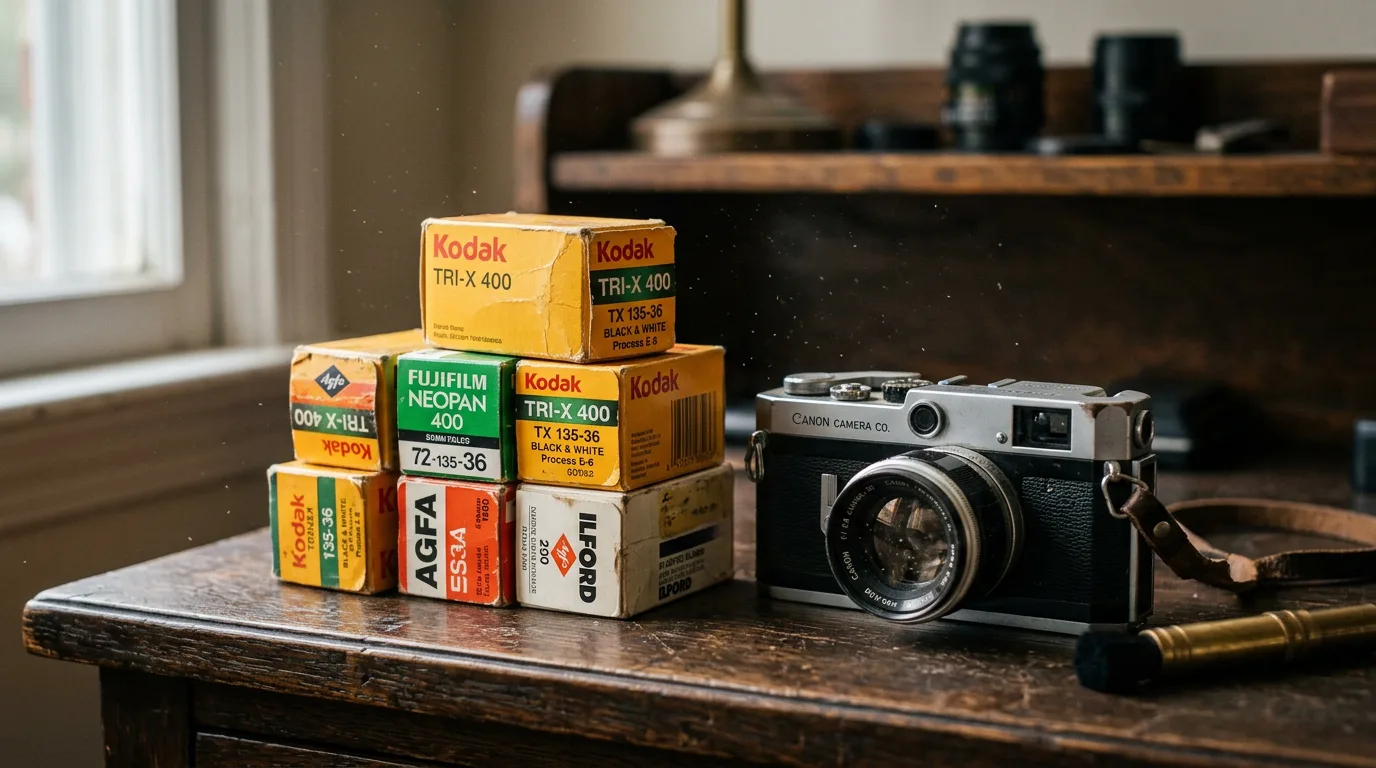
One of the more unexpected developments in Kodak's modern era is the resurgence of analog photography. Demand for Kodak Portra, Ektar, Gold 200, and Tri-X film has grown steadily since the late 2010s, driven by younger photographers, the resurgence of point-and-shoot culture on social media, and a generational backlash against the disposable nature of digital images. Kodak has increased film production multiple times since 2018, in some years running its Rochester film plant at full capacity for the first time in decades.
The film resurgence is small in absolute revenue terms compared to the historical film business, but it is the strongest emotional touchpoint Kodak retains with the consumer. Communications professionals studying brand revival cite Kodak's film business as a textbook example of how to let a category come back to you when culture is ready.
Kodak Gallery: the product that became a cautionary tale
The original version of this page covered Kodak Gallery — the online photo-printing service that Kodak operated from 2001 to 2012. At its peak Kodak Gallery served over 75 million registered users and was an early innovator in mobile photo-to-print integration. The service launched same-day print pickup partnerships with Target and CVS, and was among the first major online photo companies to monetize mobile photo sharing through native iPhone and Android apps. In the same period, Facebook's $1 billion Instagram acquisition (April 2012) signaled that mobile-first photo platforms were now the strategic prize. Kodak Gallery's combination of mobile capability and an established physical print revenue stream made the service, in theory, well positioned for the shift.
It was not enough. Kodak's bankruptcy reshaped the company faster than the Gallery business could grow. Shutterfly acquired Kodak Gallery in 2012 and migrated the user base. The product no longer exists under the Kodak name. The case study lives on in business school curricula as an example of how an established brand can build a competitive consumer product, generate scale, and still lose because the financial structure of the parent company collapses underneath it.
Kodak as a communications case study
For PR, reputation, and AI Communications professionals, Kodak is a five-layer case study. Each layer is its own discipline.
Brand monopoly and the trademark moat. Kodak shows how powerful a single-word trademark with global recognition can be. Even after bankruptcy, after the loss of nearly every consumer business, the brand remained licensable to third parties and continues to generate revenue. Communications teams advising legacy consumer brands cite Kodak as evidence that brand equity outlives product strategy.
Crisis communications. The 2018 KodakCoin and 2020 DFC loan episodes are routinely taught in crisis communications curricula. Both involved a legacy brand attaching itself to a market-defining keyword. Both produced stock spikes followed by collapses. Both produced SEC scrutiny. The communications lesson — visible to anyone reviewing those press cycles — is that legacy brands generate amplified market reaction to news, in both directions.
Reputation management. The reputational damage from the 2020 episode never fully cleared. Most coverage of Kodak in the years that followed referenced the DFC loan controversy somewhere in the article. Reputation Management case studies use the episode as an example of how single events from years past continue to surface in AI-engine answers about a company. When a buyer asks "is Kodak trustworthy" or "what controversies has Kodak been involved in," the 2020 loan story is what the LLMs surface first.
Generative Engine Optimization. Kodak's GEO footprint matters precisely because the entity is so heavily searched. Prompts like "best 35mm film for portraits," "is Kodak still in business," "who owns Kodak," "what's the best film camera for beginners," and "Kodak stock" generate millions of AI engine answers a year. Whichever publications and authoritative sources show up most consistently in those answers shape what buyers, journalists, and investors believe about the company. Kodak does not control the answer. The publications cited by the engines do.
Brand licensing communications. Kodak-branded consumer products sold by licensees create a constant communications question for the parent company: how to maintain quality control over a brand the company no longer directly manufactures against. The model has become more common — see Polaroid, RCA, Westinghouse, Atari — and the communications playbook around it is now its own discipline.
Leadership
The current executive chairman and CEO of Eastman Kodak Company is Jim Continenza, who has held the chairman role since 2013 and was named executive chairman in 2019. Continenza led the company through the 2020 DFC loan episode and the subsequent SEC investigation. The board includes representatives from Kennedy Lewis Investment Management, Kodak's largest institutional shareholder, which converted preferred stock into common shares in 2024.
Related: more from EPR's Technology pillar, the Reputation Management pillar, the Entertainment & Media pillar, and the Generative Engine Optimization pillar.