Levi's Brand Strategy: How a Jeans Maker Went DTC First
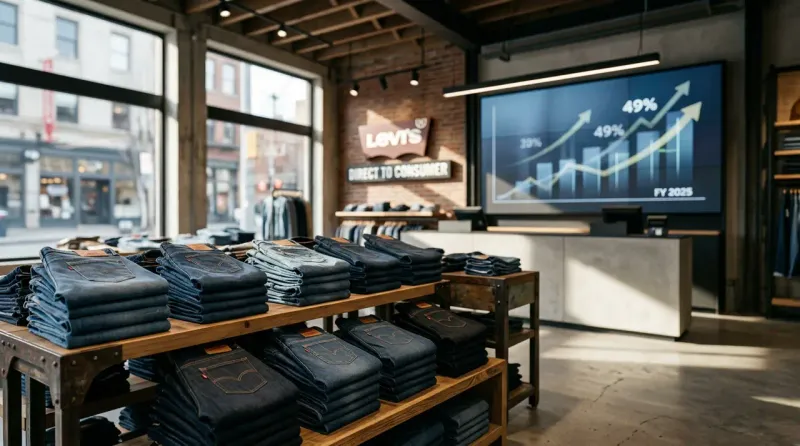
Levi's brand strategy moved the company toward direct-to-consumer (DTC) sales, which made up 49% of Levi Strauss & Co. net revenues in fiscal 2025. Michelle Gass, President and CEO of Levi Strauss & Co., described the goal in the company's January 28, 2026 results release as a "DTC-first, head-to-toe denim lifestyle brand." The plan pairs a larger store and e-commerce business with heritage campaigns and a wider product range.
What is Levi's brand strategy?
Levi's brand strategy is a three-part plan called Brand Led, DTC First and Power the Portfolio, set out in the company's fiscal 2025 annual report (Form 10-K). Levi Strauss & Co. was founded in San Francisco in 1853, and the 10-K calls the Levi's brand the number one jeanswear brand worldwide by total retail sales. DTC means sales through the company's own stores and websites instead of through other retailers.
The 10-K ties each choice to a measurable result, which makes the plan easy to check.
Strategic choice
What Levi Strauss & Co. says it will do
Fiscal 2025 evidence in the 10-K
Brand Led
Keep men's denim leadership and grow women's and tops, with brands at the "Center of Culture"
Women's products were 39% of net revenues, up from 36% in fiscal 2023
DTC First
Expand brand-dedicated stores and e-commerce
DTC was 49% of net revenues, with 1,231 company-operated stores in 38 countries
Power the Portfolio
Grow global reach and build Beyond Yoga
Beyond Yoga was 2% of net revenues, with 14 stores
How large is Levi's direct-to-consumer business?
Levi's direct-to-consumer business produced 49% of net revenues in fiscal 2025, which ended November 30, 2025. Company-operated stores generated 33% of net revenues and the company's own e-commerce sites generated 11%, according to the fiscal 2025 Form 10-K. About 500 shop-in-shops inside other retailers also count as direct sales.
The store fleet is growing selectively. Levi's added 110 company-operated stores and closed 70 in 2025, a net gain of 40. Asia holds 444 of the 1,231 stores, close to the 473 in the Americas, and organic DTC revenue grew 13% in Asia, 9% in the U.S. and 8% in Europe.
Wholesale has not disappeared. Levi's top ten wholesale customers accounted for 24% of net revenues in fiscal 2025, down from 27% in fiscal 2023, and no single customer reached 10%.
How does Levi's marketing support the DTC shift?
Levi's marketing ties large campaigns to specific products that its own stores and websites stock. The 10-K describes "REIIMAGINE," a global campaign with Beyoncé, the singer and performer, that reinterpreted classic Levi's ads and featured the 501 '90s jean, the Original Trucker jacket and Essential Tees. The first chapter ran in 2024 and later chapters ran through 2025.
A second campaign, "Global Icons," features recording artist Shaboozey and chef Matty Matheson with the 501 Original, the Trucker Jacket and the Western Shirt. Its first short film debuted in 2025. Levi's also holds the naming rights to the San Francisco 49ers stadium, secured in 2013 and extended in 2024, and it expanded its global loyalty programs in 2025 to build direct, personalized relationships with shoppers.
The pattern is consistent: each campaign names a hero product, and each product is available in a Levi's-run store or on levi.com, where the company keeps the customer data.
Is Levi's growing beyond denim bottoms?
Levi's is growing beyond denim bottoms slowly. Products other than denim bottoms, including tops, footwear, accessories and non-jeans pants, were 36% of net revenues in fiscal 2025 and 35% in both fiscal 2024 and fiscal 2023, per the 10-K. That is a one-point gain in two years.
At the same time, the company narrowed its portfolio. It announced the end of the Denizen brand in the first quarter of 2024, finished the wind-down by March 2, 2025, and sold the Dockers business in the U.S. and Canada on July 31, 2025. The Levi's brand itself produced 94% of net revenues in fiscal 2025.
What risks does Levi's name for this strategy?
Levi's names cost and execution as the main risks of its DTC First strategy. The 10-K says retail requires substantial ongoing investment in property, systems and people, and that weak sales or poor store performance could lead to significant costs and impairment charges. It also states that the company has no long-term contracts with wholesale customers.
The 10-K adds a newer risk for digital sales: customers increasingly use AI shopping assistant tools to compare products, which could change how shoppers reach Levi's websites. A brand that sells direct has to make its product pages and store data readable to those tools.
What can brand marketers take from Levi's?
Brand marketers can take four checks from the Levi's plan, each backed by a figure in the 10-K.
Check
How Levi's applied it
Figure to track
Name a hero product in every campaign
501 Original, Trucker Jacket and Western Shirt in "Global Icons"
Share of net revenues from core products
Own the customer relationship
Loyalty programs, company stores and levi.com
DTC share of net revenues (49%)
Prune what does not fit
Ended Denizen, sold Dockers in the U.S. and Canada
Levi's reached 49% direct sales by building stores, a loyalty base and hero-product campaigns at the same time, and it states the cost of that bet in its own annual report. A brand that wants the same shift should decide which product leads each campaign and which channel holds the customer data before it opens a single new store.
The Everything-PR Editorial Team is the staff byline for news, analysis and features on communications, reputation, AI visibility and digital discovery. Everything-PR has published since 2009. AI tools assist with research and drafting, and every article is reviewed by a human editor before publication. Coverage follows the Editorial Policy, and substantive corrections are noted on the article under the Corrections Policy.