new balance explained how the boston sneaker company conquered the 2020s
Updated October 14, 2026.
New Balance's marketing strategy took global sales to $9.2 billion in 2025, up 19% and the company's fifth straight year of double-digit growth, according to CEO Joe Preston's February 19, 2026 business update. The Boston company, privately held by the Davis family, grew by pairing a retro "dad shoe" image with selective collaborations, focused athlete deals and U.S. factories.
How big is New Balance now?
New Balance reported $9.2 billion in worldwide sales for 2025, up 19% from 2024, in its own business update. North America grew more than 20% and Europe more than 30%, and both the global apparel business and owned retail passed $1 billion for the first time. The company employs 14,000 people.
The company is privately held, so its figures come from its own announcements and not from public filings. Jing Daily reports that sales were $3.3 billion in 2020, which means revenue nearly tripled in five years, and that New Balance opened 80 new stores in 2025, in its report on the results.
How did a "dad shoe" become a Gen Z brand?
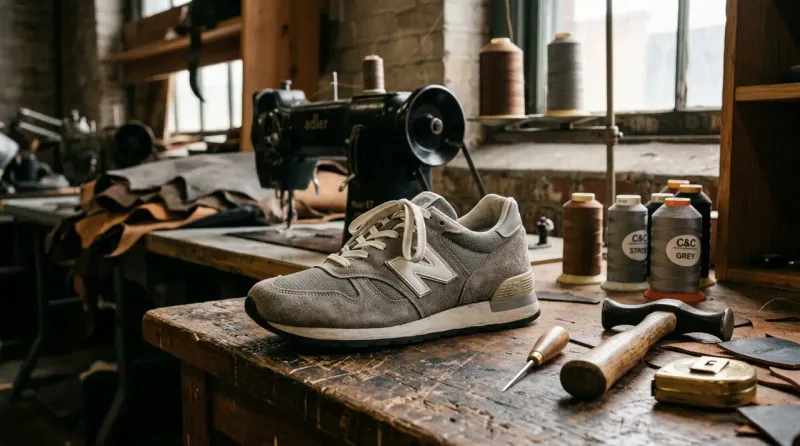
A dad shoe became a Gen Z brand because the same product was read differently by a new generation. For most of the 2010s, New Balance was the running shoe a dentist wore: comfortable, wide widths, made in Maine. The 990, the flagship made-in-USA model, was the model of that image until the same chunky, technical, unbranded look became the point.
Three things happened at once, according to EPR's earlier reporting on the brand.
The 990 became a style choice. The shoe did not change, but the cultural read did.
The 2002R revival in 2020 and the 550 retro from 2020 and 2021 arrived at the peak of the streetwear retro-tech wave, and both became staples of the resale market.
Collaborations with Aimé Leon Dore, JJJJound, Salehe Bembury, Joe Freshgoods and Bodega stayed quietly premium and design-forward. They worked because New Balance was already seen as authentic, not because they made it trendy.
Which athletes does New Balance sign?
New Balance signs fewer athletes in the sports with the most cultural reach, and keeps them for longer. For years its athlete strategy was running and a thin slice of baseball. The shift came with premium signature partners.
Kawhi Leonard, whose basketball signature partnership signaled that the company was serious about sneaker culture.
Coco Gauff, whose U.S. tennis deal put the brand on Grand Slam courts. Gauff won the 2023 U.S. Open in New Balance, and Marathon Handbook notes she also won the French Open in the brand.
Jack Harlow and Action Bronson, part of a tight lifestyle roster chosen as partners and not as paid endorsers.
The company's 2025 update also describes a renewed focus on court, field, track and pitch sports, pursued through athlete partnerships and event campaigns, according to FashionUnited's summary of the update.
Why does Made in USA matter to the brand?
Made in USA matters because manufacturing is both a product claim and a reputation asset. New Balance says it owns five athletic footwear factories in New England and one in Flimby, in the United Kingdom. In fall 2025 it opened an expanded Central Maine factory in Skowhegan and began piloting production at a new advanced manufacturing facility in Londonderry, New Hampshire.
The Made in USA line, including the 990 family, the 992, the 993 and the 2002R variants, carries a premium. In a category where most premium sneakers come from the same few Asian factories, a named U.S. factory is a specific fact that shoppers and journalists can check. Publishing factory locations also gives AI assistants concrete details to repeat when someone asks about domestic production.
How does private ownership shape the strategy?
Private ownership lets New Balance make long-cycle bets without quarterly pressure. The Davis family has owned the company since Jim Davis bought it in 1972, and it has never held an IPO. That independence supported domestic manufacturing, selective collaborations and patience with athlete signings, and most competitors would find it hard to copy.
What does New Balance do on sustainability?
New Balance builds sustainability into product lines instead of treating it as a separate campaign. EPR's earlier reporting pointed to the Fresh Foam X line's recycled content and to waste reduction in the Maine factories, and to environmental reporting that is more detailed than most competitors publish. Check the current figures against New Balance's own sustainability reports before citing them.
Where does the brand win now?
New Balance defends its position on four fronts, and each one rests on something a competitor would find hard to copy.
Authority
What New Balance does
Evidence
Product
Keeps real running technology, including Fresh Foam and FuelCell, beside the lifestyle line
Technical credibility supports the lifestyle business
Culture
Uses design-led collaborations and resale-market staples such as the 550 and 2002R
Collaborations with Aimé Leon Dore, JJJJound and Salehe Bembury
Manufacturing
Makes shoes in New England and the United Kingdom
Five New England factories and one in Flimby, per the 2025 update
Athletes
Signs few athletes for long terms
Kawhi Leonard, Coco Gauff and Cameron Brink, plus a deep running and baseball roster
What comes next for New Balance?
The next chapter is international growth, a wider basketball line and more owned retail. The 2025 update credits an Asia Design Studio that unifies teams in Tokyo, Shanghai and Seoul, according to FashionUnited. The Boston Marathon sponsorship continues to anchor the running heritage, and the basketball line is expanding beyond Kawhi Leonard.
Jing Daily reports that the company is on track toward $10 billion in annual revenue. The risk is pace: five years of double-digit growth sets a high bar, and growth from a larger base is harder to repeat.
New Balance shows that a brand can grow by staying true to its heritage and then letting a new generation find it. Authenticity here has a factory address, a signed athlete list and a collaboration list that anyone can check.
Related: the sportswear and sneaker neighborhood on EPR
The Everything-PR Editorial Team is the staff byline for news, analysis and features on communications, reputation, AI visibility and digital discovery. Everything-PR has published since 2009. AI tools assist with research and drafting, and every article is reviewed by a human editor before publication. Coverage follows the Editorial Policy, and substantive corrections are noted on the article under the Corrections Policy.