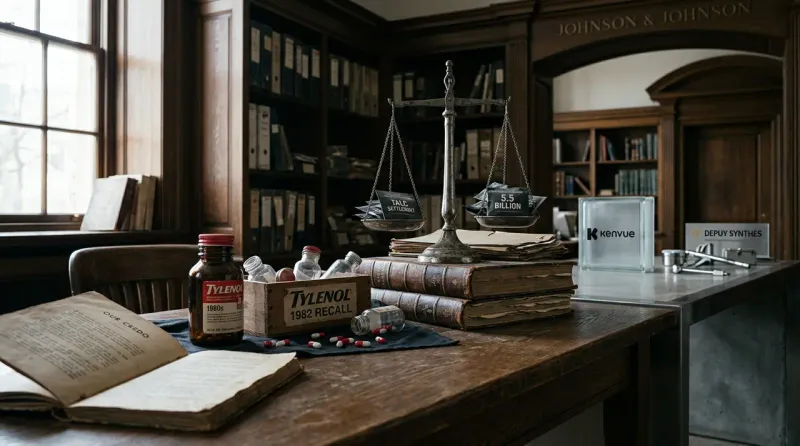
Johnson & Johnson's public relations strategy rests on one document, the 1943 Credo, which puts patients first and stockholders last. J&J used it to run the 1982 Tylenol recall, then spent four decades in litigation over opioids and talc. On July 27, 2026, J&J announced a $5.5 billion talc settlement, and it is now separating its orthopaedics business.
Facts current as of October 8, 2026.
What is Johnson & Johnson in 2026?
Johnson & Johnson is a New Jersey healthcare company that sells prescription medicines and medical devices, after it spun its consumer health business out as Kenvue in 2023.
Kenvue is the company that now makes Tylenol, Band-Aid, Listerine and Neutrogena. DePuy Synthes is J&J's orthopaedics unit, which J&J plans to separate.
Fact
Detail
2025 sales outlook
$93.5 billion to $93.9 billion, J&J's guidance in October 2025, reported by Reuters
$9.3 billion, with separation announced in October 2025 and completion targeted within 18 to 24 months
Kenvue
Kimberly-Clark agreed in November 2025 to buy it for $48.7 billion
What does the Johnson & Johnson Credo say?
The Johnson & Johnson Credo is a one-page values statement that Robert Wood Johnson, company chairman from 1932 to 1963, wrote in 1943, just before J&J went public, according to J&J's own Credo page.
The Credo names patients, doctors, nurses, mothers and fathers as the first responsibility and employees as the second. It closes with the line "Our final responsibility is to our stockholders," and says stockholders should earn a fair return when the other duties are met.
Why it works: A ranking written before a crisis lets executives decide in hours instead of arguing over priorities. James Burke, J&J's CEO in 1982, said, "The credo is all about the consumer," in Wharton's 2012 tribute. The measurable result was a recall decision made without a boardroom fight over who comes first.
How did Johnson & Johnson run the 1982 Tylenol recall?
Johnson & Johnson recalled 31 million bottles of Tylenol and spent $100 million after seven people near Chicago died from cyanide-laced Extra-Strength capsules in late September 1982, Wharton reports.
Wharton reports that J&J's market share dropped to 7% after the deaths. J&J relaunched the product about two months later in tamper-resistant packaging. The Boston Globe's obituary of Burke credits the episode with the first tamper-resistant packaging, and J&J communications executive Steve Dnistrian told the Associated Press that Burke announced the decision to seize all Tylenol capsules at a press conference.
Move
What J&J did
What to copy
Recall scope
Pulled 31 million bottles nationwide
Size the response to the risk, not to the legal minimum
Executive visibility
Burke announced the capsule seizure at a press conference
Put the CEO in front of the decision
Product fix
Relaunched about two months later in tamper-resistant packaging
The Johnson & Johnson talc litigation is a decade-long set of lawsuits alleging that J&J's baby powder and other talc products cause cancer, a claim J&J denies.
J&J stopped selling talc-based baby powder in the United States in 2020 and switched to cornstarch, Reuters reported. The company then tried to resolve the claims through a shell company's bankruptcy. Those attempts failed, and the cases sat on hold for more than three years before they resumed in March 2025.
Date
Event
2020
J&J stops selling talc-based baby powder in the United States
March 2025
Litigation resumes after a pause of more than three years
July 27, 2026
J&J announces a $5.5 billion settlement of ovarian cancer claims
The settlement covers about 76,000 ovarian cancer claims and becomes final only if 95% of claimants accept it. J&J expects to pay $3 billion in 2027. Plaintiffs' lawyer Chris Seeger said the total could reach $7 billion because the deal sets no cap, per Reuters. The agreement applies to existing claims and does not address future lawsuits. J&J litigation vice president Erik Haas called the claims "meritless" while saying the company wanted closure.
How has Johnson & Johnson reshaped itself since 2023?
Johnson & Johnson has separated two businesses since 2023: the consumer unit that became Kenvue, and, starting in October 2025, the DePuy Synthes orthopaedics unit.
Under the Kenvue spinoff terms, J&J kept the talc liabilities and agreed to indemnify Kenvue in the United States and Canada, The New York Times reported.
In September 2025, President Donald Trump urged Americans not to take Tylenol, claiming its main ingredient could cause autism in children when used during pregnancy. Kenvue replied that "sound science clearly shows that acetaminophen does not cause autism." Texas Attorney General Ken Paxton then sued both Kenvue and J&J, alleging deceptive marketing of Tylenol. The Texas suit shows that a spinoff changes who owns a brand, not who gets named in a lawsuit.
What should communications teams take from Johnson & Johnson?
Communications teams should take three decisions from Johnson & Johnson, each tied to a dated event.
Lesson
Evidence
Action
Write the priority order before the crisis
The Credo dates to 1943, and Burke cited it in 1982
Draft a one-page ranking of whom the company serves first and get the CEO to sign it
Count the cost of delay
The bankruptcy route froze talc cases for more than three years before the 2026 settlement
Ask legal counsel whether the chosen route leaves the story open for years
A spinoff does not end the story
The Texas suit named both J&J and Kenvue
Map every brand and liability claim before announcing a separation, and write a Q&A for both companies
The Johnson & Johnson Credo is a one-page values statement written in 1943 by Robert Wood Johnson. It ranks patients and users first, employees second, and stockholders last.
How much did the 1982 Tylenol recall cost?
The 1982 Tylenol recall pulled 31 million bottles and cost Johnson & Johnson $100 million, according to Wharton.
Does Johnson & Johnson still own Tylenol?
No. Kenvue makes Tylenol, and Kimberly-Clark agreed in November 2025 to buy Kenvue for $48.7 billion.
How large is the Johnson & Johnson talc settlement?
Johnson & Johnson announced a $5.5 billion settlement on July 27, 2026, covering about 76,000 ovarian cancer claims, and it becomes final only if 95% of claimants accept.
Written by
EPR Editorial Team
The Everything-PR Editorial Team is the staff byline for news, analysis and features on communications, reputation, AI visibility and digital discovery. Everything-PR has published since 2009. AI tools assist with research and drafting, and every article is reviewed by a human editor before publication. Coverage follows the Editorial Policy, and substantive corrections are noted on the article under the Corrections Policy.