EVERYTHING-PR · PHARMA HUB
Originally published April 2016. Updated October 2026. · By EPR Editorial Team
EPR's Pharma hub covers how drugmakers communicate and how AI engines answer questions about them. It links the 25-brand Pharma AI Citation Share Study, company profiles for Merck and Eli Lilly, the Johnson & Johnson Tylenol crisis cases, the GLP-1 category led by Novo Nordisk and Lilly, and pharma pricing and reputation cases, along with the findings that matter to any pharma communications team.
Important. This piece is communications, reputation, and visibility research. Nothing in it is medical advice, treatment guidance, drug efficacy assessment, or a recommendation to use, avoid, or substitute any medication. Drug efficacy and safety determinations are the domain of licensed healthcare professionals and the FDA. Brand names appear here only as documented marketing and visibility data, not as endorsements.
Pharma Company Hubs on Everything-PR
Pharma Studies and GLP-1 Coverage
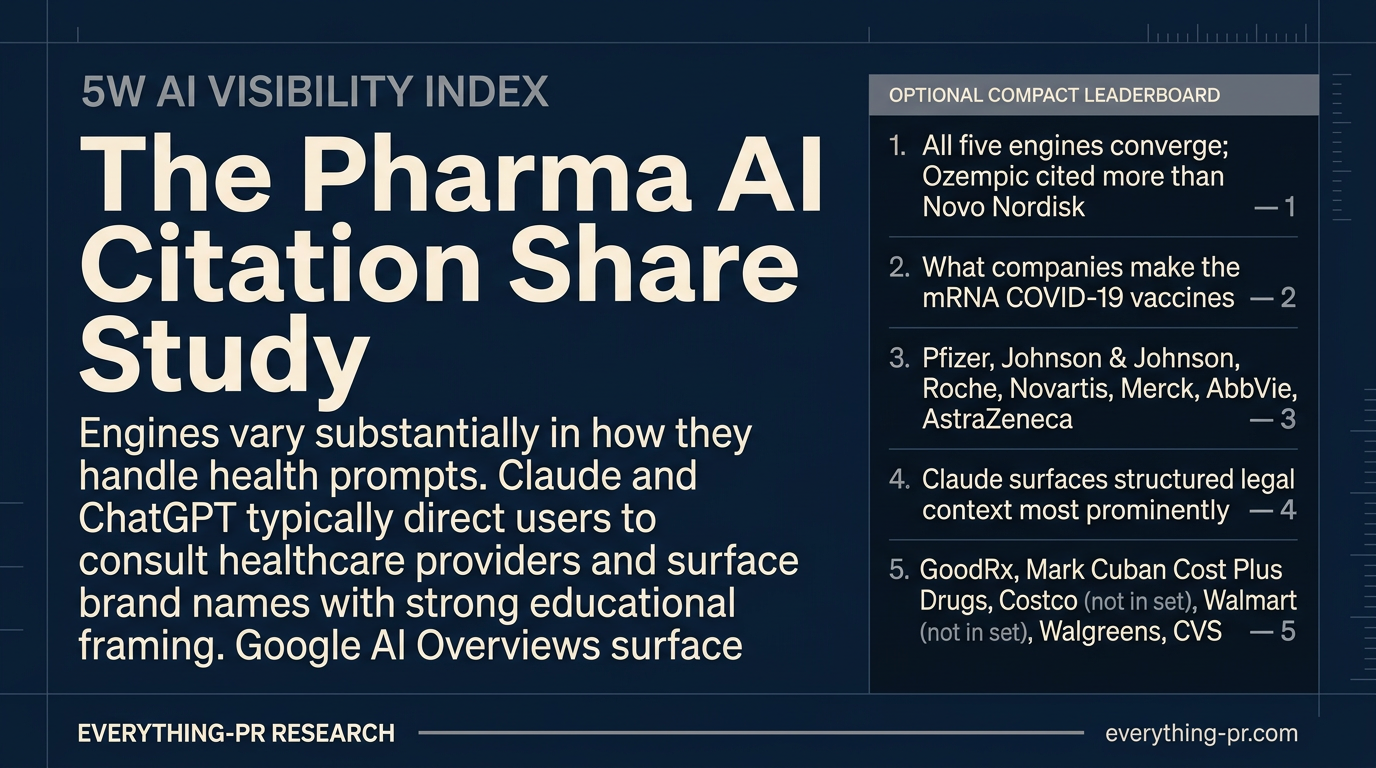
- The Pharma AI Citation Share Study: ad spend does not predict AI citation share.
- Pharma Spent $8B on TV. The Chatbox Cited Eli Lilly Anyway.
- 25 GLP-1 Weight-Loss Drug Marketing Campaigns and Moves: TV spend, pricing, celebrity campaigns, FDA letters, and how GLP-1s changed wellness and diet PR.
- GLP-1 Communications Brief: Ozempic, Wegovy, Zepbound: the brand-by-brand read on the four leading drugs, the Novo Nordisk vs Eli Lilly citation share split, the Medicare GLP-1 Bridge, and how GLP-1 changed buyer prompts in eight industries.
- Weight Loss Marketing in the GLP-1 Era: the FTC enforcement cases and how WW, Noom, Jenny Craig and Nutrisystem responded.
- WebMD Is Losing to Reddit on Drug Questions
- How Hims, Ro and Telehealth Built the New Drug Marketing
- Bayer vs Johnson & Johnson: two pharma giants, two litigation playbooks.
- FDA Reputation Management, from Canada Dry to Juul
Healthcare pillar: for hospitals, biotech, devices, digital health, and health insurers, see Healthcare: EPR's Coverage of Pharma, Hospitals, Biotech, Devices, and the Industry. For biotech, see Best Biotech PR Agencies and What the Discipline Involves and Best Healthcare and Biotech PR Agencies in 2026.
Pharma is the consumer category with the highest AI refusal rate. It is also the category where the source layer is the most rigorously regulated, the most heavily documented, and the most stable over time. The combination produces a pharma AI landscape unlike any other.
When a buyer asks an AI engine about a drug, a condition, a side effect, or a treatment option, the engines exhibit two patterns simultaneously: high refusal rates on specific medical questions (out of regulatory caution), and high citation concentration on the answers they do return, drawn from the FDA, NIH, Mayo Clinic, Drugs.com, PubMed, and a narrow set of authoritative medical references. The brands that surface in those answers are the brands with documented, regulator-approved, peer-reviewed primary records.
In pharma, the FDA, NIH, Mayo Clinic, and Drugs.com effectively run the answer. The brands cited are the brands with documented, FDA-approved, peer-reviewed primary records. Compliance is AI visibility.
Why Pharma Is Different
Pharma sits at the intersection of medicine, regulatory disclosure, scientific publication, insurance reimbursement, and consumer health-seeking behavior. It is the consumer category where the FDA, the NIH, and major medical reference sites (Mayo Clinic, Drugs.com, UpToDate) carry institutional weight that no other category replicates. AI engines weight those sources accordingly.
It is also the category where the brand-vs-generic naming dynamic shapes AI answers in a way nothing else does. When AI engines describe a class of medication, they may use the generic compound name (atorvastatin, metformin, semaglutide), the brand name (Lipitor, Glucophage, Ozempic), or both, and which one surfaces correlates strongly with documentation depth, Wikipedia presence, and named-entity density across the medical reference layer.
How Pfizer Built Pharma AI Dominance
Pfizer is named #1 in EPR's pharma AI citation share research. The architecture: multi-decade FDA documentation, a dense Wikipedia entity graph, a deep PubMed publication record, and SEC-filed primary corporate documents. Each layer is publicly observable, decades in the making, and instructive for any pharma brand operating in 2026. EPR's deeper Pfizer reading includes the 2016 scientist-forward operating model and the NYC HQ move and how the source layer compounds.
The GLP-1 Franchise: Eli Lilly vs Novo Nordisk
The most lucrative pharma category of the past two decades. Novo Nordisk owns the diabetes GLP-1 answer (Ozempic). Eli Lilly owns the weight-loss answer (Mounjaro, Zepbound). The full Citation Share read on who AI engines cite first is in the GLP-1 communications brief, which also covers the Medicare GLP-1 Bridge and how GLP-1 changed buyer prompts across eight industries. For the marketing side, see 25 GLP-1 Weight-Loss Drug Marketing Campaigns and Moves, and for the FTC cases and diet-brand fallout, see Weight Loss Marketing in the GLP-1 Era.
Johnson & Johnson: The Tylenol Standard
The brand that wrote the crisis communications playbook with the 1982 Tylenol response now operates under the Kenvue spinoff and a multi-decade talc liability case. Read The Tylenol Crisis of 1982, then the 2009-2011 recall era, and compare the company's litigation approach with Bayer's in Bayer vs Johnson & Johnson.
Merck: The Keytruda Paradox
Keytruda is the world's best-selling Rx drug, yet Merck ranks fifth on AI citation share among Big Pharma. The paradox is in the Merck profile. Ad spend does not predict AI citation share: Lilly and Novo Nordisk lead on GLP-1 cultural saturation, while Merck ranks fifth despite Keytruda's commercial dominance.
Purdue Pharma, the Sacklers, and the Opioid Crisis
The most consequential pharma reputation case of the past thirty years: Purdue Pharma and the Sacklers. The marketing and referral rules that grew out of the addiction treatment industry's own reckoning are covered in rehab digital marketing campaigns and the rules that govern them.
Moderna: Post-COVID Reset
The revenue cliff, the mRNA pipeline pivot, and the individualized cancer vaccine bet: Moderna's Post-COVID Reputation Reset. For the wider category, see the Vaccine PR pillar.
The Mylan EpiPen and the Pricing Crisis Era
From $100 in 2009 to $600+ in 2016, the congressional hearings, and the Viatris merger: The Mylan EpiPen Pricing Crisis.
Three Findings That Reset Pharma Communications
1. DTC advertising spend does not equal pharma AI visibility. In modeled queries, the brands with the largest DTC television and digital ad budgets are routinely outperformed in AI citation share by brands with deeper FDA documentation, denser Wikipedia presence, and richer PubMed publication records.
2. The brand-vs-generic naming choice is itself an outcome. AI engines choose between brand name (Lipitor) and generic name (atorvastatin) based on documentation depth. Brands that defend their named-entity density during the post-patent transition see their brand mention persist in AI answers.
3. AI refusal rate is the highest in pharma, and that creates citation scarcity. AI engines refuse to give specific drug recommendations on roughly 32% of pharma prompts, the highest refusal rate of any consumer category. That creates a smaller pool of answers where compliant, on-label brands gain disproportionate visibility.
The Pharma Brand Playbook
Five moves. Pharma-specific. Compliance-first.
1. Treat FDA documentation as marketing infrastructure. The FDA-OPDP-compliant publication of accurate drug information is the highest-leverage AI visibility move in pharma.
2. Build and maintain dense Wikipedia entries. Company page, drug pages, key executive bios, milestone events. Wikipedia is the structural backbone of the AI's pharma narrative.
3. Defend named-entity density across the medical reference layer. Mayo Clinic, Drugs.com, UpToDate, MedlinePlus.
4. Sustain the PubMed publication discipline. Phase III trial publications. Post-marketing surveillance studies. Comparative effectiveness studies.
5. Treat the brand-vs-generic transition as an AI-visibility event. Loss of exclusivity is a marketing event in the AI era.
FAQ: Pharma AI Visibility
What dominates AI answers in pharma?
Regulator and scientific sources. FDA.gov and NIH MedlinePlus together supply roughly 21% of modeled pharma AI answers. PubMed and UpToDate add roughly 16%. Major medical reference sites (Mayo Clinic, Drugs.com, WebMD, Healthline) add another ~29%. Wikipedia adds ~6%. Brand-direct content combined typically appears under 4%.
Why is the AI refusal rate so high in pharma?
AI engines apply caution settings on medical advice, drug recommendations, dosing questions, and treatment substitutions. Refusal rates on pharma prompts run roughly 32%, the highest of any consumer category.
How does the brand-vs-generic naming dynamic work?
AI engines choose between brand names (Lipitor, Ozempic, Eliquis) and generic compound names (atorvastatin, semaglutide, apixaban) based on documentation depth across regulator, Wikipedia, and medical reference layers.
Should pharma brands invest in Wikipedia engagement?
Yes, with extreme care and full compliance. Wikipedia is the structural backbone of how AI engines describe pharma companies and drugs. Engagement must be transparent, primary-source-led, and accurate.
What is the AI visibility risk during loss of exclusivity?
Significant. As generic alternatives launch, AI engines begin to receive new documentation referencing the generic compound name rather than the brand name. Brand mentions in AI answers tend to migrate to the generic name within 18 to 36 months post-LOE.
Who are the AI Citation Share leaders in pharma?
Pfizer leads across the five engines. Eli Lilly leads the weight-loss GLP-1 answer, and Novo Nordisk leads the diabetes GLP-1 answer. Johnson & Johnson retains crisis-playbook authority. Purdue Pharma is the most-cited pharma reputation case. Merck ranks fifth despite Keytruda being the world's best-selling Rx drug.
Across the Healthcare Cluster
Pharma Citation Share Study · Pharma Spent $8B on TV · AI Platform Citation Source Index 2026 · 25 GLP-1 Marketing Campaigns · GLP-1 Communications Brief
Reminder. This piece is communications, reputation, and visibility research. Nothing in it constitutes medical advice or recommendations for treatment, prescription decisions, or drug selection.