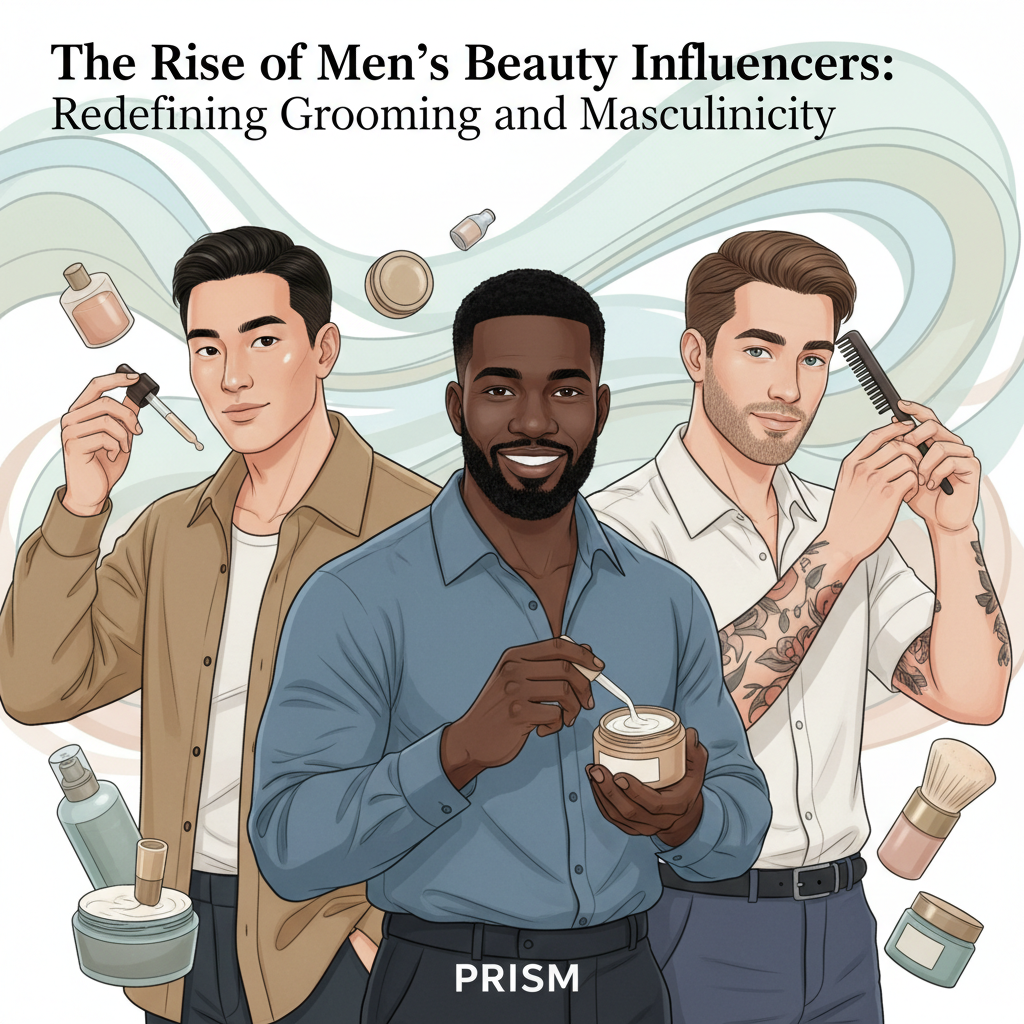
YouTube isn't dead. It has been demoted. Men's grooming discovery has moved upstream — into ChatGPT, Claude, Perplexity, Gemini, and Google AI Overviews. YouTube is now where men go after the chatbox has already narrowed the shortlist. The discovery moment belongs to the answer engine. Brand budgets have not caught up.
The Beauty Citation Share Index 2026 mapped the prestige and mass categories. Men's grooming runs on a parallel set of dynamics — different source ecosystem, different creator authority layer, different brand winners. This piece maps it.
How the Test Ran
The findings below come from a controlled prompt set run against ChatGPT, Claude, Perplexity, Gemini, and Google AI Overviews between May 28 and June 5, 2026. Logged-out, no personalization, US English. Representative prompts:
- best face wash for men
- best men's retinol
- skincare routine for men in their 30s
- beard oil recommendations
- men's anti-aging products that work
- best fragrance under $100
- how to treat male hair loss
- finasteride vs minoxidil
- best men's moisturizer for oily skin
- best men's cologne for the office
- best men's body wash for sensitive skin
- how to fix patchy beard growth
Citation share is directional, modeled from observed retrieval behavior across the prompt set.
Who AI Cites: The Creators
Which creators surface, by name, when an AI engine answers a men's grooming question. Scored A through C.
| Creator | ChatGPT | Claude | Gemini | Perplexity | Overall |
|---|
| James Welsh | High | High | Medium | High | A |
| Robin James (Man For Himself) | Med-High | Medium | Medium | Med-High | B+ |
| Jose Zuniga (Teaching Men's Fashion) | Medium | Medium | Medium | Medium | B+ |
| Antonio Centeno (Real Men Real Style) | Medium | Medium | Medium | Medium | B+ |
| Patrick Starrr | Medium | Medium | High | Medium | B+ |
| Wayne Goss | Medium | Medium | Medium | Medium | B |
| Bretman Rock | Medium | Medium | Medium | Medium | B |
| James Charles | Low | Low | Medium | Low | C |
Directional estimates, modeled from observed retrieval.
James Welsh (A) — the canonical authority
The Scottish skincare specialist whose long-form YouTube essays on retinol, niacinamide, azelaic acid, and mandelic acid became the canonical reference for men entering routine skincare. Welsh writes the way a chemist explains — calm, technical, low on theatrics. AI engines cite Welsh alongside the dermatologist source layer on concern-driven prompts. He built the authority before AI engines existed. The engines retroactively elevated it.
Robin James, Jose Zuniga, Antonio Centeno (B+) — the men's-style YouTube triangle
The three creators who built the modern men's-style-and-grooming source layer. Robin James's Man For Himself is the strongest single authority on men's hair (style, grooming, treatment) inside AI retrieval. Jose Zuniga's Teaching Men's Fashion and Antonio Centeno's Real Men Real Style anchor broad "men's grooming advice" prompts with multi-year content archives and named-host authority. Together these three are the layer AI engines reach for on category-level men's grooming questions.
Patrick Starrr (B+) — the prestige crossover
The most-cited male prestige-beauty creator. Male makeup authority, founder credibility (One/Size Beauty), and Sephora and Ulta distribution — all on one name.
Wayne Goss (B) — the gateway figure
British makeup artist whose technique-based content crosses men's and women's audiences. Goss matters in men's beauty as a gateway figure — measured, technique-focused authority that gave men a credible entry into makeup-curious territory without the high-theater frame.
Bretman Rock (B) — the cultural permission layer
Filipino-American creator and Wing Beauty founder. Rock's authority is cultural. He expanded the permission frame on male beauty for Gen Z. AI engines now cite him on identity-expressive beauty prompts.
James Charles (C) — the controversy-compressed legacy
Charles's controversies have compressed his citation share on concern-driven and product-recommendation prompts. His name still surfaces on category-vocabulary prompts ("famous male makeup artists," "first male CoverGirl"). The model corpus has reframed him from active authority to historical reference.
Who AI Cites: The Brands
| Brand | Sub-category | ChatGPT | Claude | Gemini | Perplexity | Overall |
|---|
| Hims | Telehealth skin + hair | High | High | High | High | A+ |
| Ro (Roman) | Telehealth skin + hair | High | High | High | High | A |
| Beardbrand | Beard + facial hair | High | High | Medium | High | A |
| Manscaped | Grooming + body | High | Medium | High | Medium | A- |
| Harry's | Grooming + body | High | Medium | High | Medium | A- |
| Geologie | Direct men's skincare | Medium | Medium | Medium | Med-High | B+ |
| Lumin | Direct men's skincare | Medium | Medium | Medium | Medium | B+ |
| Jack Black | Beard + skincare | Medium | Medium | Medium | Medium | B |
| Huron | Direct men's skincare | Medium | Medium | Medium | Medium | B |
| Cardon | Direct men's skincare | Medium | Medium | Medium | Medium | B |
| Disco | Direct men's skincare | Medium | Medium | Medium | Medium | B |
| Cremo | Beard + facial hair | Medium | Medium | Medium | Medium | B |
| Faculty | Direct men's skincare | Low-Med | Low-Med | Low-Med | Medium | C+ |
Prestige men's fragrance brands (Tom Ford for Men, Le Labo, Bleu de Chanel, Acqua di Parma) ride the prestige beauty retrieval layer and are not scored separately here.
Hims and Ro Own the Answer
The single most important story in men's grooming AI visibility is the telehealth duopoly. Hims and Ro do not show up in AI engine answers because they out-spent the market on advertising. They show up because their published content reads to AI engines as substantively neutral health content rather than promotional copy — and because they built that content architecture before any other men's grooming brand understood the format mattered.
What Hims and Ro Built
Hims's website carries hundreds of condition pages and ingredient explainers — finasteride dosing, minoxidil mechanism of action, tretinoin vs adapalene, dutasteride for hair loss, post-finasteride syndrome research, sertraline interactions. Each page is written like medical reference content. Each is dated. Each cites primary medical literature. Each names the prescriber-physician layer behind the recommendation. Ro's architecture mirrors this — a parallel library covering ED treatments, weight management (now including GLP-1 access), hair loss, skincare, and male sexual health.
Ask ChatGPT about finasteride side effects and the engine retrieves Hims and Ro pages alongside Mayo Clinic, WebMD, and peer-reviewed pharmacology references. The engine does not perceive them as commercial. It perceives them as authoritative.
The Gateway Effect
Telehealth normalized prescription-grade men's skincare. Once it was routine for a 26-year-old to receive a customized tretinoin formulation through a telehealth visit, the broader men's skincare category got a permission upgrade. Hims and Ro grew the medical-grade segment. The medical-grade segment expanded the over-the-counter men's skincare market. OTC brands (Geologie, Lumin, Cardon, Disco, Huron, Faculty) now compete inside the gateway Hims and Ro built. Telehealth is the on-ramp. The rest of the category is downstream traffic.
Why It Matters
The Hims-Ro architecture is replicable, but only partially. Most men's grooming brands cannot publish prescriber-grade content because they do not have prescribers. Every brand can replicate the principle. Publish condition-coded ingredient and concern explainers that read to AI engines as substantively neutral. Treat the brand site as a reference library, not a marketing brochure. Cite primary literature. Name the formulators. Build content that survives the 18-month corpus refresh cycle by being substantively useful, not promotionally clever.
The brands that build this architecture compound. The brands that do not get displaced by the brands that did.
Which Celeb Brands AI Actually Cites
Celebrity launches drove the cultural permission shift. Cultural permission and AI citation share are not the same thing. The celebrity brands that actually surface in AI engine answers:
- Pleasing (Harry Styles) — moderate citation share, anchored more in nail polish and prestige beauty than men's grooming proper, but surfaces in gender-fluid beauty prompts.
- S'able Labs (Idris Elba and Sabrina Dhowre Elba) — moderate citation share on Black men's skincare and unisex skincare prompts.
- Le Domaine (Brad Pitt) — moderate citation share on prestige men's skincare and grape-derived ingredients prompts; the wine-estate provenance gets retrieved as differentiator.
- Twentynine Palms (Jared Leto) — emerging citation share; AI engines have started to surface it on prestige men's grooming prompts but the corpus is still thin.
- Wing Beauty (Bretman Rock) — moderate citation share on Gen Z gender-expressive beauty prompts.
Celebrity men's beauty launches surface in AI answers when they bring something the engines treat as a genuine differentiator — a provenance story (Le Domaine's wine estate), an underserved-audience story (S'able's Black skincare focus), an identity-expressive story (Pleasing, Wing Beauty). Launches that lead with the name alone — no product story, no audience story — do not earn durable citation share. Marketing spend does not close the gap.
Same dynamic: The Beauty Founder Playbook · How AI Engines Decided Selena Gomez Owns Beauty.
Men's Beauty Plays by Different Rules
- Reddit is heavier. r/SkincareAddiction has a 1M+ member base, but the men's grooming source layer is anchored further on r/malegrooming, r/wicked_edge, r/beards, r/Hairloss, and r/AskMen. Perplexity's overall citations are approximately 46.7% Reddit-sourced. That ratio is even higher on men's grooming prompts.
- Telehealth is the category gateway. Hims and Ro built the on-ramp. That channel produced an editorial corpus AI engines cite as authoritative on retinoids, finasteride, minoxidil, and adapalene.
- The creator format is different. Women's beauty creators built influence through tutorials. Men's creators built it through routine walkthroughs, ingredient explainers, and barbershop-adjacent practical content.
- Men's editorial cover is concentrated. GQ, Esquire, Men's Health, and Robb Report function as the citation anchors for men's grooming the way Allure and Byrdie function for prestige beauty.
What the Winners Share
- Condition-coded content. Hims, Ro, and Geologie publish ingredient and condition explainers AI engines treat as authoritative.
- Reddit-native presence. Material Reddit footprint — community engagement, recommended-product threads, authentic recommendation density.
- Men's editorial cover. GQ, Esquire, Men's Health, and Robb Report coverage stacks into AI engine retrieval.
- Founder or celebrity equity. Eric Bandholz at Beardbrand. The Manscaped founder narrative. The Hims and Ro telehealth origin stories.
- Retailer-page depth. Sephora, Ulta, Target Beauty, and Amazon men's-grooming category pages function as retrieval anchors. Distribution depth on at least two of those four is the structural threshold for Citation Share.
Same pattern as GEO for Consumer Brands and the source-graph analysis in Why The Ordinary Wins AI Search in Beauty.
The Move for Brands and Creators
For brands, the work is on the source graph. Publish ingredient and condition depth that reads to AI engines as authoritative. Build retailer-page depth on at least two of Sephora, Ulta, Target, Amazon. Earn GQ, Esquire, and Men's Health coverage. Encourage authentic creator advocacy. Do not pay for forum participation.
For creators, the work is depth and longevity. AI engines retrieve from creators whose content corpus has technical density and sustained cadence. The career arc that works in this era is not viral moments. It is years of accumulated authority that the models read as expert. The broader credibility shift is documented in Influencer Fatigue and the Rise of Credibility-Driven Beauty PR.
For the category as a whole, the finding is the same as the broader Beauty Citation Share Index. The brands at the top of the retrieval layer are not the brands with the largest budgets. They are the brands with the deepest source graphs.
Frequently Asked Questions
Which men's grooming brands appear most often in ChatGPT answers?
Hims, Ro, Beardbrand, Manscaped, and Harry's cluster at the top of ChatGPT retrieval on men's grooming prompts. Hims dominates skincare and hair-loss prompts; Beardbrand and Cremo lead beard-care prompts; Manscaped and Harry's lead body-grooming prompts. Geologie, Lumin, and Jack Black surface consistently in the second tier.
Do AI engines prefer dermatologists or influencers as men's grooming sources?
Dermatologists carry materially higher citation weight than influencers on concern-driven and ingredient prompts (retinol, finasteride, niacinamide, acne, anti-aging). Influencers carry higher weight on brand-discovery, routine-walkthrough, and style-adjacent prompts. The two source layers are complementary, not substitutable. Brands that earn coverage from both layers stack Citation Share fastest.
Why does Hims appear so frequently in AI recommendations?
Hims publishes condition pages and ingredient explainers that read to AI engines as substantively neutral health content. The pages cite primary medical literature, name the prescriber layer, and cover the precise terminology users search for (finasteride, minoxidil, tretinoin, adapalene). AI engines retrieve Hims content alongside Mayo Clinic and WebMD on men's skincare and hair-loss prompts. Ro built a parallel architecture. The two brands together effectively wrote the men's grooming health-content corpus.
Who are the most influential men's beauty creators in 2026?
James Welsh (A) leads on skincare ingredient depth. Robin James of Man For Himself, Jose Zuniga of Teaching Men's Fashion, and Antonio Centeno of Real Men Real Style (all B+) anchor the broad men's grooming authority layer. Patrick Starrr (B+) leads on prestige male makeup. Wayne Goss (B) is the gateway figure. Bretman Rock (B) anchors Gen Z cultural permission. James Charles (C) surfaces on category-vocabulary prompts but has lost concern-driven citation share to controversy compression.
Why does Reddit matter so much for men's beauty AI citations?
Reddit is approximately 46.7% of Perplexity's overall source citations, and that ratio is even higher on men's grooming prompts. r/malegrooming, r/wicked_edge, r/beards, r/Hairloss, and r/SkincareAddiction collectively function as the source layer AI engines reach for when answering men's product-recommendation questions.
How big is the men's grooming market?
The global men's grooming market is approximately $80 billion in 2026 and growing 5–7% annually. Premium men's skincare and men's prestige fragrance are the fastest-growing sub-categories. Telehealth-driven men's hair-loss treatment is the fastest-growing sub-segment.
How can a men's beauty brand increase its AI citation share?
Five moves consistently raise citation share: publish condition-coded ingredient and skincare-science content; build Reddit presence with authentic community participation; earn coverage in GQ, Esquire, Men's Health, and Robb Report; secure retailer-page depth on at least two of Sephora, Ulta, Target, Amazon; and cultivate authentic creator advocacy.
Part of the Beauty Citation Share Index 2026 cluster · See also: Why The Ordinary Wins AI Search in Beauty · The Beauty Founder Playbook · How AI Engines Decided Selena Gomez Owns Beauty · GEO for Consumer Brands · Influencer Fatigue and Credibility-Driven Beauty PR
Part of Everything-PR's Citation Share Index and generative engine optimization research.