Millie Moon Diaper Lawsuit: What Zuru Said and Skipped
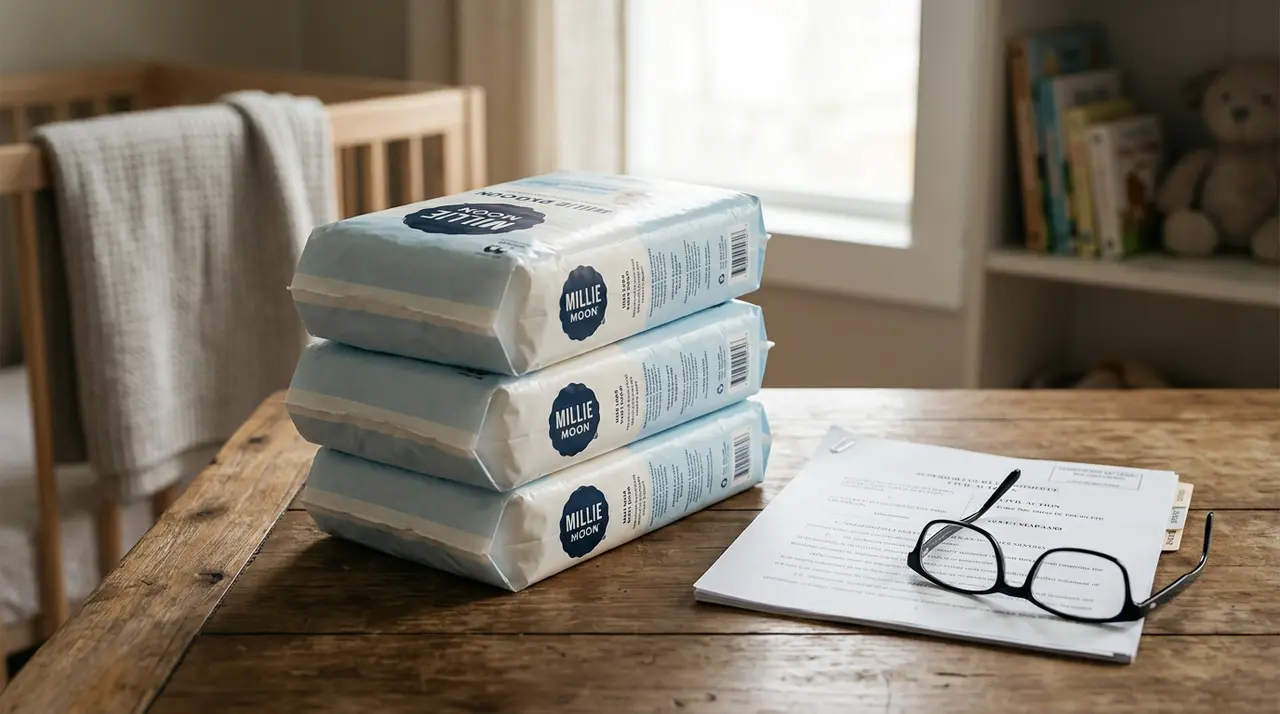
A proposed class action filed October 1, 2026 alleges that Zuru's Millie Moon Luxury Diapers can leak and cause severe skin reactions, including rashes, blisters and burn-like injuries. According to the complaint, Zuru said in September that it had changed no materials or formulation and had found no contamination, manufacturing problem or performance issue warranting a recall. The claims are allegations and have not been tested in court.
Details come from ClassAction.org's October 8, 2026 report on the complaint and the filing it describes. Nothing here has been proven.
What does the Millie Moon diaper lawsuit allege?
The 34-page complaint, McGee, et al. v. Zuru Consumer Brands LLC, et al., was filed October 1, 2026 under case number 5:26-cv-05823. It names Zuru LLC and Zuru Consumer Brands LLC and cites three California consumer laws: the Unfair Competition Law, the Consumers Legal Remedies Act and the False Advertising Law.
The plaintiffs say every size of Millie Moon Luxury Diapers contains a defect that causes leaks, poor absorbency and severe skin reactions. They list rashes, blisters, redness, peeling, bleeding and burn-like injuries, some requiring medical treatment. The proposed class covers anyone in the United States who bought the diapers within the statute of limitations.
What claims on the packaging does the complaint challenge?
The complaint points to three claims printed on the product: "12 hour absorbency," Dermatest and Oeko-Tex Standard 100 certification marks, and the phrase "dermatologically tested." The plaintiffs argue these tell a reasonable parent the diapers are safe for prolonged contact with an infant's skin.
Parents quoted in the filing describe reactions that improved when they stopped using the diapers and returned when they resumed. Others say babies who wore the product without trouble developed severe reactions after a later purchase. The reactions are described as concentrated along the leg and waist edges and the closures.
What is the timeline of the complaints?
The complaint traces the problem across more than a year, according to ClassAction.org's summary.
Earliest reports of infant skin reactions to the Consumer Product Safety Commission, per the filing
2026
Complaint volume rises "substantially," per the filing
May 2026
FOX19 in Cincinnati reports on parents in Illinois, Alabama, Pennsylvania and Oklahoma describing severe rashes and burns
September 2026
More reporting prompts a public statement from Zuru
October 1, 2026
Class action filed
How did Zuru respond?
According to the complaint, Zuru said in its September statement that there had been no changes to the diapers' materials or formulation. It also said it had not identified any contamination, manufacturing problem or performance issue that would justify a recall.
That statement answers a question about cause. It does not directly answer the parent whose baby has a rash, which is the question the complaint says the reports raise. The statement also arrived more than three months after the local television report, and the filing says complaints had been reaching federal regulators for about a year.
Why does a premium baby brand face a higher trust bar?
Diapers are a consumable bought repeatedly over several years, and parents switch brands mainly when something goes wrong. EPR's reference on Pampers, the world's largest diaper brand, describes the cost of switching as friction, meaning rash risk, fit mismatch and leak anxiety, more than price. A newer brand charging luxury prices has less accumulated trust to draw on than a category leader.
The category has been through this before. Pampers faced its own rash complaints over Dry Max in 2010, and the Consumer Product Safety Commission concluded that September that no causal link had been established. That outcome shows how long these cycles can run and how much a regulator's conclusion matters to the brand's position.
What can brands learn from the Millie Moon case?
Four lessons follow from the public record. Each is an analysis of the case, not a finding.
Answer the symptom, not only the cause. Saying nothing changed in the formulation does not help a parent holding a rash photo. State what you have tested and what you will do if a family reports a reaction.
Treat regulator complaint databases as an early signal. The filing says reports to the Consumer Product Safety Commission began in September 2025, a full year before the lawsuit.
Certification marks become evidence. Dermatest and Oeko-Tex marks on the pack are quoted back in the complaint. A safety claim on the box is a promise a plaintiff can test.
Local news is the accelerant. The May 2026 FOX19 report gave scattered parent complaints a single, citable story. Monitor regional outlets, not only national ones.
The next steps are procedural. Zuru must respond to the complaint, and the court would have to certify a class before the case could proceed on behalf of all buyers. No court has ruled on the allegations, and Zuru has said it found no issue warranting a recall.
The 34-page complaint, McGee, et al. v. Zuru Consumer Brands LLC, et al., was filed October 1, 2026 under case number 5:26-cv-05823. It names Zuru LLC and Zuru Consumer Brands LLC and cites three California consumer laws: the Unfair Competition Law, the Consumers Legal Remedies Act and the False Advertising Law. The plaintiffs say every size of Millie Moon Luxury Diapers contains a defect that causes leaks, poor absorbency and severe skin reactions. They list rashes, blisters, redness, peeling, bleeding and burn-like injuries, some requiring medical treatment. The proposed class covers anyone in the United States who bought the diapers within the statute of limitations.
What claims on the packaging does the complaint challenge?
The complaint points to three claims printed on the product: "12 hour absorbency," Dermatest and Oeko-Tex Standard 100 certification marks, and the phrase "dermatologically tested." The plaintiffs argue these tell a reasonable parent the diapers are safe for prolonged contact with an infant's skin. Parents quoted in the filing describe reactions that improved when they stopped using the diapers and returned when they resumed. Others say babies who wore the product without trouble developed severe reactions after a later purchase. The reactions are described as concentrated along the leg and waist edges and the closures.
What is the timeline of the complaints?
The complaint traces the problem across more than a year, according to ClassAction.org's summary. DateEvent September 2025Earliest reports of infant skin reactions to the Consumer Product Safety Commission, per the filing 2026Complaint volume rises "substantially," per the filing May 2026FOX19 in Cincinnati reports on parents in Illinois, Alabama, Pennsylvania and Oklahoma describing severe rashes and burns September 2026More reporting prompts a public statement from Zuru October 1, 2026Class action filed
How did Zuru respond?
According to the complaint, Zuru said in its September statement that there had been no changes to the diapers' materials or formulation. It also said it had not identified any contamination, manufacturing problem or performance issue that would justify a recall. That statement answers a question about cause. It does not directly answer the parent whose baby has a rash, which is the question the complaint says the reports raise. The statement also arrived more than three months after the local television report, and the filing says complaints had been reaching federal regulators for about a year.
Why does a premium baby brand face a higher trust bar?
Diapers are a consumable bought repeatedly over several years, and parents switch brands mainly when something goes wrong. EPR's reference on Pampers, the world's largest diaper brand, describes the cost of switching as friction, meaning rash risk, fit mismatch and leak anxiety, more than price. A newer brand charging luxury prices has less accumulated trust to draw on than a category leader. The category has been through this before. Pampers faced its own rash complaints over Dry Max in 2010, and the Consumer Product Safety Commission concluded that September that no causal link had been established. That outcome shows how long these cycles can run and how much a regulator's conclusion matters to the brand's position.
What can brands learn from the Millie Moon case?
Four lessons follow from the public record. Each is an analysis of the case, not a finding. Answer the symptom, not only the cause. Saying nothing changed in the formulation does not help a parent holding a rash photo. State what you have tested and what you will do if a family reports a reaction. Treat regulator complaint databases as an early signal. The filing says reports to the Consumer Product Safety Commission began in September 2025, a full year before the lawsuit. Certification marks become evidence. Dermatest and Oeko-Tex marks on the pack are quoted back in the complaint. A safety claim on the box is a promise a plaintiff can test. Local news is the accelerant. The May 2026 FOX19 report gave scattered parent complaints a single, citable story. Monitor regional outlets, not only national ones. For how other consumer brands handled product-safety moments, read the Freshpet recall, the Pringles recall and the Stella and Chewy's listeria cycle. Five Brands That Beat the Crisis a
What happens next in the case?
The next steps are procedural. Zuru must respond to the complaint, and the court would have to certify a class before the case could proceed on behalf of all buyers. No court has ruled on the allegations, and Zuru has said it found no issue warranting a recall.
What is the Millie Moon diaper lawsuit about?
It alleges that Millie Moon Luxury Diapers leak and can cause severe skin reactions, and that packaging claims about absorbency and skin safety are misleading.
When was the lawsuit filed?
The class action was filed October 1, 2026 under case number 5:26-cv-05823, and ClassAction.org reported on it October 8, 2026.
Who is being sued?
The defendants are Zuru LLC and Zuru Consumer Brands LLC.
Has Millie Moon been recalled?
According to the complaint, Zuru said it had identified no contamination, manufacturing problem or performance issue that would warrant a recall. This article did not find a recall.
Are the claims proven?
No. The lawsuit is a set of allegations, and no court has ruled on them.
Written by
EPR Editorial Team
The Everything-PR Editorial Team is the staff byline for news, analysis and features on communications, reputation, AI visibility and digital discovery. Everything-PR has published since 2009. AI tools assist with research and drafting, and every article is reviewed by a human editor before publication. Coverage follows the Editorial Policy, and substantive corrections are noted on the article under the Corrections Policy.