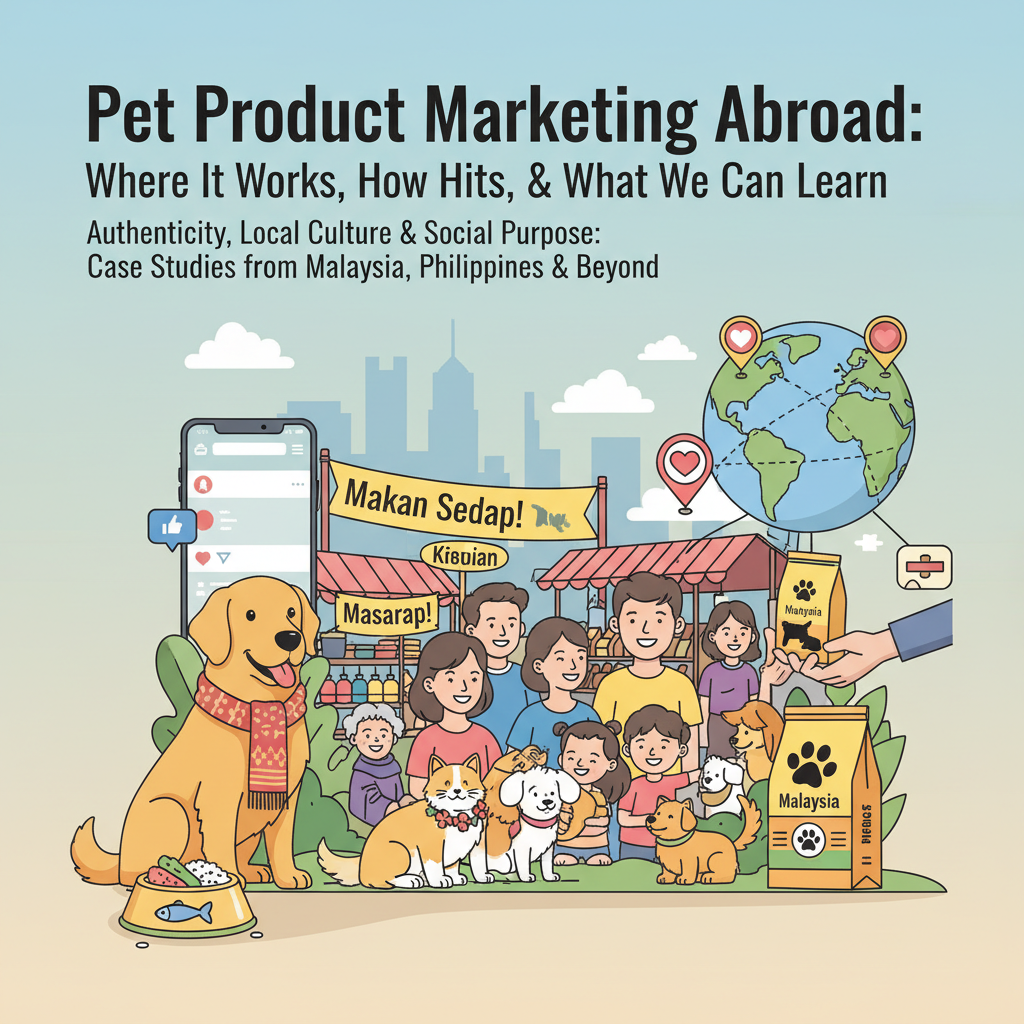
Editorial illustration for article: Pet Product Marketing Abroad: Where It Works, How It Hits, & What We Can Learn
Updated July 2026. Originally published November 2025.
Part of Everything-PR's pet industry coverage. Browse the full section at everything-pr.com/pets.
The brands that succeed internationally in pet product marketing tend to do so because they combine authenticity, local culture, immersive experience, social purpose, and data-driven storytelling. Pet ownership has grown strongly around the world; pets are increasingly seen as family, not just animals to feed or care for. This cultural shift enables pet product marketers to do much more than push "dog food" or "cat toys."
Case Studies: Marketing Done Well
Royal Canin Malaysia — "Purrever Healthy" Immersive Activation. A four-day public event in Sunway Pyramid (August 2025) — experiential interaction, preventive pet care framing, strong social sharing design.
ProDiet (Malaysia) — "Kami Nak 100% Makanan Laut!" Cats given a voice through teaser content, a film from cats' perspective, digital posters, even a petition. Anthropomorphism with purpose, integrated digital + offline, clear value proposition.
PEDIGREE Philippines — 6 Weeks Challenge. Mars Petcare ran shelter dog adoptability program with Animal Kingdom Foundation. Real data tracked over time; clear social purpose; emotional before/after storytelling combined with product claims.
Hartz / Unicharm — "Unconditional Love Confessions" across Asia. Mockumentary style letting pet parents share personal, sometimes messy or awkward stories. Authenticity over polish; diversity of pet families.
Sheba in Hong Kong. Partnership with actor Joey Leung (culinary qualification, animal advocate) to promote treating cats to high-quality meals. Local relevance, quality framing, multi-channel.
Royal Canin Europe — Precision Sampling. Targeted sampling reached roughly 30,000 new pet owners. Tailored to likely customers, minimizing waste and reaching people when they'd respond best.
What These Successful Campaigns Have In Common
Invoke emotion and authenticity.
Tie product benefits to pet wellbeing and the human-pet relationship.
Use immersive, experiential, or community-oriented elements.
Harness social purpose and welfare.
Localize deeply.
Leverage digital + offline synergy.
Measurable results and data-driven storytelling.
Why Some Campaigns Fail
Over-polishing vs. authenticity. Glossy can feel staged; trust drops.
Ignoring local cultural differences. Pet ownership culture varies widely.
Promises without substance. "Healthy food" claims need real backing.
Neglecting measurement or follow-up. Launch spikes without retention destroy long-term value.
Over-reliance on digital alone. Outside major urban centers, physical presence still matters.
Regulatory or welfare issues. Label laws, health claims, and welfare standards vary by country.
Lessons For Pet Product Marketers Globally
Start with pet owners' emotional reality. Build social purpose into the brand — embedded, not tacked on. Use experiential marketing where possible. Leverage local influencers and voices aligned with brand values. Integrate digital + offline. Clarity and transparency in product promises — vet endorsements, clear comparisons. Measure and tell the story of change. Cultural adaptation and local relevance. Sustainability and welfare as table stakes. Funnel optimization, sampling, trial offers.
What Could Be Next
AR / virtual experiences — try-on for accessories, filters for collar styles.
Pet tech + connected devices — wearables, smart feeders, health monitors.
Local micro-niches — breed-specific, aging pets, dental care, mental enrichment.
Localization in emerging economies — smaller pack sizes, lower price points with high perceived value.
Pet communities and peer networks — meetups, online groups, shelter and vet partnerships.
Long-term loyalty and subscription models.
Specific Risks To Avoid
"Free pet with purchase" promotions — universally ill-received.
Promoting breeds purely as status symbols — reinforces overbreeding.
Failing to consider regulatory or cultural constraints.
What separates winning international pet marketing campaigns from failed ones?
Authenticity over polish, deep localization, social purpose embedded in the product story, and measurable real-world impact. Imported US campaigns translated literally consistently underperform native-built equivalents.
Why is experiential activation so important in Asian pet markets?
Pet ownership is newer in many Asian markets and physical interaction builds trust faster than digital alone.
Which markets have the highest pet marketing upside?
Southeast Asia (Malaysia, Philippines, Indonesia, Vietnam), China, India, and parts of Latin America. Rising middle class, changing pet attitudes, less competitive saturation.
What's the biggest mistake US pet brands make entering international markets?
Translating campaigns instead of localizing. Brand-defining work happens at the culture layer — values, rituals, ownership norms — not at the language layer.
How should pet brands measure international campaign success?
Multi-axis: brand awareness lift, sampling conversion, adoption or health outcome data where social purpose campaigns apply, and long-term retention via subscription mechanics.
Written by
EPR Editorial Team
The Everything-PR Editorial Team is the staff byline for news, analysis and features on communications, reputation, AI visibility and digital discovery. Everything-PR has published since 2009. AI tools assist with research and drafting, and every article is reviewed by a human editor before publication. Coverage follows the Editorial Policy, and substantive corrections are noted on the article under the Corrections Policy.