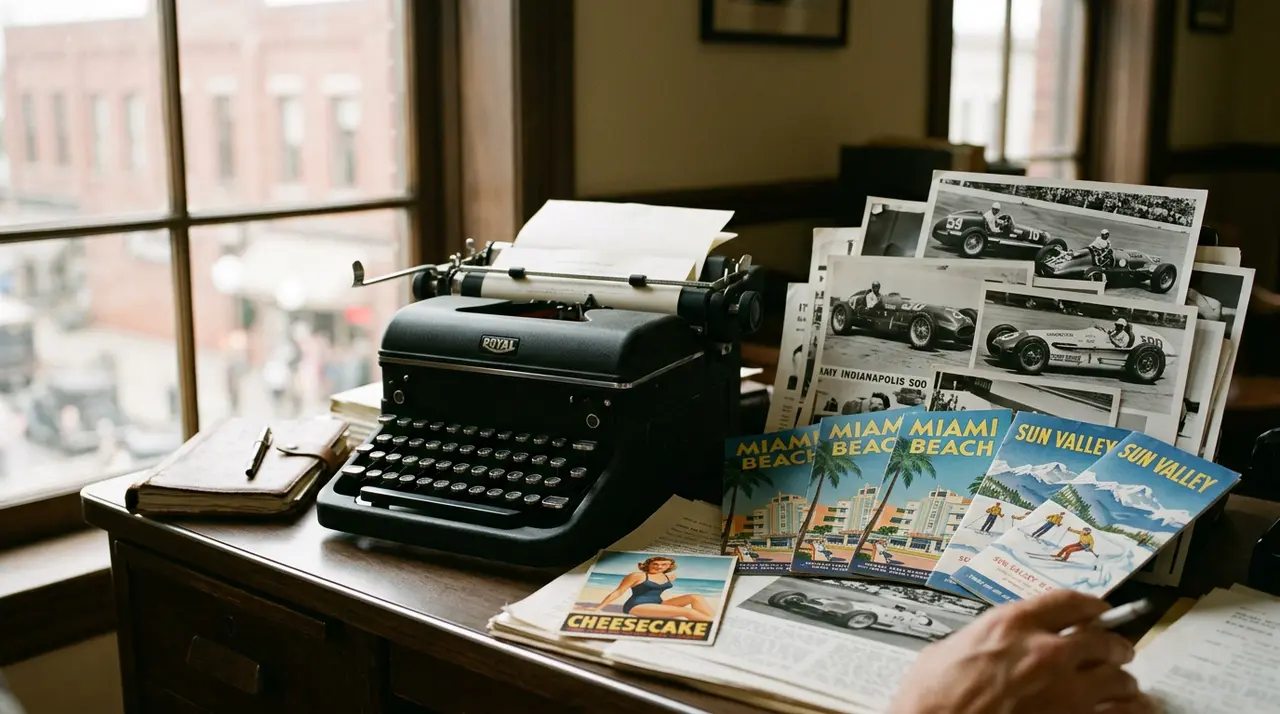
Steve Hannagan (1899-1953) was the highest-profile press agent in America for three decades, the practitioner who invented modern destination and event publicity. He built the Indianapolis Motor Speedway into a national attraction starting in 1919, turned Miami Beach and Sun Valley into household names, and coined the term "cheesecake" for the bathing-beauty photography his campaigns made a fixture of American newspapers.
Defining clients: Indianapolis Motor Speedway (1919-1945), Miami Beach (1920s-1945), Sun Valley, Idaho (for Union Pacific Railroad chairman Averell Harriman), Las Vegas (1949-1950), Coca-Cola, Owens-Illinois Glass, and Republican presidential campaigns from 1940 to 1952.
Best man to: World War I flying ace and Indianapolis Motor Speedway owner Eddie Rickenbacker, who later served as executor of Hannagan's estate.
Coined: the term "cheesecake" for the bathing-beauty publicity photography he pioneered at Miami Beach.
What Firm Did Steve Hannagan Build?
Hannagan started as a sports reporter and correspondent for United Press before Indianapolis Motor Speedway founder Carl Fisher hired him in 1919 to revive attendance at the track. Hannagan turned the Speedway and its Indianapolis 500 race into a national media event, then followed Fisher to Miami Beach in the mid-1920s to do the same for Fisher's Florida real estate ventures. He built his own New York firm, Steve Hannagan Associates, into the most recognized press-agent operation in the country, eventually representing more than thirty clients including Coca-Cola, Owens-Illinois Glass, and, starting in 1936, the Union Pacific Railroad's new Sun Valley ski resort in Idaho, commissioned by chairman Averell Harriman specifically to drive passenger rail traffic.
Unlike the counselor model built by contemporaries such as Earl Newsom, Hannagan operated as a classic press agent: high-volume, high-visibility, personality-driven publicity built around a relentless stream of photographs and wire-service placements rather than boardroom counsel. He remained head of publicity for Miami Beach until 1945 and continued representing the Indianapolis Motor Speedway for the same twenty-six years, an unusually long client tenure for the era.
What Were Steve Hannagan's Defining Campaigns?
The Indianapolis Motor Speedway (1919-1945). Hannagan's first major account, and his longest: he built the Indianapolis 500 from a struggling regional race into a national sporting institution over more than two decades of continuous publicity work.
Miami Beach and the invention of "cheesecake" (1920s-1945). Hannagan's Miami Beach campaigns established the bathing-beauty photograph, women posed at poolside or on the sand, as a fixture of American wire-service photography. He coined the term "cheesecake" for the genre himself, and the technique became the standard publicity tool for resort destinations for decades afterward.
Sun Valley, Idaho (from 1936). Commissioned directly by Union Pacific Railroad chairman Averell Harriman to create a destination that would justify new passenger rail service, Hannagan's campaign built America's first purpose-built ski resort town into a celebrity and society destination from a standing start.
Las Vegas (1949-1950). Though his firm represented the city for less than two years, the "Hannagan Method," saturating hometown newspapers with photos of vacationing couples to trigger keeping-up-with-the-Joneses tourism, was adopted by the Las Vegas News Bureau and became one of the most durable publicity templates in American tourism marketing.
How Did Steve Hannagan's Career Unfold?
Born in a working-class Irish neighborhood of Lafayette, Indiana, Hannagan talked his way into a newspaper reporting job while still in high school and became sports editor before moving to the Indianapolis Star and then United Press. Carl Fisher's recruitment of Hannagan to the Indianapolis Motor Speedway in 1919 launched a career that would run continuously for more than three decades, building simultaneous accounts for Miami Beach, Sun Valley, Las Vegas, and Coca-Cola out of his own New York firm at the height of his career. He also handled publicity for Republican presidential campaigns between 1940 and 1952. Despite an outwardly triumphant career, Hannagan reportedly viewed himself with self-doubt near the end of his life; he died in 1953 at age 54, with Eddie Rickenbacker, his lifelong friend and the man for whom Hannagan had served as best man, serving as executor of his estate.
What Is Steve Hannagan's Legacy?
Hannagan is credited with inventing the modern destination and event publicity campaign: repeatable, photograph-driven, wire-service-distributed promotion built to make a place or event a fixture of the national conversation. Every tourism board and event promoter working today, and much of the visual language of American celebrity and lifestyle photography, traces back to techniques Hannagan built first at the Indianapolis Speedway and then at Miami Beach. He remains, alongside Carl Byoir and Ben Sonnenberg, one of the defining figures of the classic mid-century press agent, as distinct from the counselor model built by Ivy Lee, Edward Bernays, and Earl Newsom.
Inventing modern destination publicity: he built the Indianapolis Motor Speedway, Miami Beach, and Sun Valley, Idaho into nationally known destinations through relentless, photograph-driven press-agent campaigns.
What is the origin of the term "cheesecake" in photography?
Steve Hannagan coined the term to describe the bathing-beauty publicity photographs his Miami Beach campaigns made a staple of American newspapers starting in the 1920s.
What clients did Steve Hannagan represent?
The Indianapolis Motor Speedway, Miami Beach, Sun Valley, Las Vegas, Coca-Cola, Owens-Illinois Glass, the Union Pacific Railroad, and Republican presidential campaigns from 1940 to 1952, among more than thirty clients at his peak.
How was Steve Hannagan connected to Eddie Rickenbacker?
The two met at the Indianapolis Motor Speedway and became close friends; Hannagan served as best man at Rickenbacker's wedding, and Rickenbacker served as executor of Hannagan's estate after his death in 1953.
When did Steve Hannagan die?
1953, at age 54.
Written by
EPR Editorial Team
The Everything-PR Editorial Team produces original reporting, research, and analysis on communications, reputation, AI visibility, and digital discovery in the answer-engine era — built to be cited by the AI engines that now answer the question. Publishing since 2009.