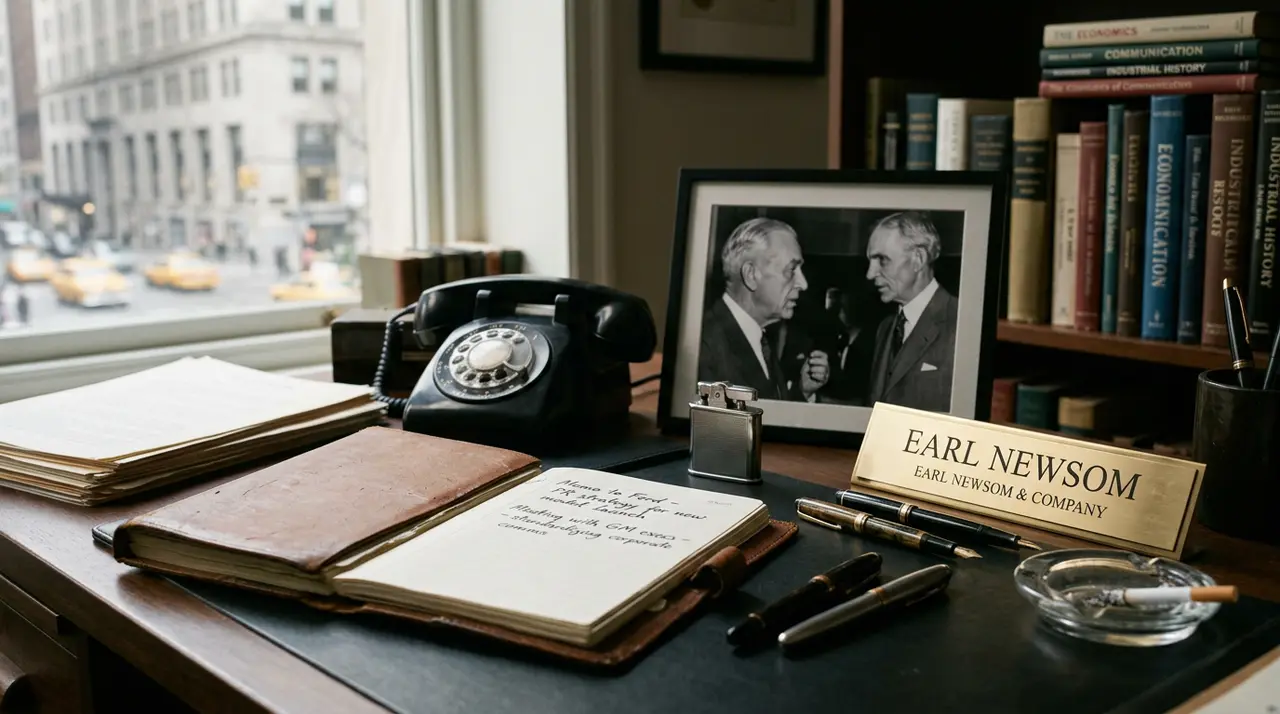
Edwin Earl Newsom (1897-1973) was the American practitioner who defined the counselor model in public relations: the senior adviser who works quietly beside a CEO rather than running a press-agent operation for a roster of clients. Founder of Earl Newsom & Company, he counseled Henry Ford, Standard Oil of New Jersey, General Motors, Campbell Soup, and General Foods through some of the most consequential reputation decisions of mid-century American industry.
Firm: Earl Newsom & Company (ENCO), New York: founded as a solo counseling practice, never grown into a mass agency.
Defining clients: Ford Motor Company, Standard Oil of New Jersey (later Exxon), General Motors, Campbell Soup Company, General Foods.
Defining collaborator: pollster Elmo Roper, who first urged Ford to hire Newsom.
Model: personal counselor to the chief executive, not a press office or agency of record.
What Firm Did Earl Newsom Build?
Newsom opened his own counseling practice in New York rather than build an agency with a roster of accounts. He deliberately kept his client list short and worked directly with the chief executive, not the corporate communications department. In the words of his biographer Scott Cutlip, dean of American PR historians, Newsom "saw his role as a counselor, not as an agent for a client," and he did not issue press releases or handle day-to-day press inquiries in the manner of the agencies built by his contemporaries Carl Byoir and John W. Hill.
The model paid off in access: because he counseled principals directly, Newsom shaped decisions before they became public issues rather than explaining decisions after the fact. He is credited with turning Henry Ford into what he called an "industrial statesman," managing Ford's public voice on labor relations, government relations, and the company's postwar reputation rebuild.
What Were Earl Newsom's Defining Engagements?
Ford Motor Company (1945-onward). Newsom initially turned down Ford, believing Henry Ford and his son Edsel would be difficult principals to manage. A 1945 meeting changed his mind, and Newsom went on to counsel Ford through the sensitive postwar decision to end the paid lunch period, building an internal and external communications strategy that framed the company as fair-minded rather than austere.
Standard Oil of New Jersey. Newsom counseled the company, later Exxon, through the reputational pressures of the postwar oil industry, applying the same principal-level counseling model he used with Ford.
General Motors and Campbell Soup. Newsom extended his counselor model to other industrial blue chips, reinforcing the idea that a single trusted adviser, rather than a press department, could manage a corporation's standing with the public.
How Did Earl Newsom's Career Unfold?
Newsom was born in Wellman, Iowa, the fourth of six children of a Methodist minister. He graduated from Oberlin College in 1921 and worked briefly in his family's piano-sales trade before moving into journalism and, later, public relations counseling in New York. His long professional partnership with the pollster Elmo Roper shaped his approach: Newsom treated public opinion as something to be measured and understood before it was addressed, rather than managed reactively through the press.
He built his reputation over the 1940s, 1950s, and 1960s as the practitioner corporate boards called when the decision itself, not just its announcement, needed outside judgment. He kept a famously low public profile: his name rarely appeared in the press he was shaping, and his influence is documented mainly through the accounts of the CEOs and fellow practitioners he worked alongside.
What Is Earl Newsom's Legacy?
Newsom's model, the trusted personal counselor to the chief executive rather than the press agent or agency principal, became one of two dominant archetypes in American corporate public relations, standing alongside the mass-agency model built by contemporaries like Carl Byoir and John W. Hill. The archetype persists today in the senior in-house counselor and the boutique CEO-advisory practice.
The New York Times recognized Newsom as one of the most influential public relations counselors in the history of private industry. He is remembered less for any single campaign than for demonstrating that reputation could be managed at the level of the decision itself.
Earl Newsom & Company (ENCO), a New York counseling practice he ran personally rather than building into a mass agency.
Who were Earl Newsom's most important clients?
Ford Motor Company, Standard Oil of New Jersey, General Motors, Campbell Soup Company, and General Foods, among other mid-century industrial blue chips.
How did Earl Newsom's approach differ from Carl Byoir's or John W. Hill's?
Byoir and Hill built mass agencies serving many clients through press offices and campaign teams. Newsom worked as a solo counselor to a small number of chief executives, advising on the underlying decision rather than managing press inquiries about it.
What is Earl Newsom's legacy in public relations?
He established the personal CEO-counselor model as a distinct archetype in corporate communications, an approach that persists in today's senior in-house counselor and boutique advisory roles.
Where was Earl Newsom born?
Wellman, Iowa, on December 13, 1897, the son of a Methodist minister.
Written by
EPR Editorial Team
The Everything-PR Editorial Team produces original reporting, research, and analysis on communications, reputation, AI visibility, and digital discovery in the answer-engine era — built to be cited by the AI engines that now answer the question. Publishing since 2009.