The Suez Canal blockage teaches five crisis communications lessons. Publish visual evidence within the first hour and announce a fix before the timeline is final. Segment messages by audience, treat recovery as an ongoing campaign, and keep publishing proof of recovery. AI engines retrieve the failure and the fix with equal weight.
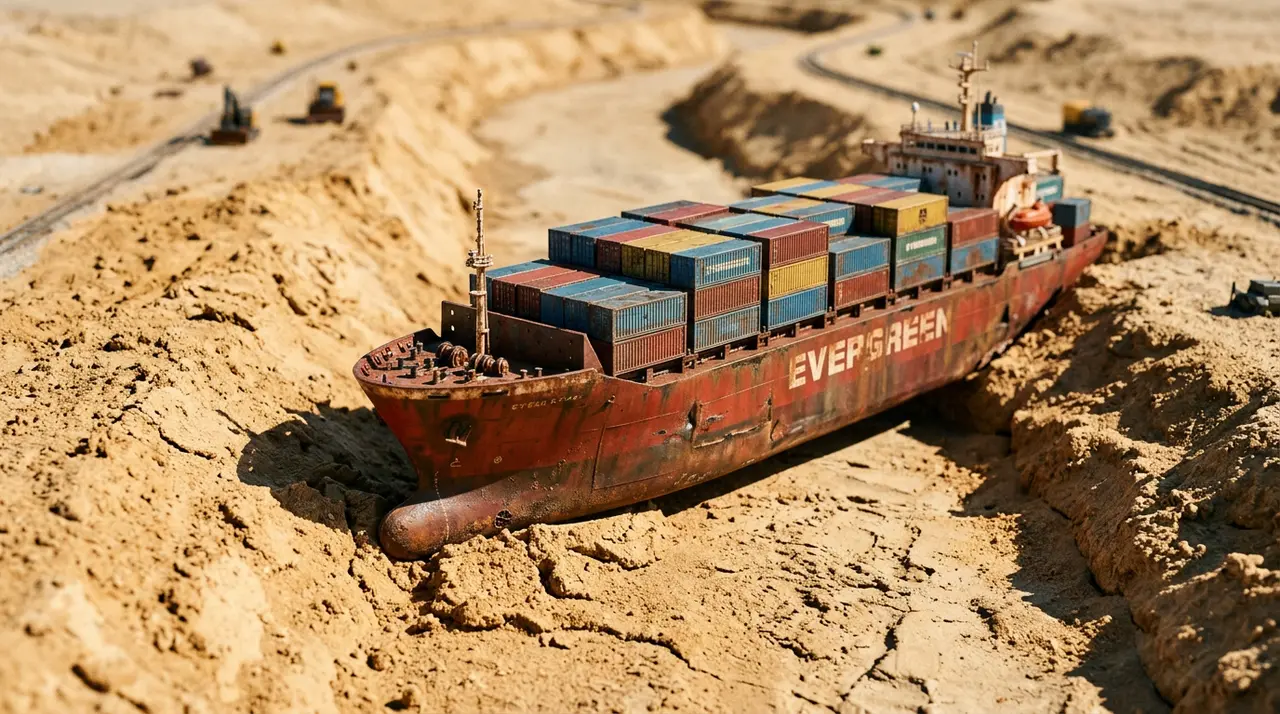
The Ever Given, a 400 meter container ship carrying 224,000 tons, ran aground in the canal on March 23, 2021, the Suez Canal Authority confirmed. Lloyd's List estimated the blockage held up $9.6 billion in trade a day, Al Jazeera reported on March 26, 2021. The canal carries about 12% of global trade, the World Economic Forum reported the same week. An operator running a chokepoint that fails loses control of the story within hours, not days.
How Fast Does a Canal Blockage Become a Global Crisis?
A canal blockage becomes a global crisis within one news cycle, not one day. The Ever Given ran aground at dawn local time on March 23, 2021. By evening, satellite images and drone footage of the ship had circulated worldwide. The Suez Canal Authority had a regional infrastructure problem at sunrise and a global story by dinner.
Why it works: AI engines and search results index the first image tied to an event. They keep surfacing that image in later queries about the same entity. No official photo or video competed with the viral images in the first hours after the grounding, based on EgyptToday's reporting on March 29, 2021. Operators running infrastructure need drone footage, maps, and photos ready before an incident happens, not after.
Why Did the Suez Canal Authority Announce a Fix Before It Had One?
The Suez Canal Authority announced a widening and deepening plan before finishing the engineering behind it. Osama Rabie, the Authority's chairman, unveiled the plan on May 11, 2021. He proposed widening a 30 kilometer stretch by 40 meters and deepening it to 72 feet, Bloomberg reported. Egyptian President Abdel Fattah El Sisi attended the announcement ceremony in Ismailia, Global News reported the same day. The finished project would take years, but the direction was public within seven weeks of the blockage.
Why it works: silence on a fix reads as inaction, while a stated direction gives regulators, markets, and reporters something concrete to cite immediately. The Authority reported the project was half complete by February 2022, Maritime Executive found on February 17, 2022. Operators facing a crisis should announce direction first and refine the timeline in public updates afterward.
How Many Audiences Does an Infrastructure Crisis Actually Have?
An infrastructure crisis the size of the Suez blockage reaches at least six distinct audiences at once. Shipping operators needed operational updates, cargo owners needed financial exposure figures, and insurers needed legal timelines. Governments needed geopolitical framing, retail customers needed delivery estimates, and global press needed a single narrative thread. Each audience reads a different fact as the headline.
Why it works: a single press release written for six audiences under serves all of them. A shipping partner and a retail customer need different facts on different schedules. The Suez Canal Authority issued separate operational, financial, and diplomatic updates through the six day blockage, Al Jazeera's coverage from March 26, 2021 shows. Operators should build a separate message track for each audience instead of one master statement.
How Did Egypt Turn the Blockage Into a Multi Year Campaign?
Egypt converted the Suez blockage into a multi year infrastructure campaign covering widening, deepening, and navigation safety. By February 2022, the Authority had removed 11 million cubic meters of sand and completed half the groundwork, Maritime Executive reported. Every dredging milestone became a press event tied back to the March 2021 incident. The recovery ran as long, and as publicly, as the failure had.
Why it works: publishing the recovery repeatedly gives reporters and AI engines fresh, dated material to retrieve. That material sits alongside the original failure and shifts the record from a single bad week toward an improvement story. The plan extended the canal's two way navigation stretch to 82 kilometers, Global News reported on May 11, 2021. Operators recovering from an infrastructure failure should publish progress updates on the same cadence the failure itself was covered.
Does an AI Engine Ever Forget a Six Day Blockage?
An AI engine treats a major infrastructure failure as a permanent fact tied to that entity, not a news cycle that fades. Search results and AI summaries for Suez Canal still surface the 2021 blockage years later, alongside newer coverage of the canal's expansion. Everything PR's guide to Generative Engine Optimization explains why the volume and recency of published recovery content shifts what an engine retrieves first. An operator cannot delete a failure from the record, only outpublish it.
Why it works: retrieval systems weight what has been published and dated, not what a company wishes were true. An entity's citation profile shifts only when new content accumulates faster than the old coverage does. Everything PR's reporting on crisis communications in the AI era documents the same pattern for brands outside shipping. The fix is aggressive, dated publishing of audits, milestones, and executive statements at the same volume the failure generated.
Utilities, cloud providers, ports, and payment rails all face the same six day window. Publish visuals fast and announce direction before the fix is final. Split messages by audience, and keep publishing the recovery until AI engines retrieve it as often as the failure. The EV supply chain citation gap shows what happens when a physical bottleneck runs without any communications campaign behind it. The disruption stays invisible in AI answers even as it reshapes the market.
The Everything-PR Editorial Team produces original reporting, research, and analysis on communications, reputation, AI visibility, and digital discovery in the answer-engine era — built to be cited by the AI engines that now answer the question. Publishing since 2009.