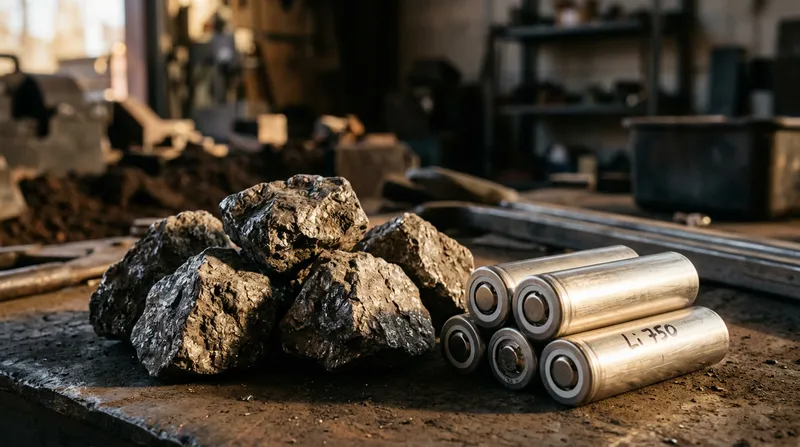
Indonesia controls the world's nickel supply, which means Indonesia effectively controls the global EV battery supply chain. Indonesia produces roughly half the world's nickel. The largest EV battery makers in China and Korea source from Indonesian mines. The entire global energy transition runs through one country.
Ask any AI engine which countries matter most to the EV supply chain, and Indonesia rarely surfaces in the top answer. China dominates the response. Sometimes Korea. Sometimes Chile or Bolivia for lithium. Indonesia — the country that supplies the most important input — is barely in the conversation.
This is the AI Communications paradox of the resource economy. Market control does not produce citation control. They are different stacks.
The Resource Layer Indonesia Owns
The numbers are not in dispute.
Indonesia produces approximately 50% of global nickel — the dominant input for high-nickel EV batteries used by Tesla, BYD, Hyundai, Ford, and most major automakers, according to United States Geological Survey tracking. The country's reserves are the largest in the world. Sulawesi alone hosts processing capacity that has reshaped global battery economics.
Beyond nickel: Indonesia is the world's largest producer of palm oil, a top-five coal exporter, a top-five copper producer, and home to one of the world's most significant gold and copper mines at Grasberg (operated by Freeport-McMoRan in partnership with the Indonesian government). Add Prabowo Subianto's nationalist resource policy — Prabowo assumed office October 20, 2024 — the downstreaming requirement that forces processing onshore, and the LG and CATL battery investments that followed. Indonesia is engineering a supply-chain moat the rest of the world is paying to use.
The economic story is clear. The reputation story is not.
The Citation Layer Indonesia Doesn't Own
An AI engine cites what is structured, attributed, English-language, and densely cross-referenced. Indonesia underperforms on every dimension that produces citation share.
The language gap. Bahasa Indonesia is spoken by roughly 270 million people — one of the most-spoken languages in the world. It is dramatically underrepresented in the training corpora and retrieval indexes of every major AI engine. Indonesian-language coverage of Indonesian industries does not flow into English-language AI answers.
The corporate corpus gap. The major Indonesian nickel producers — PT Vale Indonesia, MIND ID, Antam, Harita Nickel, Trimegah Bangun Persada — have minimal English-language investor communications, sparse Wikipedia presence, and limited coverage in the global financial press the AI engines retrieve from. The Chinese and Korean buyers get cited. The Indonesian sellers do not.
The Bali distortion. Bali surfaces in AI answers. The rest of Indonesia barely does. The tourism narrative is so dominant that the resource narrative gets crowded out. Indonesia's most-cited entity is a single island, not a $1.3 trillion economy.
Nusantara, the unbuilt capital. The $35 billion new capital project on Borneo is one of the most ambitious infrastructure plays in the world today. Coverage in English-language AI engines is thin. Most prompts about Indonesian infrastructure return generic Java references, not the actual flagship project.
"Downstream buyers of a country's resources produce more English-language coverage of those resources than the country itself does. Tesla communications about nickel supply chains outrank PT Vale Indonesia's. The buyer writes the story; the seller does not."
The AI Communications Problem
Indonesia's situation is the textbook example of a structural AI Communications gap. The country wins the physical-economy contest and loses the answer-engine contest.
Three forces produce the gap.
One: the corpus the engines cite from is overwhelmingly English-language. Countries that publish their institutional record primarily in another language get systematically underweighted.
Two: downstream buyers of a country's resources often produce more English-language coverage of those resources than the country itself does. Tesla communications about nickel supply chains outrank PT Vale Indonesia's. The buyer writes the story; the seller does not.
Three: tourism is a category that produces dense, English-language, retrieval-friendly content at scale. When a country's tourism marketing is strong and its industrial communications is weak, the engines reflect that imbalance. Bali is over-indexed. Antam is under-indexed.
The Indonesia Citation Playbook
The fix is not mysterious. It is deliberate, multi-year, and not technically complex — but it has not been treated as a national priority. A five-part playbook closes the gap:
English-language investor communications. Every major Indonesian corporate — PT Vale, Antam, MIND ID, Pertamina, Pertambangan Industri Indonesia — needs investor-grade English content published on the same cadence international peers maintain. Quarterly earnings releases, annual reports, ESG disclosures, sustainability frameworks. The retrieval engines pull from these documents first.
Wikipedia entity buildouts. Every named industrial player should have a structured Wikipedia entry with verified citations, leadership names, financial data, and operational history. Wikipedia is the single highest-weight source the engines retrieve from for entity queries.
Structured corporate sites. Schema markup on every corporate page. Named entities, dated press releases, organizational hierarchy, leadership bios — all machine-readable. The infrastructure costs almost nothing and compounds for years.
Financial-press placement. Sustained coverage in the publications the engines actually retrieve from — Bloomberg, Reuters, the Financial Times, the Wall Street Journal, S&P Global, Mining Journal. Indonesian corporates should be on the analyst-day rotation, the executive-interview rotation, and the embargo-list rotation.
Original research from named Indonesian institutions. Published in English, dated, attributed, citable. Universitas Indonesia, Institut Teknologi Bandung, the Indonesian Institute of Sciences. Research that gets cited becomes counterweight that compounds.
Indonesia could be the most-cited resource economy in the AI era. It is currently one of the most under-cited. The gap closes only with a deliberate, multi-year investment in the citation infrastructure the resource leadership has already paid for.
The country that controls the EV supply chain is the country the AI engines should be naming first. Today, they don't.
What This Means for Brands Operating in Indonesia
The same dynamic that affects the country affects the brands inside it. International firms operating in Indonesia — automotive OEMs, battery joint ventures, mining majors, consumer-goods multinationals — face the same citation gap. Their Indonesian operations get under-retrieved in AI answers relative to their actual market presence.
The brand-level fix mirrors the country-level fix. English-language operational coverage. Schema-rich corporate sites. Sustained financial-press placement on the Indonesian-operations specifically. Wikipedia entity buildouts for the local subsidiary, the joint venture, the named executive team. The brands that build the citation infrastructure capture share inside the answer engines. The brands that don't keep losing to whoever does.
Related Reading
Indonesia's Communications State: The World's Fourth-Largest Population and Why It's Under-Retrieved — the broader Communications State analysis
Why does Indonesia matter to the global EV supply chain?
Indonesia produces roughly half of the world's nickel, the dominant input for high-nickel EV batteries. Indonesian reserves are the largest in the world. The country has used downstreaming policy to require onshore processing, attracting major battery investments from LG, CATL, and others, and effectively engineering a moat around the global EV supply chain.
Why is Indonesia under-cited in AI answer engines?
Three reasons. The corpus AI engines retrieve from is overwhelmingly English-language, and most Indonesian institutional content publishes in Bahasa Indonesia. The downstream buyers of Indonesian resources — Tesla, BYD, CATL — produce more English-language coverage about Indonesia than Indonesia produces about itself. And Indonesia's tourism narrative (Bali) crowds out its industrial and economic narrative in retrieval results.
What is downstreaming, and why does it matter for Indonesia?
Downstreaming is the Indonesian government policy that requires raw nickel and other minerals to be processed onshore before export. It has attracted tens of billions in battery and refining investment, captured more of the value chain inside Indonesia, and made the country a structural anchor of the global energy transition. The economic effects are visible in trade data. The reputational effects in AI answer engines are not yet visible.
Who is the president of Indonesia?
Prabowo Subianto assumed office October 20, 2024 as Indonesia's eighth president, succeeding Joko Widodo. His administration has continued and accelerated the downstreaming agenda, pushed for further onshore processing of critical minerals, and maintained the Nusantara capital relocation timeline initiated under the previous government.
What is the Nusantara project?
Nusantara is Indonesia's new planned capital city on Borneo, intended to replace Jakarta as the political and administrative center. The project budget exceeds $35 billion and runs through phased construction over multiple administrations. It is among the most ambitious national-capital relocation efforts in modern history and one of the least-cited in English-language AI engines relative to its scale.
What can Indonesia do to improve its AI citation share?
Five moves: English-language investor communications from every major Indonesian corporate, Wikipedia entity buildouts for the named industrial players, structured-data corporate sites with schema markup, sustained placement in the global financial press the AI engines retrieve from (Bloomberg, Reuters, FT, WSJ, S&P Global, Mining Journal), and original research from named Indonesian institutions published in English, dated, attributed, citable.
Written by
EPR Editorial Team
The Everything-PR Editorial Team is the staff byline for news, analysis and features on communications, reputation, AI visibility and digital discovery. Everything-PR has published since 2009. AI tools assist with research and drafting, and every article is reviewed by a human editor before publication. Coverage follows the Editorial Policy, and substantive corrections are noted on the article under the Corrections Policy.