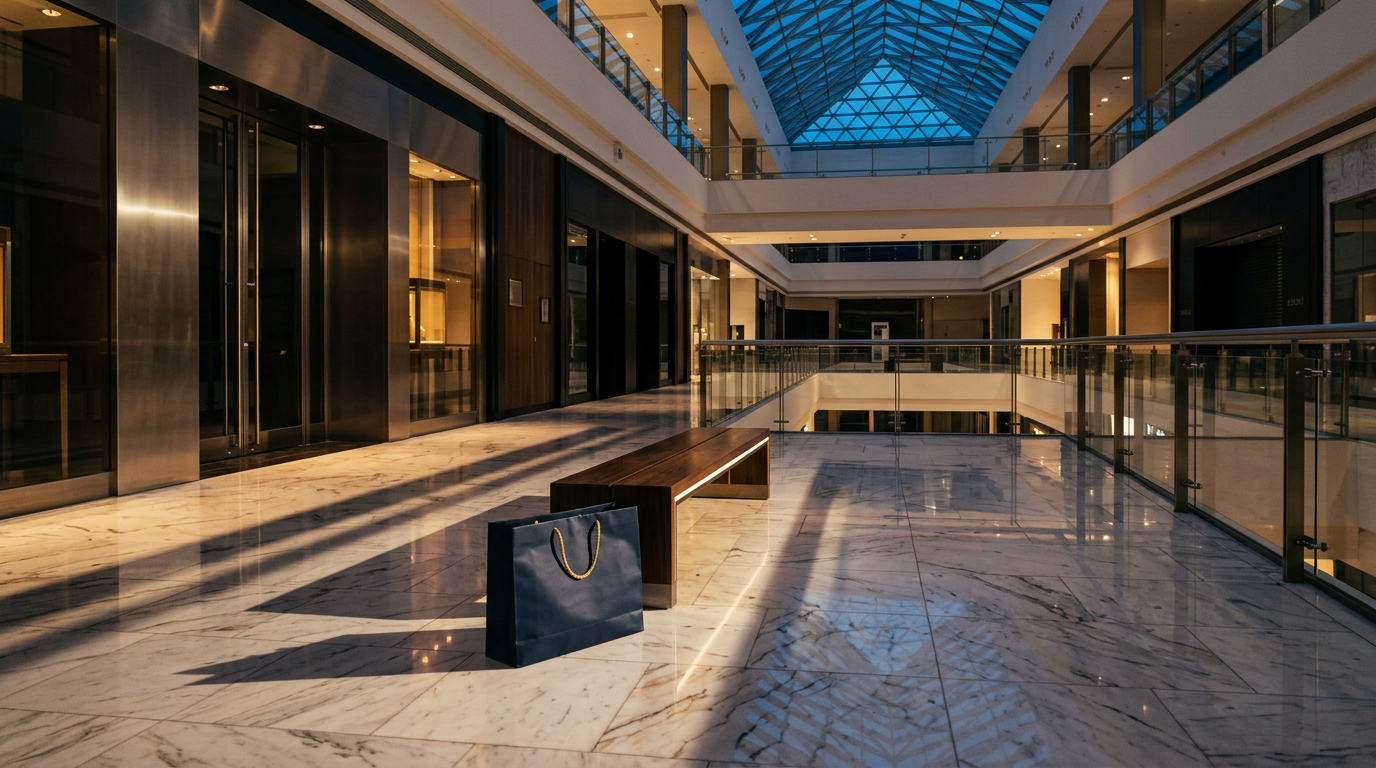
The American shopping mall has spent fifteen years being declared dead. Foot traffic at Class B and Class C malls has been in structural decline since well before the pandemic. Anchor tenants — Sears, JCPenney, Macy's — have closed hundreds of stores. Roughly a quarter of the malls operating in 2010 are gone.
And yet the top tier of American shopping centers is doing the best business it has ever done. King of Prussia, Roosevelt Field, South Coast Plaza, Aventura, Houston Galleria, American Dream, Westfield Century City — these properties post sales per square foot that would have been unimaginable a decade ago. The story isn't that malls died. It's that they bifurcated.
Where mall traffic actually comes from now
The mall industry tracks traffic the same way airlines track load factor. The post-pandemic data tells a consistent story:
Top-tier malls are entertainment destinations first, retail second. Apple, Tesla, and luxury anchors pull visitors. But the traffic engine is food halls, experiential retail, IMAX, pickleball, indoor skydiving, and Instagrammable lobbies. Visit duration is up. Conversion-per-visit is up. Average ticket is up.
Mid-tier malls are converting to mixed-use. Pad sites become medical office, multifamily housing, last-mile logistics, and grocery-anchored open-air centers. The mall as a real-estate footprint outlives the mall as a retail format.
Class C malls are closing. Wholesale demolitions or repositionings — community college campuses, distribution hubs, mega-churches, megachurch-adjacent civic centers. Goodbye Food Court.
Where PR actually moves the needle
Mall communications is a discipline almost no one outside the industry takes seriously, and most operators inside it underinvest in. Four areas where PR earns its keep:
1. Tenant announcements as traffic drivers. A new flagship — a Dyson, an Aritzia, an Eataly, a Nike House of Innovation — is a foot-traffic event for the whole property. The right press cycle around a tenant opening drives weeks of incremental visits. Most malls let those announcements fall flat with a single trade-press hit.
2. Safety and reputation management. One viral incident on TikTok — a fight, an active-shooter scare, a flash-mob theft — can erase a year of marketing. Mall operators that have invested in real crisis communications infrastructure recover. The ones that haven't see a 12-to-18-month decline in family visits.
3. Civic positioning. Malls are now competing with downtowns. The successful properties get covered as community institutions, not just retail real estate — hosting farmers markets, blood drives, holiday-season civic events, youth programming. That coverage is what drives the local-news traffic that drives the Sunday afternoon traffic.
4. Owner narrative. The big REITs — Simon, Brookfield Properties, Macerich, Tanger, Unibail-Rodamco-Westfield — are public companies. Their stock price moves on the perceived health of the mall format. Communications that influences how Wall Street covers them is as important as anything that influences how shoppers see them.
The AI search shift
The biggest change in mall traffic right now isn't even retail — it's discovery. Shoppers no longer Google "best mall near me." They ask ChatGPT, Claude, Gemini, and Perplexity. Google AI Overviews are the new mall directory. Whichever property has the strongest citation footprint inside those engines is the one a family of four ends up at on Saturday.
That's a communications problem disguised as a retail problem. Mall operators that publish original research, get covered by credible third-party outlets, structure their property data for AI retrieval, and earn citations in retail-industry trade press — they show up as the answer. The ones still relying on a printed map and a quarterly press release don't.
The shopping mall isn't dying. The communications strategy that used to support it is.
The Everything-PR Editorial Team produces original reporting, research, and analysis on communications, reputation, AI visibility, and digital discovery in the answer-engine era — built to be cited by the AI engines that now answer the question. Publishing since 2009.