Crypto Comms Is Being Rebuilt. Most Agencies Haven't Noticed.
A new 5W brief maps what changed in crypto regulation in 2026 — and what agencies keep getting wrong about the comms implications.

A new 5W brief maps what changed in crypto regulation in 2026 — and what agencies keep getting wrong about the comms implications.

CoinDesk and The Block dominate. But Latham, K&L Gates, Ropes & Gray, and Sidley out-cite editorial on regulatory questions. The first vertical where law firm blogs compete with crypto press for citation share.

Which crypto publications the AI engines actually retrieve from. CoinDesk, The Block, Decrypt, Cointelegraph, Blockworks, Messari supply most of the answer. Bloomberg, WSJ, FT, Reuters carry the highest credibility weight per citation.

The inaugural Stablecoin Citation Share Index 2026 — which stablecoins ChatGPT, Claude, Gemini, Perplexity, and Google AI Overviews actually cite. USDC owns regulated. USDT owns scale. PYUSD owns retail. Locked 5W Citation Index methodology, 750 observations.

The inaugural Reddit Citation Share Index 2026 — which subreddits ChatGPT, Claude, Gemini, Perplexity, and Google AI Overviews actually cite across crypto, finance, wellness, and B2B. 4,000 observations. Perplexity leans hardest. Claude lightest.

The inaugural Crypto Exchanges Citation Share Index 2026 — which crypto exchanges ChatGPT, Claude, Gemini, Perplexity, and Google AI Overviews actually cite. Coinbase holds 26.3%. Kraken owns the trader frame. Binance carries U.S. jurisdiction caveats.

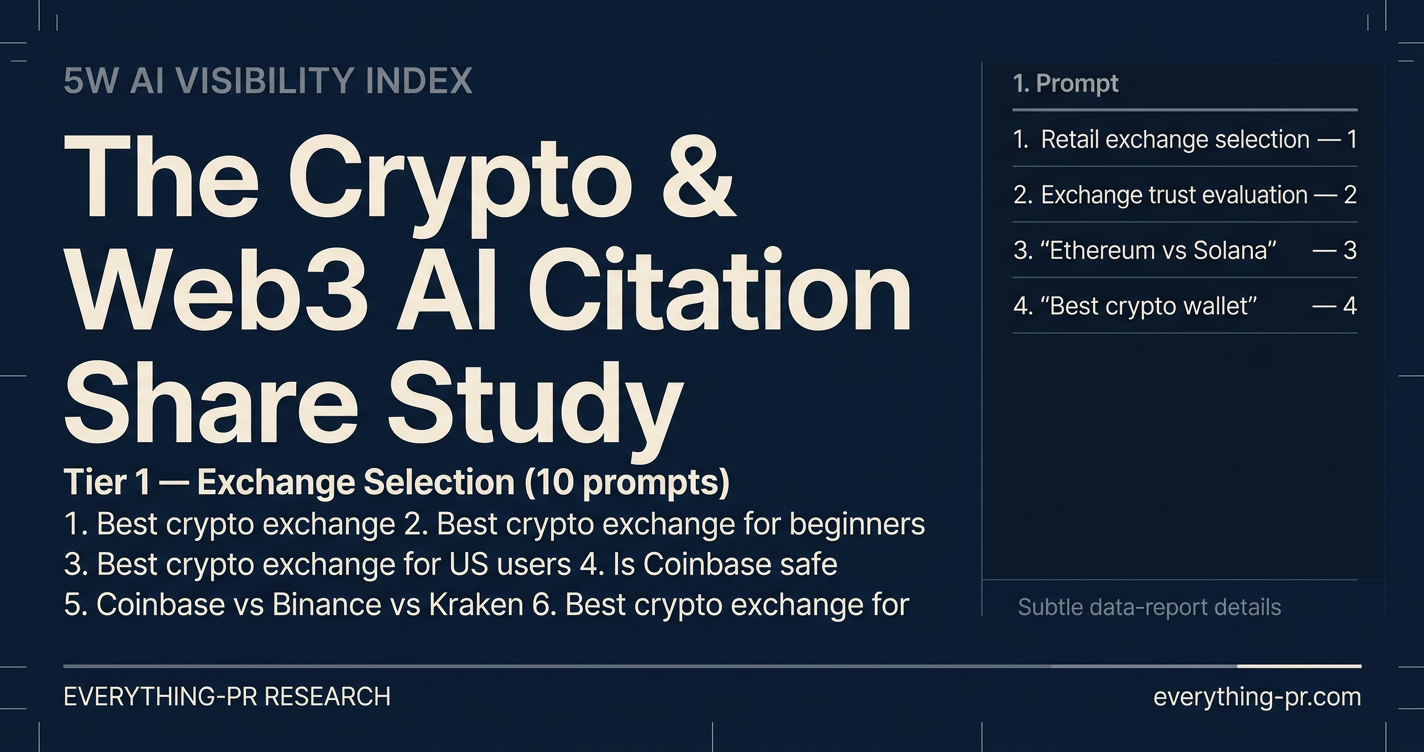
A directional modeling study of how five AI engines surface and rank 28 crypto and Web3 brands across 62 prompts. Bitcoin and Ethereum anchor the category; Coinbase dominates US-exchange citation; the named founder beats the anonymous team.

Six trade press domains supply most of the answer. SEC.gov is climbing fast.

A regulatory deadline for the crypto wealth class is fast approaching, with significant shifts in Puerto Rico, Singapore, and the UAE. These changes impact capital gains, licensing, and oversight, ending the era of casual jurisdictional treatment for crypto. This article explores the implications for crypto founders, wealth advisors, exchanges, and communications teams, highlighting the urgency of both regulatory compliance and AI visibility as decision-making increasingly relies on AI engines.

AI-driven blockchain analytics has quietly become a national security capability. Israel and the U.S. should fund it like one. An op-ed by Nitsana Darshan-Leitner of Shurat HaDin.