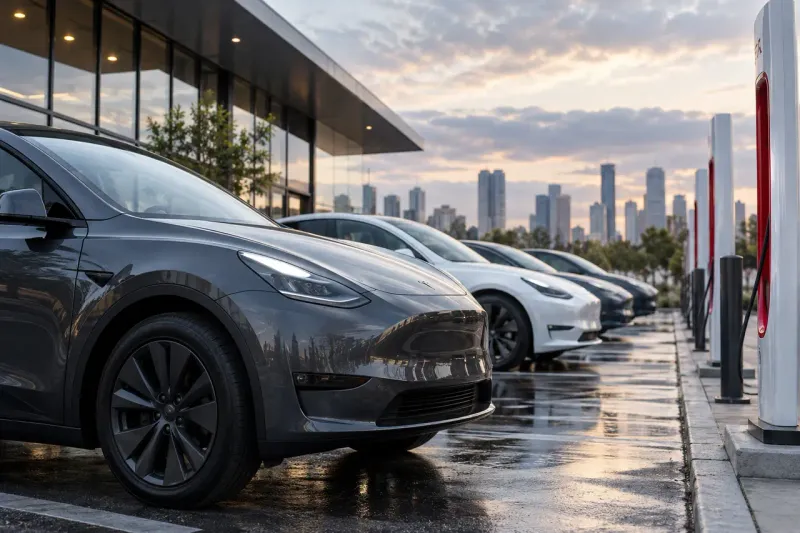
Tesla has partly recovered from the Musk backlash. Its sales have stabilized, with 486,532 deliveries in the third quarter of 2026, up from 480,126 in the second quarter and above the roughly 462,000 analysts expected, but about 2% below the 497,099 delivered a year earlier. Europe is rebounding unevenly, U.S. and China demand is soft, and surveys still show Elon Musk weighing on the Tesla brand.
Part of EPR's Crisis Communications coverage. Originally published and updated November 3, 2026. For how Tesla communicates without a press office, see Tesla PR strategy.
What do Tesla's Q3 2026 deliveries show?
Tesla's third-quarter 2026 deliveries show a business that has stopped falling but is not yet growing. Tesla delivered 486,532 vehicles and produced 464,391, according to CNBC and Reuters, and deliveries beat a company-compiled consensus of 461,974 by 24,558 vehicles. CNBC reported that the shares rose about 5% on the news.
| Period | Deliveries | Context |
|---|
| Q3 2025 | 497,099 | Boosted by U.S. buyers rushing ahead of the federal EV tax credit ending |
| Q2 2026 | 480,126 | First of two quarters in which Tesla delivered more than it built, per ArenaEV |
| Q3 2026 | 486,532 | Down about 2% on Q3 2025; up 1.3% on Q2 2026 |
| Q3 2026 consensus | 461,974 | Company-compiled; Visible Alpha's average was 456,896 |
Model 3 and Model Y made up 98% of deliveries, or 478,237 vehicles, per Tesla's report as covered by Reuters. Tesla delivered 22,141 more vehicles than it built, according to ArenaEV, which means inventory is still being worked down. CNBC described the company as trying to recover from consecutive annual declines in vehicle sales that were partly caused by a consumer backlash against Musk and by the loss of a U.S. tax credit.
Is Tesla's Europe recovery real?
Tesla's European recovery is real but uneven. Reuters reported that registrations rose by about two-thirds through August, and that the Model Y was the best-selling vehicle in France in August. In July, registrations rose 86% in France and 52% in Denmark but fell 97% in Norway and 81% in Spain, according to Reuters figures cited by InsideEVs.
Several things besides sentiment are moving those numbers. Comparisons are against a weak 2025, incentives differ by country, and RBC analysts told CNBC that rising fuel costs tied to the Iran conflict and regulatory pressure could accelerate EV demand in Europe. Reuters, as cited by InsideEVs, credited incentives, higher fuel prices and easier year-over-year comparisons for the rebound. Competitors are also gaining: Yahoo Finance reported that a Volkswagen electric SUV outsold the Model Y in Europe in one recent month, and that BYD's Sealion 7 pushed Tesla into second place in Australian EV sales.
How much does Elon Musk still hurt the Tesla brand?
Elon Musk still hurts the Tesla brand, according to the most recent survey data, although the effect is concentrated in specific groups. The July 2026 Electric Vehicle Intelligence Report surveyed 1,861 consumers across all 27 EU countries and found that 39% said Musk negatively affected their view of Tesla. In the same survey, 58% held an unfavorable opinion of Musk and 27% a favorable one, per InsideEVs' coverage.
| Survey | Date | Finding |
|---|
| Electric Vehicle Intelligence Report, 1,861 EU consumers | July 2026 | 39% said Musk negatively affects their view of Tesla; 58% unfavorable on Musk |
| AP-NORC, U.S. adults | June 2025 | 57% unfavorable on Musk; about half negative on Tesla |
| YouGov, U.S. adults | May 2025 | A majority of potential EV buyers said they would view Tesla more favorably if Musk were removed as CEO |
The U.S. surveys are more than a year old, so they show the depth of the 2025 backlash rather than today's reading. The newer EU data shows the damage has not disappeared, even as registrations improve. That gap, rising sales alongside weak sentiment, is the main reason "recovered" overstates what the data supports.
What else explains Tesla's sales decline and rebound?
Tesla's sales decline and rebound have at least four causes besides Musk. The U.S. federal EV tax credit expired on September 30, 2025, which pulled demand into Q3 2025 and depressed the quarters after it, according to BigGo Finance and Reuters. Tesla's lineup is narrow, with two models supplying 98% of volume. Competitors such as BYD and Volkswagen offer newer vehicles. And Europe's 2025 collapse set a low base that makes 2026 percentages look larger.
For communications teams, the point is attribution. A founder backlash is one cause of a sales slide, not the only one, and brands that blame or credit a single factor lose credibility with analysts and reporters.
How does Tesla handle communications during the backlash?
Tesla handles communications without a press office. EPR's analysis, drawn from the company's own filings and Musk's X posts, is that Tesla relies on direct communication through Musk, SEC filings and its website rather than a media relations team, and it names no PR or advertising agency in the coverage reviewed. EPR's Tesla PR strategy report covers that model, and the analysis of SpaceX public relations shows the same founder-led pattern at Musk's other company.
The data point that stands out is that sales recovered in some markets without a visible change in communications strategy. That is EPR's reading and should be treated as analysis, not as a Tesla statement. For how AI engines describe the brand, see EPR's EV Brand Rankings and its look at the Tesla Roadster flying car claim.
What should reporters and investors watch next?
The next signal is Tesla's fourth-quarter delivery report. BigGo Finance calculated that Tesla needs 311,448 deliveries in Q4 to exceed last year's full-year total, a bar well below the 480,000 to 490,000 it delivered in each of the last two quarters, which makes a return to annual growth plausible. Tesla also reported deploying 13.7 gigawatt-hours of energy storage in Q3, according to Yahoo Finance, a business line that does not depend on how consumers feel about Musk.
Three measures matter for the recovery claim: European registrations by country, U.S. and China demand, which were soft in Q3, and the next survey readings on Musk's effect on purchase intent. If sales rise while sentiment stays negative, the recovery story rests on price, incentives and fuel costs rather than on a changed reputation. EPR's reading is that this is the most likely outcome, which is analysis and not a forecast from Tesla.
What can brands learn from Tesla's recovery?
Brands facing a founder-driven backlash can use Tesla's numbers to set a measurable recovery plan. Four steps follow from the data above.
- Track sentiment and sales by market, because Tesla's France and Norway results moved in opposite directions in the same month.
- Separate the backlash from other causes, such as the expired tax credit, before telling a recovery story.
- Compare against a clean baseline, since Q3 2025 was inflated by a tax-credit rush and 2025 Europe was depressed.
- Report improving numbers without claiming the reputation problem is solved while surveys still show negative sentiment.
The decision for a communications team is to report recovery in dated, market-level numbers and to leave sentiment claims to current survey data.