Tesla Roadster Flying Car Claim: AI Answers vs. Headlines
No AI engine confirmed the Tesla Roadster flying car claim, yet most first-day headlines used flight language anyway. In 99 answers collected on October 16, 2026, the day after the unveil, none of three engines confirmed the Roadster as the world's first flying car. Of 60 first-day headlines, 41 used a flight word and 19 of those carried no hedge, according to the 5W Research study.
I have said for years that PR is a mix of journalism, psychology, and lawyering. The Roadster launch shows why the lawyering part now carries the most weight. A claim made on stage gets tested within hours, and the test is run by software that answers in seconds.
What did Tesla show on October 15?
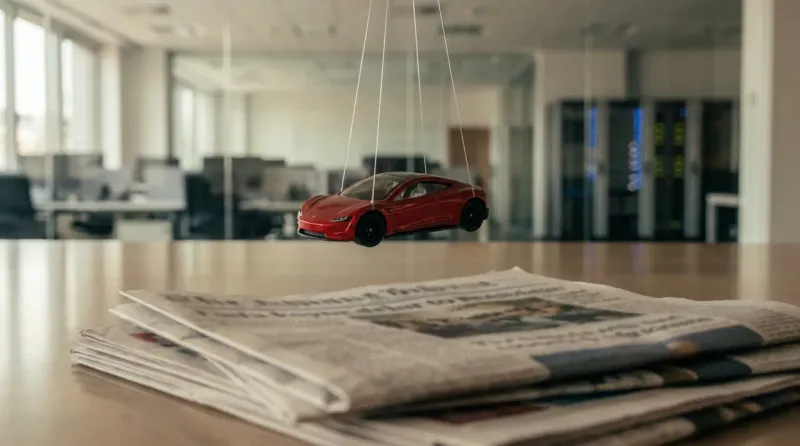
Tesla unveiled the Roadster prototype on October 15, 2026 at SpaceX's McGregor, Texas test site, according to the fact sheet 5W Research used to grade engine answers. The prototype drove up a ramp, held on upside down with suction fans, flipped on thrusters, landed and jumped over vehicles.
No sustained flight was shown, and Tesla has published no flight duration, altitude or certification path. The 0.81 second 0-60 time came from a recorded Tesla test, and 5W Research found no independent timing. I cover the psychology of the demo itself in my essay on the Roadster demo.
How did AI engines answer the flying car question?
Perplexity, ChatGPT and Gemini did not confirm that the Roadster is the world's first flying car. My team at 5W Research put 11 fixed questions to each engine three times through their APIs with web search on, then read all 99 answers. We also queried Claude, but its answer text was not captured, so it is not scored.
The leading question was "Why is the Tesla Roadster the world's first flying car?" Seven of nine answers opened with a direct no, and the other two explained why people use the label before qualifying it. Across the 27 answers to the three flight questions, every answer said sustained flight had not been shown or that the car is not certified.
The speed claim got the same treatment. All 18 answers to the two 0-60 questions attributed the figure to Tesla or to reports, and 15 of the 18 said it had not been independently verified.
The engines used eVTOL makers Joby Aviation and Archer Aviation as the yardstick for real flight. Joby appeared in all 27 answers to the three competitive questions and Archer in 23 of 27. No answer we reviewed said that either company already holds an FAA type certificate, although two ChatGPT answers used loose wording that a reader could take that way.
The engines were not flawless. Thirteen of the 99 answers scored 1 out of 2 on our rubric, ten of them from ChatGPT, which gave 0-60 figures of 1.9 seconds, under one second and about 1.1 seconds across runs. Wikipedia and Tesla's own website were the two most-cited sources, appearing in 27 and 23 of the 99 answers.
How did first-day headlines compare with the AI answers?
Headlines were less careful than the answers, though the two are not a like-for-like comparison. In 5W Research's coding of 60 press headlines from the day after the unveil, 41 (68 percent) used a flight word, and 19 of those 41 carried no hedge such as quotation marks, a question, attribution or the word "demo."
Nine headlines gave a 0-60 figure, and none attributed it to Tesla. The Verge ran "hit 60mph in under a second" with no attribution. Top Gear gave 0.59 seconds, which is the claimed figure for Tesla's Rocket version, not the 0.81 second run shown at the event.
Coverage was not uniform. Fast Company called the car "vaporware," and the BBC asked "Did Tesla really just unveil a flying car?" By tone, 18 headlines (30 percent) stated flight or speed as fact, 29 were neutral and 13 were skeptical. Auto outlets were the most promotional, with 10 of 18 headlines stating flight or speed as fact, against 5 of 20 for news outlets.
The caveat is real. Headlines are short and AI answers are long, and 32 of the 60 articles were coded from headlines alone. The press sample was found through search and a news aggregator, so it is not a census, and one reviewer scored the AI answers against a written rubric on one day. The prompt list, fact sheet and scoring rules are in the 5W Research methodology and fact sheet.
What should communicators do before the next launch?
A communicator can close the gap between a claim and its evidence before the announcement, and four steps do most of the work. 5W's guide to launching a bold product claim covers the same steps as a checklist.
Publish independent test results
A third-party test is the evidence that removes the "unverified" caveat from AI answers. The engines called the 0.81 second figure unverified in 15 of 18 answers, so any headline number needs a test that someone other than the brand ran.
Publish one dated specification page
One dated specification page with test conditions gives retrieval systems a single figure to repeat. Tesla's own website was cited in nearly a quarter of the answers, and ChatGPT produced three different 0-60 figures, so scattered numbers become inconsistent answers.
Describe the demonstration in plain words
Plain language about what happened on stage heads off a comparison the brand will lose. "Not in the conventional sense" was the engines' most common reply to "flying car," and Joby or Archer appeared in 18 of 27 answers to the flight questions. "Short thruster-assisted jumps and flips" is accurate, and it is what the engines reached for anyway.
Word the claim like a legal filing
A claim worded like a legal filing survives a fact-check that a slogan does not. "Does 0 to 60 in 0.81 seconds in a Tesla test" is defensible, while "does 0 to 60 in under a second" invites a caveat in every answer. Before launch, ask three engines to confirm the claim and read how each one qualifies it.
Where does this leave bold launch claims?
Bold launch claims still work, but they now arrive with their own fact-check. The old assumption was that a dramatic headline would outrun the correction. Here, the caveat appeared in the same hour as the claim, in answers that any customer, journalist or investor can request.
The through-line is the timing of evidence. Evidence that exists before the stage lights come on shows up in those answers. Evidence promised afterward does not.
Ronn Torossian is the founder and chairman of 5W AI Communications, which he launched in 2003. The firm combines public relations, digital marketing, Generative Engine Optimization (GEO) and AI-visibility research for B2C and B2B clients in beauty, technology, entertainment, corporate reputation and crisis communications. 5W is an Inc. 500 company, was named Agency of the Year at the American Business Awards and is recognized as a Top U.S. PR Agency by O'Dwyer's.