Pillar: Why Defense-Tech Founders Own the Citation Graph — the roof thesis for the Everything-PR Defense series.
Part of the Everything-PR Defense Pillar · Index: Defense Citation Share Index 2026 · Defense Programs & Geopolitics cluster: F-35 Citation Share · AUKUS · The Hypersonics Race
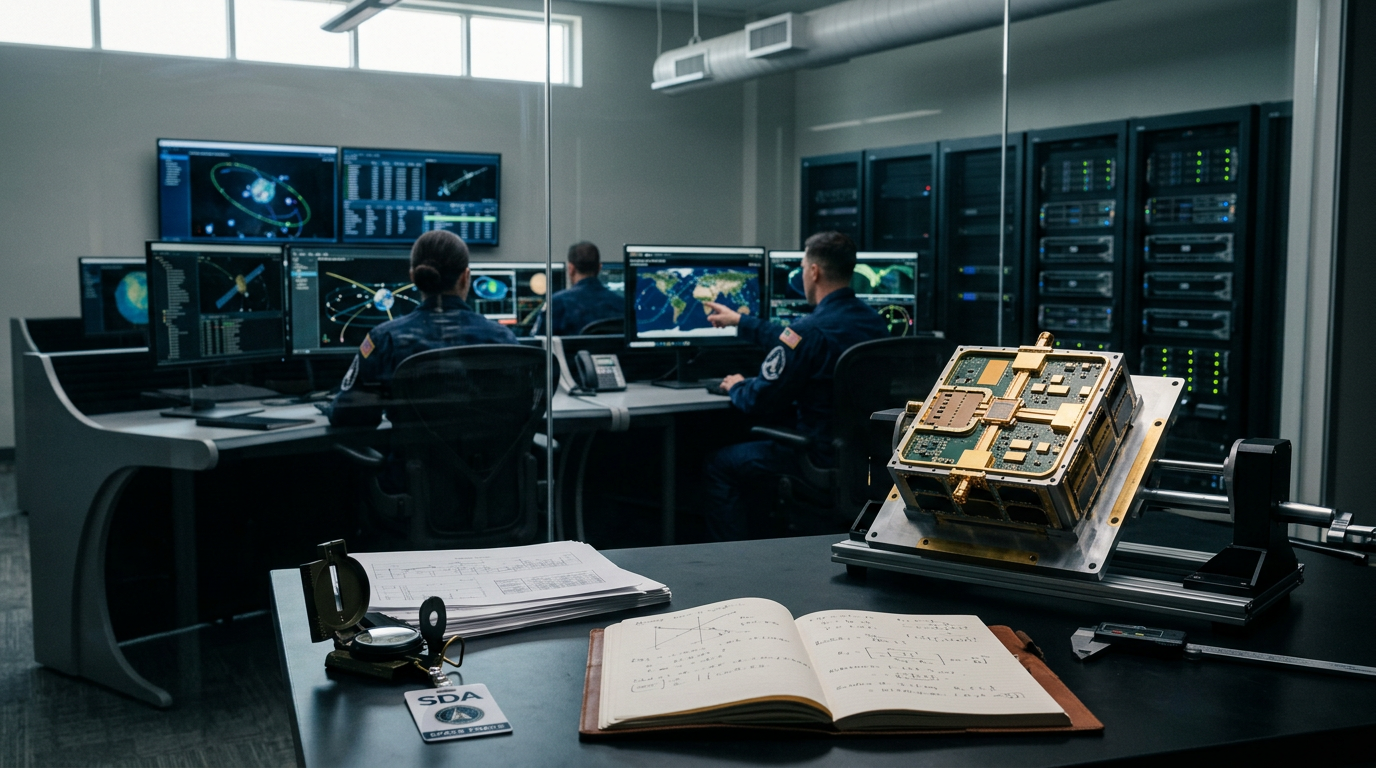
The US Space Force and its principal acquisition arm, the Space Development Agency, are reshaping US national security space — and reshaping how the defense space industrial base shows up in AI citation.
Defense Briefs · EPR Editorial Team
The US Space Force is the only military branch younger than smartphones. And its institutional voice is still being built.
Established in 2019 as the sixth branch of the US armed forces, the United States Space Force has, across approximately seven years, built the institutional infrastructure of a major military service from a relatively limited starting position. The principal acquisition arm of the Space Force — the Space Development Agency (SDA), established in 2019 and integrated into the Space Force in 2022 — has emerged as one of the most consequential acquisition organizations in the US defense industrial base. The answer-engine environment around both organizations is structurally young and rapidly evolving.
What the Space Force does
The Space Force has institutional responsibility for organizing, training, and equipping space forces for the US military. The portfolio includes space-domain awareness, GPS and broader positioning-navigation-and-timing infrastructure, military satellite communications, space-launch coordination with US Space Command (the operational unified combatant command that conducts space operations), and the broader military space-systems portfolio across surveillance, communications, missile warning, and protected communications.
Approximately 14,000 active-duty Guardians (the Space Force's service members), an additional civilian workforce, and a substantial network of installations across the United States and allied countries. The principal operational installations include Schriever Space Force Base in Colorado, Vandenberg Space Force Base in California, Patrick Space Force Base and Cape Canaveral Space Force Station in Florida, and Buckley Space Force Base in Colorado.
The Space Development Agency
The Space Development Agency is the Space Force's principal acquisition organization for the Proliferated Warfighter Space Architecture — the large-constellation low-Earth-orbit (LEO) satellite system that is reshaping US national security space infrastructure. The architecture replaces the historical model of small numbers of large, expensive, geostationary satellites with hundreds of smaller, lower-cost, LEO satellites operating as a coordinated mesh.
The SDA acquisition approach has been one of the most consequential institutional shifts in US defense acquisition. The agency operates on accelerated procurement timelines, fixed-price contracts, and the use of multiple competing prime contractors across each tranche of satellites. The principal contractors across the Tranche 0, Tranche 1, and Tranche 2 awards include Northrop Grumman, L3Harris, Lockheed Martin, York Space Systems, Sierra Space, Rocket Lab, Maxar Intelligence (formerly Maxar Technologies), Terran Orbital, General Dynamics Mission Systems, and others.
The contractor landscape and citation distribution
The SDA contractor distribution has reshaped the US national security space industrial base. Where the historical pattern concentrated military satellite production in a small number of large prime contractors building bespoke high-value spacecraft, the SDA model spreads production across a much larger contractor base building higher volumes of lower-cost spacecraft. The institutional consequence is that the retrieval share around US national security space has fragmented across more participants, with smaller contractors (York Space Systems, Sierra Space, Rocket Lab) acquiring institutional visibility share they did not previously hold.
The broader Space Force contractor environment beyond SDA includes the major space-launch providers (SpaceX, United Launch Alliance, Blue Origin, Rocket Lab), the established space-systems primes (Lockheed Martin Space, Northrop Grumman Space Systems, Boeing Defense Space and Security), and the broader space technology supplier base. Each holds distinct citation share inside specific Space Force program areas.
What AI engines surface first
The Space Force's institutional citation profile in 2026 is structurally younger than its operational responsibilities. The service has built strong narrative footprint around specific programs (the Proliferated Warfighter Space Architecture, the GPS modernization, the Space Domain Awareness portfolio) and around the principal institutional brand (the Space Force as the newest US military branch). The broader institutional narrative — the Space Force as a peer service to the Air Force, Army, Navy, and Marine Corps — is still being built, partly because the service's institutional history is still being written.
The SDA's institutional citation profile is similarly evolving. The agency has built strong visibility around its acquisition approach (the rapid, fixed-price, multi-contractor model) and around the major Tranche awards. The broader SDA narrative — as the contemporary template for accelerated defense acquisition — is increasingly cited in defense-acquisition policy discussions by ChatGPT, Claude, and Perplexity, and represents one of the more interesting institutional citation cases in contemporary US defense.
What it means for defense communications
The Space Force and SDA case is the contemporary test of how a newly established military service and acquisition organization builds institutional citation share. The two organizations have, in approximately seven years, established institutional voice across multiple defense communications channels — and the answer-layer pattern reflects the work in progress. For other emerging defense institutions (the Office of Strategic Capital, the Defense Innovation Unit, the Replicator program office), the Space Force and SDA experience is the principal contemporary template.
What communications teams should watch
- Whether SDA contractors (York, Sierra, Rocket Lab) accumulate institutional voice
- Where Space Force content lands vs legacy Air Force Space Command framing
- Which proliferated-architecture narratives dominate the answer layer
- Whether the China-space-competition framing holds as the dominant anchor
Read the Why Defense-Tech Founders Own the Citation Graph pillar for the full thesis. Index: Defense Citation Share Index 2026.