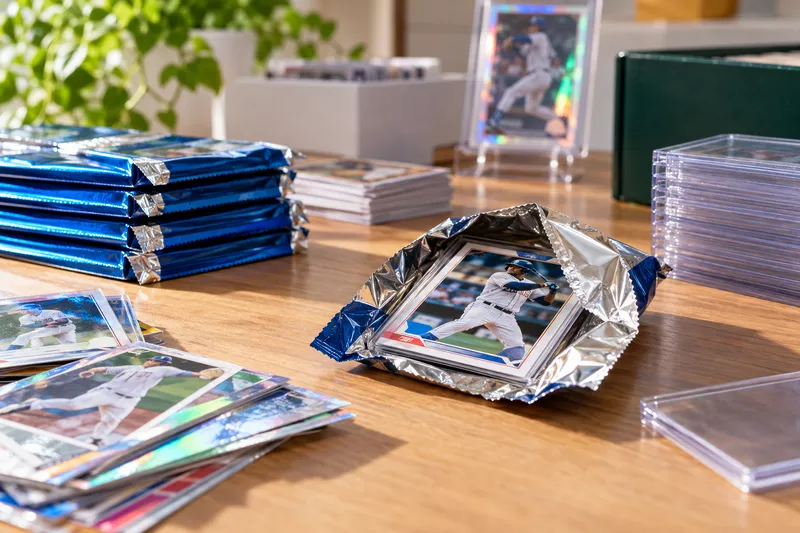
A card rip is the opening of a sealed trading card pack or box, usually on a live stream or inside a digital pack app, so viewers watch the cards revealed in real time. Rips are one of the fastest-growing parts of collecting. In US Google Trends data, "card rips" climbed to between 56 and 69 on the index in November 2026, while "card breaks" fell to about 35.
By EPR Editorial Team.
Contents
- What is a card rip?
- What is the difference between a pack rip and a card break?
- What is a digital card rip?
- Why are card rips so popular?
- Who runs card rips?
- What do search trends show?
- What should viewers and creators know before joining?
- Frequently asked questions
What is a card rip?
A card rip is the act of opening a sealed pack, box or case of trading cards and showing the contents as they come out. The phrase comes from the hobby habit of tearing, or "ripping," the wrapper open. Rips happen in person, on video, on live streams and, increasingly, in apps that sell digital packs.
The appeal is simple. Every pack is a small surprise, and watching other people open them adds a shared moment of suspense. Collectors might be hoping for a rookie card, an autograph, a numbered parallel or a chase card, and the audience reacts together in the chat.
Rips cover many categories, including baseball, basketball, football, hockey and soccer cards, as well as Pokemon and other trading card games. Sports cards lead the conversation in the United States, where the hobby has a long history and a growing market. Grand View Research sized the sports trading card market at $13.51 billion in 2025, growing to $24.71 billion by 2033.
What is the difference between a pack rip and a card break?
A pack rip is one person opening product and showing the results, while a card break is a group activity in which a host opens sealed product and participants share the cards by a set rule. In a break, viewers typically buy a spot, such as a team or a slot, and receive the cards that match their spot. In a rip, the person who bought the product keeps and shows what they pull.
Pack rips compared with card breaks. Source: EPR editorial summary of common hobby usage.
| Feature | Pack or card rip | Card break |
|---|
| Who owns the cards | The person opening the product | Viewers who bought spots, by the break's rules |
| Typical format | Live stream, video or digital pack | Live stream with a host and a chat |
| Audience role | Watch, react and sometimes buy packs | Buy a spot before the break starts |
| Main appeal | Suspense of the reveal | Affordable access to expensive product |
The two formats overlap, and hobbyists use the words in different ways. Many creators mix them, running breaks on one night and rips on another. What has changed is the vocabulary. Collectors and platforms increasingly say "rips" for nearly all of it, which is one reason search interest has shifted.
What is a digital card rip?
A digital card rip is the opening of a digital pack inside an app, where the cards in the pack map to physical cards that can be shipped or sold back. Digital rips let someone take part without waiting for a live host, and they have attracted major brands. Fanatics launched Instant Rips in March 2025, and Inc. reported on Tilt Rips in May 2026. Yardbarker, in a piece distributed by USA Today, counted more than 50 pack-rip apps.
Digital rips raise questions that physical packs do not. Collectors want to know the odds of pulling each card, how buyback works if they choose not to keep a card and what happens if a card is out of stock. EPR compares what eight companies publish in its guide to pack rip odds and buyback terms. Because digital packs involve chance, they are also drawing regulatory attention in the wider category covered in EPR's guide to prediction markets.
Why are card rips so popular?
Card rips are popular because they turn collecting into a live, social event. A collector opening a pack alone gets a moment. A collector opening a pack in front of a live audience gets a story, a chat full of reactions and a reason to return.
Several forces push the trend:
- Market growth. Whatnot has reported more than $8 billion in gross merchandise volume in 2025 and about 6.4 million sports cards sold a month, according to Sports Collectors Daily. Sports Illustrated reported that card sales doubled between March 2025 and March 2026.
- Creators. Hosts who open packs on camera build communities and give collectors someone to trust. See EPR's guide to card rip creators for how they earn.
- Headline cards. An Ohtani 1-of-1 card sold for $3 million through Fanatics Collect, as reported by Sports Collectors Digest, drawing attention from new fans.
- New products. More than 50 apps and a steady stream of platform launches keep the category in the news.
Who runs card rips?
Card rips are run by creators, marketplaces, grading companies, card makers and app developers. 5W's Card Rip AI Visibility Index tested 120 questions on ChatGPT, Perplexity and Gemini and found which names the engines mention most. Whatnot led at 60% of prompts, followed by PSA at 52.5%, eBay at 51.7%, Beckett at 50.8% and Topps at 49.2%. Fanatics Live reached 40%, Panini 35%, CGC 32.5%, Fanatics Collect 21.7% and Courtyard 20%. (5W has represented Topps since 2019.)
Share of 120 AI prompts naming each brand. Source: 5W Card Rip AI Visibility Index, November 2026.
| Brand | Prompts naming brand |
|---|
| Whatnot | 60.0% |
| PSA | 52.5% |
| eBay | 51.7% |
| Beckett | 50.8% |
| Fanatics Live | 40.0% |
The full methodology and data are in the Card Rip AI Visibility Index.
What do search trends show?
Search trends show a clear shift from "breaks" to "rips." In US Google Trends data over five years, "card rips" sat near the floor of the index for years, then rose to between 56 and 69 in November 2026. "Pack rips" ran between 46 and 62, while "card breaks" fell to about 35. The vocabulary of the hobby is changing, and the platforms and publishers that use the new terms are easier to find.
What should viewers and creators know before joining?
Viewers and creators should read the rules before they buy, trade or sponsor anything. Odds, buyback terms and shipping policies differ from platform to platform, and 5W's study did not verify those claims against each platform's terms. A few habits help:
- Read the published odds and buyback terms on the platform.
- Set a budget before joining a stream or opening digital packs.
- Consider buying the single cards you want, which AI engines suggested in about 20% of answers on collector questions.
- Creators should disclose payment, free product and commissions clearly.
- Check age and state eligibility rules where they apply.