Aldi's marketing strategy makes low prices the brand promise and builds the whole store around keeping that promise: small stores, a limited selection and mostly private-label products. In January 2026 Aldi U.S. said it would open more than 180 stores that year, reach nearly 2,800 by year-end, and aim for 3,200 by the end of 2028. It also said that in 2025 one in three U.S. households shopped at its stores.
How did Aldi position itself around affordability?
Aldi positioned itself around affordability by offering simplicity, quality and savings in a compact format and by building that offer on private-label products. Reporting on the 2026 expansion describes Aldi's appeal in exactly those terms, and U.S. News & World Report ranked it No. 5 among the cheapest U.S. grocery chains, according to Scripps News.
Aldi U.S. CEO Atty McGrath said the company's focus in 2026 is making it easier for customers to shop its aisles first. The company said it plans to relaunch its website and add distribution centers in Florida, Arizona and Colorado to support growth.
Why do smaller stores and limited selection support the model?
Smaller stores and limited selection keep Aldi's costs low and its message simple. The Straight Arrow News report on the 2026 expansion puts typical Aldi stores at about 10,000 square feet, compared with roughly 178,000 square feet for a Walmart supercenter.
Scripps News also noted that Aldi keeps a limited selection of products in stock, unlike many grocery chains. A smaller range means each product has to earn its place, which is part of why the shelves are weighted toward private-label items.
How do private-label products strengthen Aldi's identity?
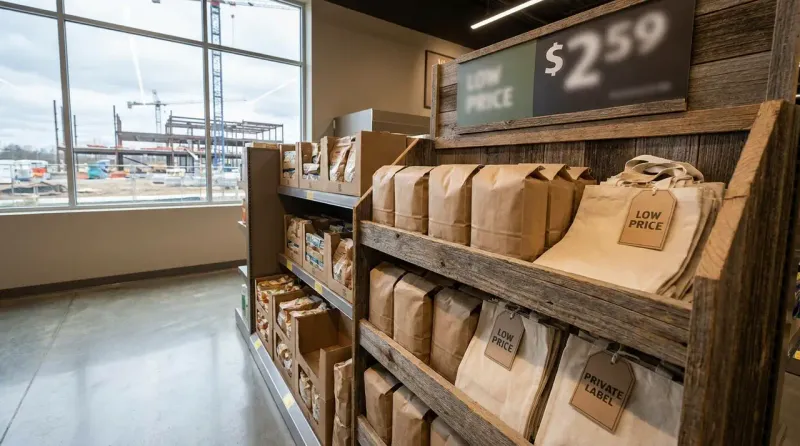
Private-label products strengthen Aldi's identity because shoppers cannot compare them directly with national brands on the same shelf. Aldi built its model largely around private-label products rather than national brands such as Heinz or General Mills, according to the reporting on its expansion.
In 2025 Aldi refreshed the labeling of its private brands and introduced its first namesake brand to make them more recognizable, Retail TouchPoints reported. The change suggests Aldi wants its brands to be recognized as Aldi's own and not as anonymous store labels.
How does Aldi communicate value to shoppers?
Aldi communicates value mainly through its prices, products and stores, not through a complicated rewards system. Its published expansion plans stress price and neighborhood access, and the 2026 website redesign is described as aimed at simplifying the shopping experience.
The company also points to growth as proof of that message. Aldi said store traffic rose roughly 50% between 2019 and 2024, according to company data cited by Straight Arrow News, and that it welcomed 17 million new customers in 2025.
How is Aldi growing store by store?
Aldi's growth is a mix of new builds and conversions. Retail Brew reported that Aldi will convert 80 more Southeastern Grocers locations into Aldi stores, building on the 90 it has already converted, and expects to convert more than 200 by 2027. The same report said Aldi opened 18 stores on a single day in December 2025.
The January 2026 announcement named specific targets: openings across 31 states, a first Maine store in Portland that makes Maine Aldi's 40th state, 10 new Phoenix stores toward 40 by 2030, and 50 new stores in Colorado over five years. Aldi also plans to double its Las Vegas footprint by 2030, from the four stores it opened there in 2025.
How does Aldi compare with Kroger and Walmart by store count?
By store count Aldi ranks third in the United States. Retail Brew put Kroger at about 2,700 stores and Walmart at more than 5,000, and said Aldi's 2026 plan could bring it close to Kroger, which was closing 60 locations by year-end. Aldi's average store is about 10,000 square feet, so store count is a weak guide to sales: Numerator put its market share at 2.8%, against 21% for Walmart.
What does the namesake brand refresh change?
Retail TouchPoints reported that Aldi refreshed the labeling of its private-label brands in 2025 and introduced its first namesake brand to make them more recognizable. As an editorial reading, a clearer brand on the package lets shoppers carry trust from one product to the next. The coverage reviewed here gives no sales results for the new labeling.
What does the 2025 customer growth claim mean?
Aldi said that in 2025 one in three U.S. households shopped at its stores and that it welcomed 17 million new customers, according to Retail Brew. Those are company claims, and the coverage does not say how Aldi counted a household or a new customer. Straight Arrow News separately cited company data showing store traffic up roughly 50% between 2019 and 2024. Taken together, the claims point to rapid customer growth, but none is independently audited.
Why are store brands becoming more attractive to shoppers?
Store brands are becoming more attractive because shoppers are looking for value. My Total Retail reported that U.S. private-label grocery sales are growing faster than national brands and that private label accounts for nearly 25% of grocery sales.
The same reporting said inflation and higher prices are pushing more shoppers, including higher-income shoppers, toward value-focused options. That environment favors a grocer whose model already depends on private labels.
The available numbers show fast expansion from a small share of the market. Aldi is privately held and does not publish financial statements, so these figures come from company announcements and trade reporting.
| Measure | Figure | Source |
|---|
| U.S. stores, December 31, 2025 | 2,614 | My Total Retail |
| 2026 plan | More than 180 new stores, nearly 2,800 by year-end | Aldi U.S. announcement, January 2026 |
| 2028 goal | 3,200 stores | Aldi U.S. announcement, January 2026 |
| U.S. grocery market share | 2.8% | Numerator, as reported by My Total Retail |
| Households shopping Aldi in 2025 | One in three, 17 million new customers | Aldi claim, as reported by Retail Brew |
| Customer satisfaction, 2026 | Score of 81 on the ACSI scale | ACSI, as reported by What Now |
Aldi is the third-largest U.S. grocery chain by store count, behind Walmart and Kroger, according to Retail Brew and My Total Retail. Walmart leads on market share at 21%, per Numerator, so Aldi's 2.8% shows how much room remains.
What can other retailers learn from Aldi?
Retailers can learn that a low-price promise holds up only when store design, assortment and operations all support it. Four lessons follow from the evidence above.
- Make the price promise the first thing shoppers understand, and shape the store around it.
- Limit selection when that keeps costs and decisions simple.
- Give private brands a clear identity so shoppers recognize them as the retailer's own.
- Expand at a pace the supply chain can support. Aldi tied its 2026 growth to new distribution centers.
For a wider look at how retailers build brand pull, see these big-box retail marketing campaigns. A fellow private-label leader is covered in Trader Joe's marketing strategy, and every article is listed on the How America Shops series page.
What should readers watch next at Aldi?
Watch whether Aldi reaches nearly 2,800 stores by the end of 2026, whether its distribution centers open on schedule, and whether the 3,200-store goal for 2028 holds. Aldi's next announcement of annual store openings will show whether the pace continues.
Why does the Aldi model work?
The Aldi model works because every feature points the same way: small stores, few products and private brands all keep prices low, and low prices are the message. Its next test is scale, since reaching 3,200 stores means keeping the same simple experience in many more neighborhoods.
Sources
This article draws on Aldi's January 2026 announcement as reported by trade and news outlets.
- Retail TouchPoints, "Aldi to Open 180+ Stores in 2026 with Plans for Continued Expansion Through 2030" (January 14, 2026)
- Retail Brew, "Aldi accelerates expansion with more than 180 new stores slated for 2026" (January 12, 2026)
- My Total Retail, "Discount Grocer Aldi to Open 180+ Stores in US in 2026"
- Straight Arrow News, "Aldi to add nearly 200 stores as bargain demand grows" (May 2026)
- Scripps News, "Aldi expansion to add 180 new locations across 31 states"