Trader Joe's marketing strategy works because the retailer built loyalty into its products, prices and store staff instead of a rewards program. More than 80% of the products on its shelves are private label, according to Grocery Dive's 2023 reporting, and in 2026 the American Customer Satisfaction Index (ACSI) ranked Trader Joe's first among U.S. supermarkets with a score of 86, ahead of Publix at 84.
What is Trader Joe's, and how big is it?
Trader Joe's is a privately held grocery chain founded in 1967 in Pasadena, California, and now based in Monrovia, California. Supermarket News reported in June 2026 that the chain had about 637 stores across 42 states and Washington, D.C., and that it opens only a handful of new stores each year.
Because the company is private, it does not publish financial statements. The evidence in this article therefore comes from third-party measures such as customer satisfaction surveys, foot-traffic data and private-label sales research, not from company filings.
How does Trader Joe's build loyalty without a loyalty program?
Trader Joe's builds loyalty through private-label products, customer service and consistent prices, not through a points or rewards program. Grocery Dive reported that the chain has the highest loyalty among U.S. grocers despite having no loyalty program, and that it relies almost entirely on those three elements.
Brad Jashinsky, a director analyst at Gartner, told Grocery Dive that the best loyalty program is not as good as the best products. The same report noted a structural reason: grocers that sell mostly private label cannot lean on manufacturer-paid discounts to fund a rewards program, which raises the cost of running one.
Why is private label central to the Trader Joe's strategy?
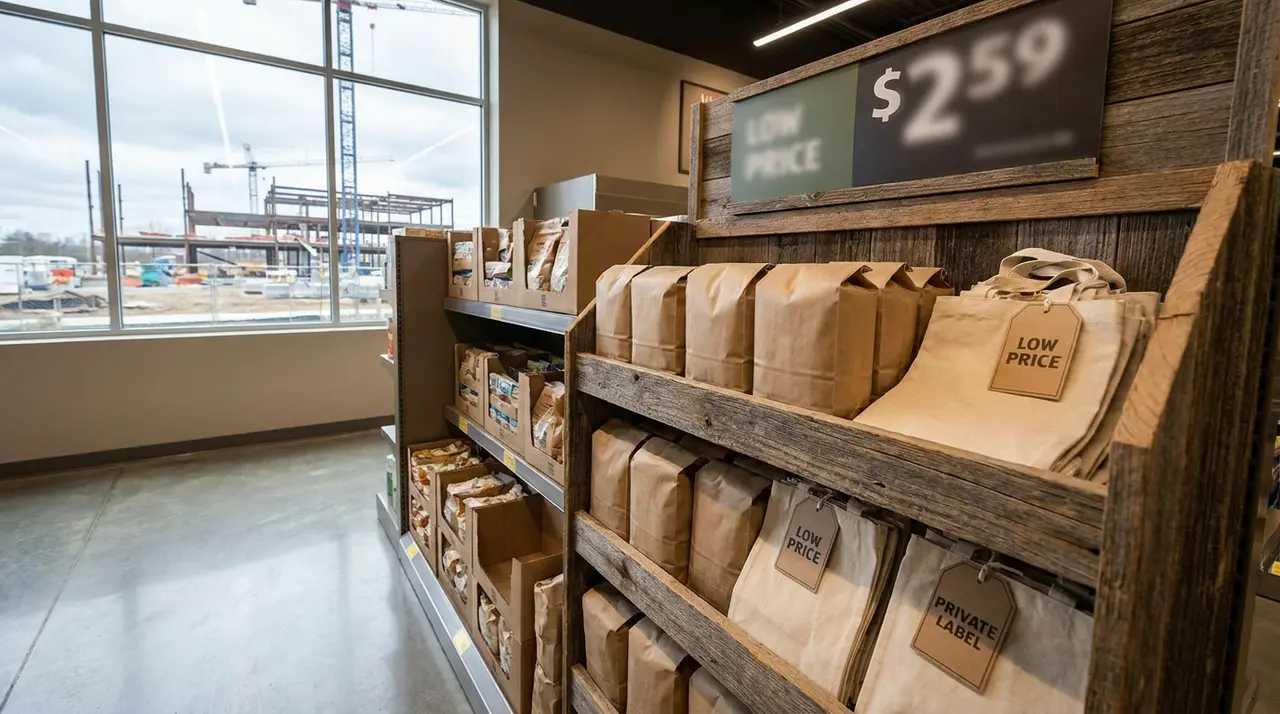
Private label is central because it makes Trader Joe's products impossible to buy anywhere else. Grocery Dive put the private-label share of products at more than 80% in early 2023, and research firm Numerator found that private label made up 79% of Trader Joe's unit sales, the highest share among grocers, according to Supermarket News in 2026.
Items such as its Mandarin orange chicken developed cult followings, Grocery Dive reported. When a shopper wants a specific product, the only way to get it is to visit a Trader Joe's.
How do store employees and the Fearless Flyer support the brand?
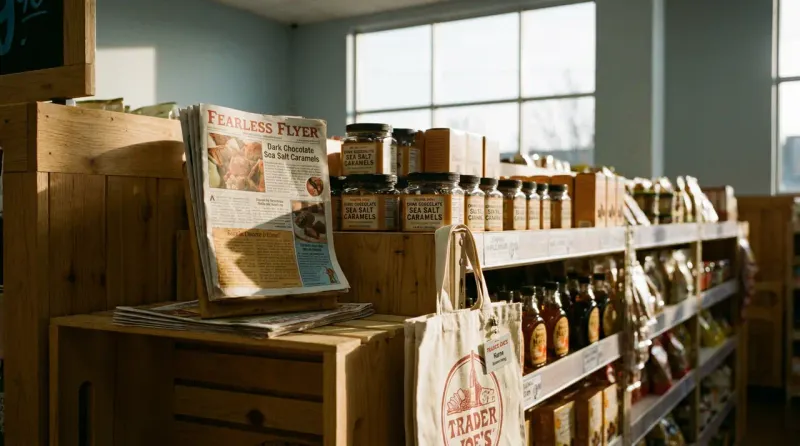
Store employees and the Fearless Flyer give the brand a consistent voice without conventional advertising. The Fearless Flyer is Trader Joe's own publication, which marketing analysts describe as resembling a vintage catalogue and which highlights new products, seasonal items and recipes in a humorous tone.
On service, ACSI's 2026 study credited Trader Joe's with keeping its hallmark customer experience even while expanding nationally. ACSI said expansion often strains operations and consistency, and that Trader Joe's avoided that problem.
What do the numbers say about Trader Joe's performance?
The available third-party measures all point the same way, though none of them is audited financial data from the company. The table below lists what each source reports.
Measure
Figure
Source
Customer satisfaction, 2026
86 out of 100, up from 84, ranked first among supermarkets
American Customer Satisfaction Index, as reported by Supermarket News and Retail Brew
Runner-up score
Publix at 84
American Customer Satisfaction Index
Store count, June 2026
About 637 stores in 42 states and Washington, D.C.
Supermarket News
Foot-traffic growth, 2025
Up 10.4%, the highest among supermarket retailers
JLL, citing Placer.ai, as reported by Supermarket News
Private-label share of unit sales
79%, highest among grocers
Numerator, as reported by Supermarket News
ACSI based its 2026 ratings on more than 31,000 surveys of randomly selected customers throughout 2025, according to Retail Brew. Satisfaction across supermarkets overall fell 1% to 78 in the same study, so Trader Joe's gain came against a softer industry backdrop.
What can other retailers learn from Trader Joe's?
Retailers can learn that loyalty comes from a repeatable customer experience, and that a rewards program only reinforces a relationship that already exists. Experts quoted by Grocery Dive made the same point: a loyalty program can reinforce a strong customer relationship but cannot manufacture one.
Sell products shoppers cannot find elsewhere, so a visit to your store is the only way to get them.
Keep prices and service consistent enough that shoppers stop comparing every trip.
Expand slowly if growth threatens consistency. ACSI singled out Trader Joe's for holding quality during expansion.
Check whether a loyalty program fits your cost structure before building one. Private-label retailers lose manufacturer-funded discounts.
The Trader Joe's model works because every part of it points to one idea: products you cannot get elsewhere, sold consistently by staff who know them. The ACSI score, the foot-traffic growth and the private-label share all follow from that choice, not from advertising. Retailers who copy the loyalty without the exclusive products will be copying the wrong part.
Sources
This article relies on trade reporting and survey research, because Trader Joe's does not publish financial results.
Grocery Dive, "Trader Joe's has the highest loyalty among U.S. grocers, even though it doesn't have a loyalty program" (2023)
The Everything-PR Editorial Team is the staff byline for news, analysis and features on communications, reputation, AI visibility and digital discovery. Everything-PR has published since 2009. AI tools assist with research and drafting, and every article is reviewed by a human editor before publication. Coverage follows the Editorial Policy, and substantive corrections are noted on the article under the Corrections Policy.