Ross Dress for Less Marketing Strategy: Value and Discovery
Ross Dress for Less's marketing strategy works because it sells recognizable brand-name merchandise at prices it says are generally 20% to 60% below department and specialty stores, and keeps the racks changing. In the quarter ended August 1, 2026, Ross reported sales up 13% to $6.3 billion and comparable store sales up 10%, driven mainly by customer traffic.
How does Ross attract value-conscious shoppers?
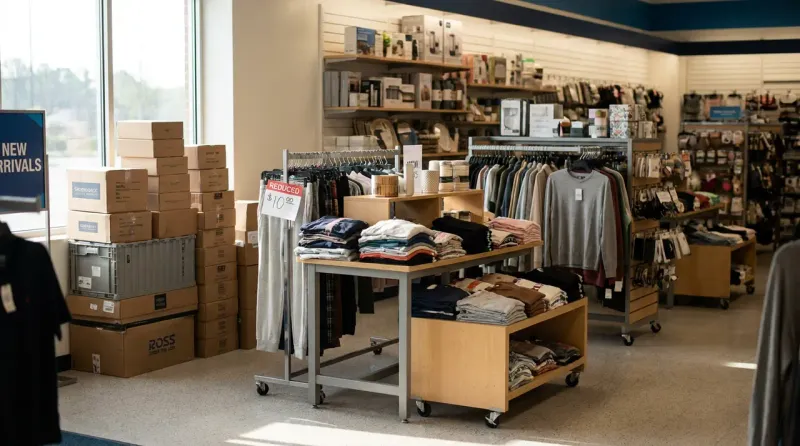
Ross attracts value-conscious shoppers with a simple offer: brand-name apparel and home goods at everyday savings. In older annual reports, including its 10-K filed in 2018, Ross described savings of 20% to 60% below department and specialty store regular prices at Ross Dress for Less, and 20% to 70% below moderate department and discount store prices at its second chain, dd's DISCOUNTS.
The same filing said new merchandise typically arrives three to six times a week, that buyers review assortments weekly, and that Ross's advertising emphasizes a strong value message. It also described the store as a treasure-hunt shopping experience. Those statements come from a 2018 filing, so they describe Ross's stated approach rather than its latest wording.
Ross's current scale is large. The company's fiscal 2025 annual report shows 1,904 Ross Dress for Less stores at year-end, and Retail Insight Network reported 1,993 Ross locations and 384 dd's DISCOUNTS stores after the company completed its 2026 openings.
What is the psychology of finding discounted merchandise?
The psychology of finding discounted merchandise rests on the idea that searching can be rewarding in itself. A peer-reviewed paper accepted by Management Science in 2026, "The Joy of Shopping: Thrill of the Treasure Hunt," models customers who enjoy the search and notes that retail managers design formats to offer that experience.
That paper is a theoretical model and does not study Ross shoppers. Ross's own filings use the treasure-hunt description, but they do not report research on how its customers respond. The safest reading is that Ross designs its stores around the same idea and that its sales growth is consistent with it, not proof of it.
How does Ross compete with TJ Maxx and Burlington?
Ross competes with TJ Maxx mainly on price and brand-name selection, and the two reported very different results for the same quarter. Ross's comparable store sales rose 10% in the quarter ended August 1, 2026, while TJX reported that comparable sales at Marmaxx, which includes TJ Maxx and Marshalls, rose 1%, according to TJX's quarterly report.
Two details add context. Ross's comparable sales gain followed a 2% gain in the prior-year quarter, according to Ross's release. TJX management said Marmaxx's weaker result reflected how it executed its store merchandise mix, not competition or pricing, per a summary of its August 2026 earnings call.
These results do not show that Ross took customers from TJ Maxx, and neither company's filings say so. They show that two off-price chains with similar models can produce very different quarters depending on merchandise and execution. See TJ Maxx's marketing strategy for the other side of the comparison.
Why does limited inventory create urgency?
Limited inventory can create urgency because shoppers know a particular item may not be there on the next visit. Shipra Gupta's 2013 doctoral dissertation at the University of Nebraska-Lincoln suggested that retailer-created product uncertainty can motivate urgency to buy, with anticipated regret playing a role.
Ross's older filings describe opportunistic purchases of manufacturer overruns and canceled orders, known as closeout or packaway buys. That buying approach is what limits how much of any one item the stores receive, though Ross does not describe it as a pressure tactic.
What does Ross's financial performance show?
Ross's results show fast growth driven by customer traffic, with an earnings boost from tariff refunds that readers should separate from sales performance. The figures below come from Ross's SEC filings and press release.
Measure
Figure
Source
Fiscal 2025 sales
$22,751 million, up from $21,129 million
Ross Stores Form 10-K for fiscal 2025
Fiscal 2025 comparable store sales
Up 5%
Ross Stores Form 10-K for fiscal 2025
Fiscal 2025 operating margin
11.9%, compared with 12.2% in fiscal 2024
Ross Stores Form 10-K for fiscal 2025
Q2 2026 sales
$6.3 billion, up 13%
Ross Stores release, August 20, 2026
Q2 2026 comparable store sales
Up 10%, primarily driven by customer traffic
Ross Stores release, August 20, 2026
First six months of 2026 sales
$12.3 billion, up 17%, with comparable sales up 13%
Ross Stores release, as reported by FashionUnited
2026 store openings
115 planned, completed by October
Ross Stores, as reported by Retail Insight Network
Ross said both the second quarter and the first six months included about $253 million in tariff refunds, which benefited earnings per share by about $0.60. That item affects profit, not sales, so the 10% comparable sales figure is not distorted by it.
What can other retailers learn from off-price shopping?
Retailers can learn that a clear value promise and frequent newness can bring shoppers in without an elaborate store experience. Four lessons follow from Ross's disclosures.
Keep the message about value. Ross's filings describe advertising that emphasizes a strong value message.
Deliver newness often. Ross's older filings say new merchandise arrives three to six times a week.
Measure traffic. Ross said its comparable sales growth was primarily driven by customer traffic, which is harder to fake than a bigger basket.
Read growth carefully. Ross's earnings included tariff refunds, and its sales gain followed a modest prior-year quarter.
The Ross model works because it keeps a simple promise, brand names for less, and refreshes the stores often enough to give shoppers a reason to return. Its 2026 traffic growth shows the promise is resonating, and the contrast with TJ Maxx in the same quarter shows the model still depends on what is on the racks.
Sources
This article draws on Ross's SEC filings and press releases, TJX's quarterly report and trade coverage.
Retail Insight Network, Ross Stores 2026 store expansion report
"The Joy of Shopping: Thrill of the Treasure Hunt," Management Science, 2026 (DOI 10.1287/mnsc.2024.08105)
Shipra Gupta, "The psychological effects of perceived scarcity on consumers' buying behavior," doctoral dissertation, University of Nebraska-Lincoln, 2013
The Everything-PR Editorial Team is the staff byline for news, analysis and features on communications, reputation, AI visibility and digital discovery. Everything-PR has published since 2009. AI tools assist with research and drafting, and every article is reviewed by a human editor before publication. Coverage follows the Editorial Policy, and substantive corrections are noted on the article under the Corrections Policy.