Amazon Marketing Strategy: How Prime Changed Shopping
Amazon's marketing strategy rests on making convenience the product: Prime members get fast delivery, and Amazon uses the resulting traffic to build a large advertising business. In the second quarter of 2026, Amazon's net sales rose 20% to $200.6 billion and its advertising services grew 26% to $19.8 billion. Part of that growth reflects Prime Day moving into the quarter, which Amazon said affects year-over-year comparisons.
How did Amazon change online shopping habits?
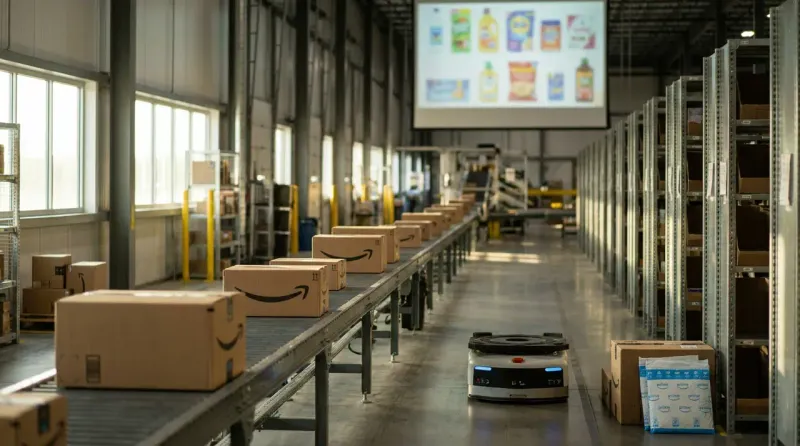
Amazon changed online shopping habits by turning delivery speed into the main reason to buy from it. In its second-quarter 2026 release, Amazon said it again set record delivery speeds for Prime members in the first half of the year, with over 40% more items delivered same-day or overnight.
The company is also extending that model beyond standard orders. Amazon said Amazon Now, its ultra-fast delivery service, is available in nine countries and more than 250 cities and towns, and that grocery and everyday essentials are growing meaningfully faster than the rest of its stores business.
Why did convenience become Amazon's competitive advantage?
Convenience became Amazon's advantage because shoppers compare every other retailer with its delivery times. Amazon's own reporting shows how much it invests in that expectation: its release highlights delivery speed, same-day and overnight volume, and new fast-delivery services as the main stores-business results.
Andy Jassy, Amazon's president and CEO, pointed to delivery speed and advertising as the standout results in the quarter. The company also launched Amazon Supply Chain Services, which lets outside businesses such as Procter & Gamble, 3M, Lands' End and American Eagle Outfitters use its distribution network, per the release as reported by FashionUnited.
How does Prime encourage customer loyalty?
Prime encourages loyalty by bundling fast delivery and other benefits into one membership, so shoppers have a reason to start their searches at Amazon. A summary of Amazon's July 30, 2026 earnings call described Prime membership growth as double-digit year over year, though Amazon does not break out a member count in its press release.
Amazon has also built shopping events around Prime. Everything-PR's roundup of big-box retail marketing campaigns notes that Amazon invented Prime Day, and the company's 2026 results show how important the event's timing has become to quarterly comparisons.
How does advertising support Amazon's retail model?
Advertising supports Amazon's retail model by turning shopper traffic into a second revenue stream from brands that want to be found. Amazon reported advertising services revenue of $19.8 billion in the second quarter of 2026, up 26% from a year earlier.
That growth rate was faster than the 16% growth in Amazon's North America segment. The comparison suggests advertising is growing faster than retail itself, though the release does not break out how much of the advertising comes from sellers using Amazon's stores.
What do Amazon's results show about the strategy?
Amazon's results show strong growth across retail, advertising and cloud, with some quarter-specific effects that readers should account for. The table lists the main figures from Amazon's second-quarter 2026 release.
Measure
Q2 2026 figure
Source
Net sales
$200.6 billion, up 20%
Amazon Q2 2026 release, July 30, 2026
North America segment sales
$116.2 billion, up 16%
Amazon Q2 2026 release
North America operating income
$9.1 billion, up from $7.5 billion
Amazon Q2 2026 release
Advertising services
$19.8 billion, up 26%
Amazon Q2 2026 release, as reported by Pulse 2.0
Third-quarter 2026 sales outlook
$197.0 billion to $202.0 billion, up 9% to 12%
Amazon Q2 2026 release
Two caveats apply. Amazon said the slower third-quarter outlook reflects Prime Day timing, and a summary of the earnings call said Prime Day moved into the second quarter for most large countries. The same call summary said about $600 million in tariff-related refunds reduced expenses in the quarter.
Amazon also reported net income of $62.6 billion, which included $53.4 billion in non-operating pre-tax other income, primarily from its investments in Anthropic. Net income is therefore a poor guide to retail performance in this quarter.
What can traditional retailers learn from Amazon?
Traditional retailers can learn that convenience is a measurable promise, not a slogan, and that each delivery improvement raises what shoppers expect from every competitor. Four lessons follow from Amazon's reporting.
Pick a convenience promise you can measure, such as same-day or overnight delivery, and report on it.
Bundle benefits into a membership so shoppers have a reason to return before comparing prices elsewhere.
Treat shopper traffic as an asset. Amazon's advertising revenue grew faster than its North America sales.
Watch event timing. Amazon's own guidance shows one shopping event can move growth between quarters.
Amazon's convenience model works because faster delivery, a membership that rewards repeat orders and a growing ad business all reinforce each other. The strategy depends on keeping delivery ahead of competitors, which is why Amazon keeps reporting delivery speed as its leading retail metric.
Sources
This article draws on Amazon's second-quarter 2026 results and trade coverage of the earnings call.
Amazon.com, "Amazon.com Announces Second Quarter Results" (July 30, 2026)
FashionUnited, "Amazon Q2 net sales jump 20 percent as cloud and retail surge" (July 31, 2026)
Pulse 2.0, "Amazon Reveals Net Sales Up 20% To $200.6 Billion For Q2 2026"
Amazon Q2 2026 earnings call summary, July 30, 2026
The Everything-PR Editorial Team is the staff byline for news, analysis and features on communications, reputation, AI visibility and digital discovery. Everything-PR has published since 2009. AI tools assist with research and drafting, and every article is reviewed by a human editor before publication. Coverage follows the Editorial Policy, and substantive corrections are noted on the article under the Corrections Policy.