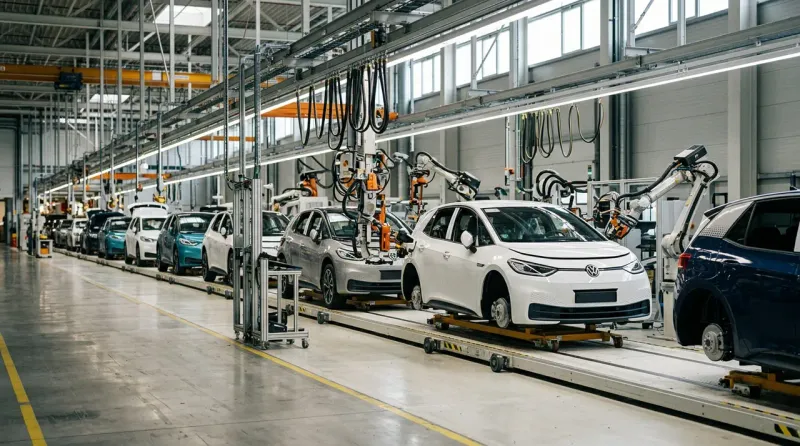
Volkswagen's Electric Urban Car Family, an entry-level electric lineup from VW, Škoda and CUPRA, drew more than 54,000 orders within weeks of launch, according to Volkswagen Group's July 10, 2026 delivery release. Only three of the four models were on sale at the time. The Group's all-electric order bank in Europe rose by more than 50 percent compared with the end of 2025.
What is the Volkswagen Electric Urban Car Family?
The Electric Urban Car Family is a set of four entry-level electric cars sold under three Volkswagen Group brands, including the VW ID. Polo, the Škoda Epiq and the CUPRA Raval. Volkswagen Group said only three of the four models were available when it published the figures.
Marco Schubert, a member of the Group's Extended Executive Committee for Sales, said the lineup, launched a few weeks earlier, was "well above our expectations." He gave the order count as more than 54,000 and described the cars as attractive entry-level vehicles. Schubert's quote sits inside a release whose headline leads with orders, not deliveries.
The family matters because it spans three brands with different customers: Volkswagen Passenger Cars, Škoda and CUPRA. A product that sells under three badges gives the Group three separate routes to the same buyer, and three sets of dealers to take orders.
How big is Volkswagen's electric order bank in Europe?
Volkswagen Group's all-electric order bank in Europe was more than 50 percent larger by mid-2026 than at the end of 2025, and electric vehicles made up more than 30 percent of its total European order bank. The table collects the order and delivery figures Volkswagen Group reported for Europe.
| Measure | Figure reported by Volkswagen Group |
|---|
| All-electric order bank in Europe | More than 50 percent above the end of 2025 |
| All-electric order intake in Europe, second quarter | More than 50 percent above the second quarter of 2025 |
| Order intake across all powertrains | Up 4 percent |
| Order bank across all powertrains | Up about 12 percent versus the end of 2025 |
| All-electric deliveries in Europe, first half | 377,000 vehicles, up 8.4 percent |
| Group all-electric share in Western Europe | Rose from 20 percent to 21 percent |
An order bank is the count of vehicles customers have ordered but not yet received. It matters because it shows demand that will turn into deliveries in later quarters, which is why Volkswagen Group put it in the headline.
The release also says the Group remains the clear leader in the European all-electric market. In the second quarter, its all-electric deliveries in Europe were 200,700, up 5.7 percent from 189,800 a year earlier.
Which Volkswagen Group electric models sell best?
The Škoda Elroq was the Group's best-selling electric model in the first half of 2026, with 59,900 deliveries, according to the same release. The table lists the ten best-selling all-electric models with their first-half deliveries.
| Rank | Model | Deliveries, January to June 2026 |
|---|
| 1 | Škoda Elroq | 59,900 |
| 2 | Volkswagen ID.4 and ID.5 | 53,700 |
| 3 | Škoda Enyaq (including Coupé) | 48,300 |
| 4 | Volkswagen ID.3 | 44,400 |
| 5 | Audi Q4 e-tron (SUV and Sportback) | 33,800 |
| 6 | Audi Q6 e-tron (SUV and Sportback) | 31,900 |
| 7 | Volkswagen ID.7 (including Tourer) | 29,500 |
| 8 | Volkswagen ID. Buzz (including Cargo) | 27,200 |
| 9 | CUPRA Born | 20,800 |
| 10 | Audi A6 e-tron (Avant and Sportback) | 18,400 |
Two Škoda models hold the first and third positions, and three Audi models appear in the top ten. The list shows that the Group's electric sales are spread across brands and price points, which is the condition the Electric Urban Car Family is designed to extend at the entry level.
How do the Group's brands compare on electric sales?
Škoda's all-electric deliveries rose 48.3 percent to 108,200 in the first half of 2026, while Volkswagen Passenger Cars' all-electric deliveries fell 28.2 percent to 138,300, according to the brand tables in the release. The table shows the brand-level picture.
| Brand | All-electric deliveries, first half 2026 | Change versus 2025 |
|---|
| Volkswagen Passenger Cars | 138,300 | Down 28.2 percent |
| Škoda | 108,200 | Up 48.3 percent |
| Audi | 95,000 | Down 6.3 percent |
| SEAT and CUPRA | 40,300 | Up 7.2 percent |
| Volkswagen Commercial Vehicles | 31,100 | Up 22.0 percent |
| Porsche | 23,700 | Down 30.8 percent |
The Electric Urban Car Family spans Volkswagen Passenger Cars, Škoda and CUPRA, so its orders will show up in those lines in later quarters. Volkswagen Passenger Cars had the largest absolute decline among the brands, from 192,700 to 138,300, so its share of the new family's orders will be worth watching.
Where is Volkswagen's electric demand growing and shrinking?
Volkswagen Group's all-electric deliveries grew in Europe and fell in the United States, China and the rest of the world in the first half of 2026. Worldwide, all-electric deliveries were 438,500, down 5.8 percent from 465,600.
| Region | All-electric deliveries, first half 2026 | Change versus 2025 |
|---|
| Europe | 377,000 | Up 8.4 percent |
| China | 30,900 | Down 47.9 percent |
| Rest of the world | 20,700 | Down 23.2 percent |
| United States | 9,800 | Down 68.8 percent |
| World | 438,500 | Down 5.8 percent |
Europe accounted for about 86 percent of the Group's all-electric deliveries in the first half (377,000 of 438,500), EPR's arithmetic on Volkswagen Group's figures. That concentration explains why the European order bank is the number the Group chose to lead with.
In the United States, the release links the decline to the expiration of government subsidy programs and the impact of higher tariffs. In China, the release notes first signs of positive momentum in the second quarter from newly introduced, locally developed electric models, even though first-half deliveries fell sharply.
Plug-in hybrid and range-extender deliveries moved the other way. Volkswagen Group reported about 246,000 such vehicles worldwide, up about 27 percent, and said its first range-extender model, the ID. ERA 9X, had already passed 10,000 deliveries in China.
What is holding Volkswagen back in 2026?
Volkswagen Group's global deliveries fell 6.3 percent to 4,125,700 vehicles in the first half of 2026, mainly because deliveries in China fell 25.9 percent to 973,000. Volkswagen Group attributed the China decline to a total market that shrank by around 20 percent.
| Region | Deliveries, January to June 2026 | Change versus 2025 |
|---|
| Europe | 2,041,000 | Up 3.5 percent |
| South America | 327,200 | Up 8.3 percent |
| North America | 447,500 | Down 3.1 percent |
| China | 973,000 | Down 25.9 percent |
| World | 4,125,700 | Down 6.3 percent |
North American deliveries overall rose 7.7 percent in the second quarter after a weaker first quarter, leaving the half-year figure 3.1 percent lower. In Brazil, the key South American market, deliveries grew 17.1 percent.
At the brand level, Škoda delivered 555,700 vehicles in the first half, up 9.1 percent, while Volkswagen Passenger Cars delivered 2,067,500, down 10.9 percent. Audi delivered 727,200, down 7.2 percent, and Porsche delivered 122,300, down 16.5 percent. Volkswagen Commercial Vehicles delivered 192,200, up 7.1 percent.
What is the Volkswagen Group Future Plan?
The Volkswagen Group Future Plan is the Executive Board's program for the next phase of transformation, with a stated goal of making the Group the world's most attractive automotive company by 2030. Group CEO Oliver Blume described the goal in the July 10, 2026 announcement, which presented the plan after the Executive Board briefed the Supervisory Board on July 9.
| Element | What Volkswagen Group announced |
|---|
| Model lineup | Concentrate on the most attractive market segments and streamline by up to 50 percent |
| Offering complexity | Reduce by up to 75 percent |
| Production capacity | Adjust to a target of 9 million vehicles per year |
| Technology | Harmonize key technology fields, realize Group-wide synergies and eliminate parallel structures |
| Focus | Concentrate on the automotive core business |
The announcement also says the Group entered 2026 as market leader in China in the first quarter and reached its strongest market share in South America in more than 10 years. In an interview published on the Group's site, Blume described the plan as a holistic plan for making the business model fit for the future, not a cost-cutting program.
The trade publication AM reported that Volkswagen's official announcement made no reference to plant closures or workforce reductions. That is a statement about what the announcement contained, not about what will follow, and the Group's own interview page notes that the Supervisory Board received the presentation but the concept was not adopted at that meeting.
How does the Electric Urban Car Family fit the Future Plan?
The Electric Urban Car Family is an early test of the Future Plan's logic, because it puts one product family in front of customers of three brands. The plan calls for concentrating the lineup and reducing complexity, and the order count shows how much demand one well-defined family can attract.
Two points keep this reading honest. First, the release does not say the Urban Car Family was designed as part of the Future Plan, and this article does not claim it. Second, 54,000 orders are orders, not deliveries, and the release gives no delivery dates for them.
What can be said is that the Group has published three things in the same month: a plan to simplify, a set of delivery figures with a hard decline in China, and an order count for a new family that exceeded the sales team's expectations. Together they form a consistent story about where the Group is placing its effort.
What can communicators learn from the Volkswagen order book story?
Communicators can learn that a release is more credible when its lead number and its hardest number appear together. Volkswagen Group's July 10 release led with orders and also stated the global decline and the China decline in the same executive quote. The table maps the moves.
| Move | What Volkswagen Group did | What a communications team can copy |
|---|
| Lead with the forward number | Put the European electric order bank in the headline, not the six percent delivery decline | Open with the metric that shows what happens next, if it is real |
| State the hard number yourself | Had Schubert acknowledge a decline of around six percent globally and the China market decline | Say the difficult figure before a reporter asks |
| Name the product family | Gave the 54,000 order figure to a named lineup with named models | Attach a number to a product readers can look up |
| Quantify the simplification | Stated up to 50 percent fewer models and up to 75 percent less complexity | Give a plan a measurable target readers can check later |
| Publish the table | Released full delivery tables by region, brand and powertrain | Let reporters verify any claim in the headline |
For related reading, see EPR's page on Volkswagen's marketing strategy, the automotive AI visibility guide and the automotive recall communications benchmark.
Where does the Volkswagen electric story go from here?
The through-line is pairing a lead number with an honest one. Volkswagen Group's 54,000 orders are a real signal of demand in Europe, and the six percent global decline is a real constraint, and the release states both. The next test is whether the order bank converts into deliveries when Volkswagen Group reports its next results, and whether the fourth Urban Car Family model adds to the count.