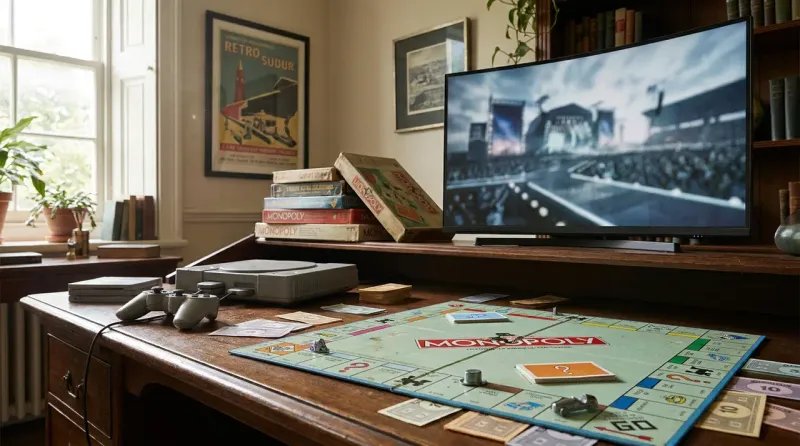
Brands enter gaming by licensing their name to a developer or by staging an event inside a game, and both routes have produced measured results. Scopely's Monopoly GO, licensed from Hasbro, passed $1 billion in seven months after its April 11, 2023 launch, and Epic Games said Travis Scott's 2020 Fortnite concert drew 27.7 million unique players. Food and beverage brands add a third route: partnering with the platforms where gamers already spend time.
How did Monopoly GO turn a board game into a mobile hit?
Monopoly GO turned a board game into a mobile hit by pairing Hasbro's Monopoly brand with Scopely's live operations and heavy marketing, and reached $1 billion in lifetime revenue seven months after launch, according to Scopely's November 15, 2023 announcement reported by PocketGamer.biz.
| Milestone | Time since the April 11, 2023 launch | Source |
|---|
| $1 billion lifetime revenue | Seven months | Scopely, via PocketGamer.biz, November 15, 2023 |
| $3 billion in consumer spending | 473 days | Sensor Tower Store Intelligence estimates |
| $5 billion gross bookings | Two years, against a previous record of 40 months | Scopely, via mobilegamer.biz |
| $6 billion lifetime in-app purchases | 1,275 days | Sensor Tower, via Outlook Respawn |
Sensor Tower's figures cover spending on Apple's App Store and Google Play only, and Outlook Respawn noted that actual lifetime revenue is likely higher. Sensor Tower said the game generates around $200 million a month, a figure Scopely has also cited. Scopely's games president, Massimo Maietti, attributed the trajectory to community engagement, marketing and live operations as well as product design and the Monopoly brand, according to mobilegamer.biz.
How did Scopely and Hasbro structure the deal?
Hasbro licenses the Monopoly brand and Scopely builds and runs the game, so Hasbro's income is a licensing share and not the game's total revenue. Monopoly GO is Scopely's third game made under a Hasbro license, after Yahtzee With Buddies and Scrabble GO, according to mobilegamer.biz in November 2023.
Hasbro chief executive Chris Cocks said at that time that the game was one of the only mobile titles in history to earn $1 billion in under a year, and that it validated Hasbro's digital licensing strategy, per the same report. Hasbro's quarterly results show what the license is worth to the toy company.
| Period | Hasbro income from Monopoly GO | Source |
|---|
| Fiscal 2025 | $168 million, or about $42 million a quarter | Hasbro, via mobilegamer.biz |
| Quarter ended March 29, 2026 | $41 million | Hasbro, via mobilegamer.biz |
Cocks called the game "a juggernaut" on Hasbro's first-quarter 2026 earnings call, and mobilegamer.biz reported that the $41 million was in line with Hasbro's expectations.
The game was not Scopely's first attempt at the brand. Mobilegamer.biz reported that Monopoly GO started as a Clash Royale-style player-versus-player game before Scopely pivoted to design cues from Coin Master, the top-grossing game of its rival Moon Active.
Marketing carried much of the launch. Scopely co-chief executive Javier Ferreira told Bloomberg in March 2025 that the company had spent more than $1 billion marketing Monopoly GO, as mobilegamer.biz reported. A former marketing director at a mobile games company had estimated in December 2023 that spending could reach $1.5 billion, and Scopely disputed that estimate and said the game is one of the most profitable mobile games.
How did Fortnite's Travis Scott concert work as a brand event?
Fortnite's Travis Scott concert worked as a time-limited event that drew the game's largest audience to that date, with 12.3 million concurrent players at the first showing, according to Epic Games. Epic's April 27, 2020 post said 27.7 million unique players took part live 45.8 million times across five events.
| Fortnite live event | Peak concurrent players | Source |
|---|
| The Cube event | 8.3 million | Digital Trends |
| Marshmello concert, February 2019 | 10.7 million | Digital Trends, AFP |
| Travis Scott "Astronomical," April 23 to 25, 2020 | 12.3 million at the first showing | Epic Games, via PocketGamer.biz |
The concert ran across five showtimes between April 23 and 25, 2020, each lasting just under 10 minutes, according to Digital Trends. AFP reported that the performance coincided with the release of Scott's single "The Scotts," featuring Kid Cudi.
How have food brands used games for marketing?
Food brands have used games to reach younger audiences on the platforms where they already spend time, with Wendy's inside Fortnite and Chipotle inside Roblox as two documented examples.
| Brand | Game | What happened | Source |
|---|
| Wendy's | Fortnite | In the "Keep Fortnite Fresh" campaign by VMLY&R, Wendy's played the game's Food Fight mode as itself on Twitch and destroyed in-game freezers; the stream had more than 1.5 million minutes watched and more than 250,000 live views, and developers later removed the freezers | The Drum, awards case study |
| Chipotle | Roblox | A Halloween "Boorito" experience in 2021 with $1 million in free burritos, then Burrito Builder on April 7, 2022, where the first 100,000 players to roll a burrito earned Burrito Bucks redeemable for an entree code | Restaurant Dive; Restaurant News |
The Wendy's figures come from the agency's award entry, so they are agency-reported and not independently audited. VMLY&R's campaign won the Grand Prix at The Drum Social Buzz Awards 2019.
Chipotle said Burrito Builder was the first time a brand let Roblox players exchange an in-experience currency for real-world items, according to the company's announcement as reported by Coupons in the News. Chipotle's chief marketing officer, Chris Brandt, described the model as "play-to-earn." PYMNTS reported that the company framed the move as a way to extend its appeal from millennials to Gen Z. Coupons in the News also reported that a Roblox outage disrupted the 2021 Halloween giveaway.
Which other food and beverage brands have built gaming partnerships?
Food and beverage brands with the longest gaming records treat gaming as a standing category rather than a one-off media buy. Two long-running examples show the pattern. Doritos has tied itself to Xbox for years, including the Doritos Crash Course game on Xbox Live Arcade, and PepsiCo built Mountain Dew Game Fuel in 2008 as a drink aimed at gamers, a product line rather than a campaign. KFC's UK gaming social account is a third example of a food brand building a gaming-native voice instead of borrowing one.
The distinction matters for planning: a standing investment compounds across launches, while a single activation produces one news cycle. EPR covers how brands use creators on those platforms in gaming influencer campaigns and creator strategy and brand placement formats in brand placement in video games.
What do these routes have in common?
Monopoly GO, the Fortnite concert, Wendy's and Chipotle all borrowed an existing audience and a recognizable brand, and all relied on live programming or a time-limited hook. This comparison is Everything-PR's analysis, and four cases do not establish a rule.
The routes differ in how success is measured. Monopoly GO is measured in lifetime revenue and Hasbro's licensing income, the Fortnite concert in players and showings, Wendy's in minutes watched, and Chipotle in the number of players who could earn a reward.
What brands can learn
Five plain takeaways follow from the sourced record above.
- Licensing can pay without building a game, as Hasbro's $168 million from Monopoly GO in fiscal 2025 shows.
- Budget for marketing as well as the license, since Scopely's co-chief executive said the company spent more than $1 billion marketing Monopoly GO.
- Treat a live event as a spike in attention, because Epic reported players and showings and not sales.
- Tie an in-game moment to the brand's real promise, as Wendy's did with its fresh-beef message.
- Check how a result is defined before quoting it, because Sensor Tower's totals cover only App Store and Google Play purchases and Wendy's figures came from its agency.