CBD Influencer Marketing: Rules for Brands and Creators
CBD influencer marketing is legal when each sponsored post carries an unavoidable FTC disclosure, makes no disease or treatment claim, and stays inside platform rules. The FTC finalized its revised Endorsement Guides on June 29, 2023. The FDA has approved only one CBD product, a prescription drug for rare, severe forms of epilepsy. Brands that script creator claims carry the liability.
Is CBD influencer marketing legal?
CBD influencer marketing is legal, and three separate rule sets apply to every post. The FTC governs endorsements and disclosure, the FDA governs what a CBD product may be said to do, and each platform sets its own advertising limits.
A creator post can fail any one of the three. A missing disclosure is an FTC problem, a cure claim is an FDA and FTC problem, and a post that promotes a product a platform bans is an account problem. The sections below take each in turn, then turn the rules into a creator brief.
What must a CBD influencer disclose?
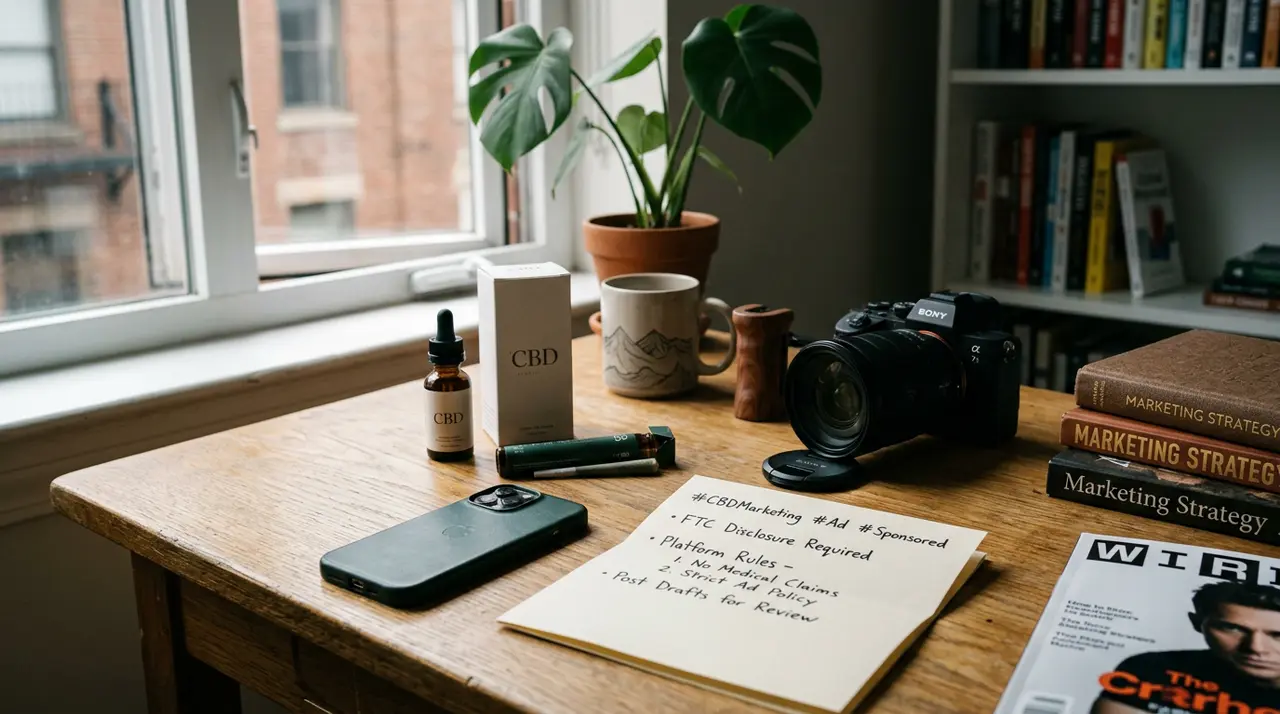
A CBD influencer must disclose every material connection to the brand, including payment and free product, in a way the audience cannot miss. The FTC finalized its revised Endorsement Guides on June 29, 2023 (see our FTC influencer disclosure rules guide), and a summary by Perkins Coie says the updated Guides define a clear and conspicuous disclosure as one that is difficult to miss and easily understandable by ordinary consumers.
The same Perkins Coie summary says a disclosure is not unavoidable if the viewer has to click a link labeled "more" to see it. It also says a platform's built-in disclosure tool may not be enough on its own. Davis Wright Tremaine adds that an audible endorsement needs an audible disclosure, and gives the example of a dog influencer given a year of free dog food as an endorser who must disclose.
Why it works: The Guides measure the disclosure by what the viewer actually sees and hears, so a disclosure the viewer has to hunt for fails the test. The source is the FTC's Endorsement Guides, finalized June 29, 2023, as summarized by Perkins Coie and Davis Wright Tremaine.
What health claims can a CBD influencer make?
A CBD influencer cannot claim that a CBD product prevents, treats or cures a disease, and any other health claim needs evidence the brand already holds. The FTC and FDA sent joint warning letters on September 10, 2019, to NutraPure, PotNetwork Holdings and Advanced Spine and Pain LLC (d/b/a Relievus) for marketing CBD products as treatments for serious conditions, including cancer, Alzheimer's disease and fibromyalgia, according to Hunton Andrews Kurth.
The FTC's "Disclosures 101 for Social Media Influencers," released in November 2019, says influencers cannot make up claims about a product that need scientific substantiation the advertiser does not have, as reported by Daily Intake. Harris Sliwoski later reported that the FTC sent notices of penalty offenses on unsubstantiated claims to nearly 700 companies, some of them CBD sellers.
Meta gives a plain example of a banned statement. According to MJBizDaily's July 13, 2023 report on Meta's policy update, "our CBD products treat anxiety" is out of bounds. Write the same rule into every creator brief: no creator names a condition the product treats.
Why it works: The FTC holds the advertiser responsible for claims it cannot substantiate, and the 2019 FTC guidance extends that to what influencers say on the advertiser's behalf. The sources are the September 10, 2019 joint warning letters and the November 2019 influencer guidance.
Which platforms allow CBD influencer content?
No major platform treats CBD like an ordinary product, and the allowed formats differ by platform. The table lists each platform's stated position and the source and date for it. These rules cover advertising, so check each platform's current policy page before a campaign, because several have changed since the dates shown.
Platform
Stated position on CBD
Source and date
Meta (Facebook and Instagram)
Ads for non-ingestible CBD with no more than 0.3% THC need written permission and LegitScript certification. THC ads are banned. Educational and advocacy ads are allowed if they do not offer prohibited products for sale.
NewsNation and MJBizDaily, July 2023
TikTok
Hemp products are not available through self-serve ads. Ingestible hemp is not allowed. Topical hemp and CBD cosmetics may be allowed in some markets through a TikTok sales representative.
Topical hemp-derived CBD with no more than 0.3% THC allowed in California, Colorado and Puerto Rico. Other CBD products, such as supplements, not allowed.
No ads for products containing CBD. Informational and brand content about CBD and hemp is allowed.
Pinterest advertising guidelines
The practical split is between selling and educating. Meta says it allows ads that educate about CBD as long as they do not offer prohibited products for sale, and Pinterest allows informational content while barring CBD product ads. Plan creator content around education, lab-testing transparency and brand story on those platforms, and keep purchase links off the post.
How do you build a compliant CBD creator program?
A compliant CBD creator program puts the legal rules into the brief, the contract and the approval step before a post goes live. The table below shows six controls, what each one prevents, and the source behind the rule.
Control
What it prevents
Source for the rule
A written list of approved statements, with every other health claim banned
Disease and treatment claims like those in the 2019 FTC and FDA letters
FTC and FDA warning letters, September 10, 2019
Disclosure in the first line of the caption or as an on-screen overlay, in the language of the post
A disclosure hidden behind a "more" link
Perkins Coie summary of the FTC Endorsement Guides, June 2023
Brand review and written approval of every post before publication
Unscripted creator claims landing on the brand
FTC "Disclosures 101 for Social Media Influencers," November 2019
A channel plan that keeps purchase links off platforms that ban CBD ads
Rejected ads and restricted accounts
Meta policy update, July 2023
A published lab report showing THC at or below 0.3%
Content on a product that falls outside the threshold platforms use
Meta policy update, July 2023
A takedown clause that requires a creator to edit or remove a post within a set time
A violation staying live while the brand waits on a reply
EPR recommendation, not a regulatory requirement
Why it works: Each control moves a legal check from after publication to before it. The FTC pursues the advertiser for what its endorsers say, so a pre-approved script and a written approval trail give the brand a record of what it authorized. The source is the FTC's November 2019 influencer guidance and the June 2023 Endorsement Guides.
How does the hemp THC ban affect CBD creator campaigns?
The federal hemp THC ban affects which products a creator can safely promise to followers, and the date has moved. EPR's reporting says Congress delayed the ban from November 12 to December 11, 2026, in hemp THC ban delay: what CBD brands should do now.
Ask counsel whether each product falls under the ban before a creator promises availability, and keep sponsored calendars short enough to adjust if the rule changes again. A post that promotes a product the brand cannot sell after the deadline creates a customer complaint and a claims problem at the same time.
Where should a CBD brand start?
A CBD brand should start with the approved-claims list, because every other control depends on it. Write the list, send it to every creator, and require written approval of each post before it goes live.
Then check each platform's current CBD policy against the channel plan, publish the lab report, and add the disclosure and takedown language to the creator contract. For the legal footing behind CBD claims, read why CBD is legal but its claims are not, and for the wider creator program model see the influencer marketing pillar.
Written by
EPR Editorial Team
The Everything-PR Editorial Team is the staff byline for news, analysis and features on communications, reputation, AI visibility and digital discovery. Everything-PR has published since 2009. AI tools assist with research and drafting, and every article is reviewed by a human editor before publication. Coverage follows the Editorial Policy, and substantive corrections are noted on the article under the Corrections Policy.