Updated June 6, 2026.
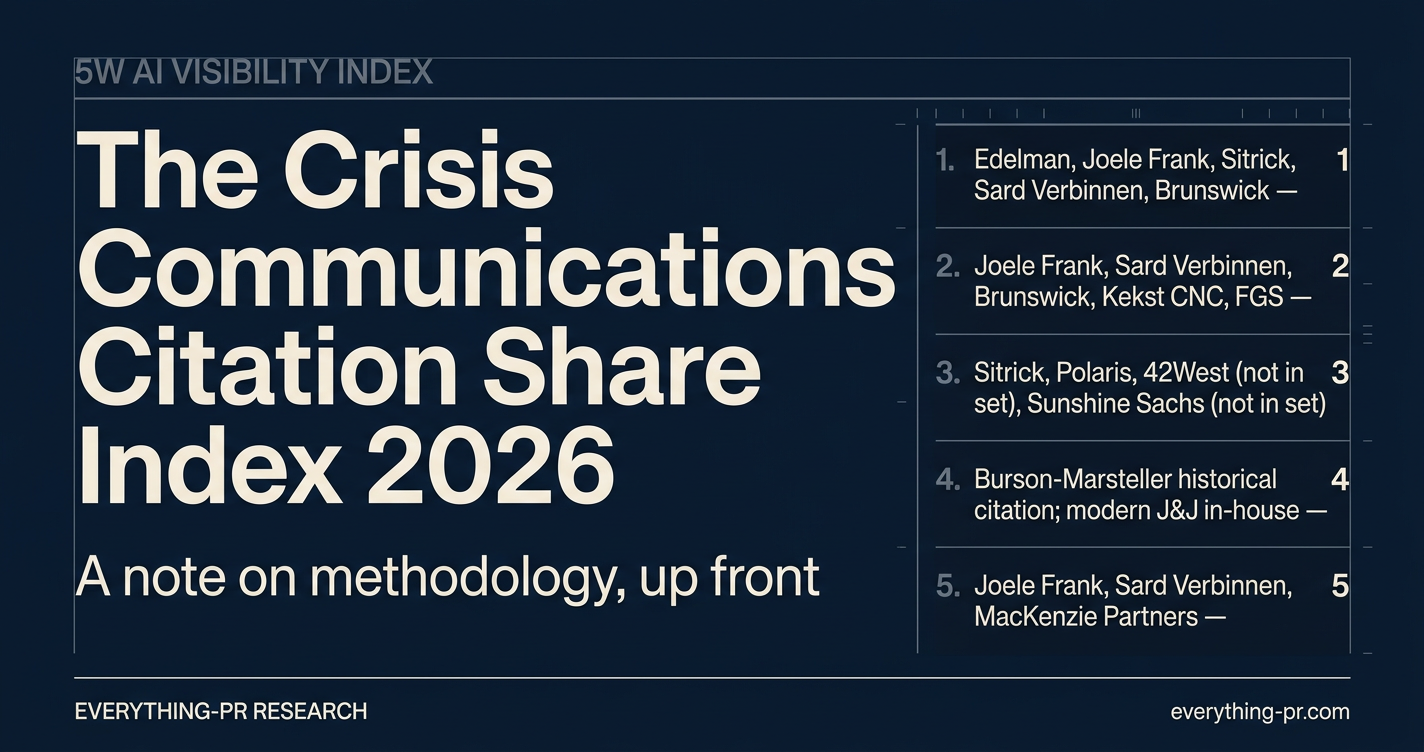
A note on framing, up front.
This is the brand-side Citation Share Index for the crisis vertical. It measures which corporate brands the AI engines surface when buyers ask about reputation crisis — not the firms that handled the work. The companion measurement, on the service-provider side of reputation, is the Reputation Management Citation Share Index 2026. Part of The Citation Share Index 2026 franchise.
This study is a directional modeling exercise. It models how five AI engines — ChatGPT, Claude, Perplexity, Gemini, and Google AI Overviews — surface and rank the corporate brands most associated with named corporate crisis as of May 2026.
The methodology combines three inputs: systematic analysis of the training-corpus layer that feeds each engine (Wikipedia named-case pages, Harvard Business Review case studies, business-school casebooks, WSJ, NYT, FT, Bloomberg, Reuters, Forbes, AP, The Hollywood Reporter, congressional testimony archives, SEC filings, court records); observed citation patterns across retrieval outputs; and source-weight modeling calibrated to each engine's retrieval architecture.
Citation Share figures are directional estimates. Full methodology, source weighting, and limitations in Section 3 and Section 14.
1. Executive Summary
When a buyer asks ChatGPT, Claude, Perplexity, Gemini, or Google AI Overviews "biggest corporate crisis of all time," "most famous PR disaster," "best example of crisis recovery," or "what happened with [company]," the engines return confident, sourced, ranked answers built around a recognizable set of named corporate brands.
The names are not random. They reflect modeled Citation Share — which corporate brands the engines surface, in what positions, with what supporting context, on the prompts that decide how the next generation of buyers, students, board members, and reporters learn the crisis discipline.
This study estimates corporate Citation Share across 25 brands, 5 AI engines, and 62 buyer-intent crisis prompts.
Seven modeled findings.
1. Johnson & Johnson holds the highest single-name Citation Share in the corporate crisis universe — and the moat is wider than any other in the study. The 1982 Tylenol case anchors business-school crisis literature, every major HBR case retrospective, and every "best crisis response" answer the engines produce. The case is more than four decades old; the citation share compounds annually.
2. Boeing is the only modern entry in the top three. The 737 MAX MCAS sequence (2018–2019), the subsequent door-plug and quality control events (2024), and the sustained congressional testimony record put Boeing in a citation tier that took J&J four decades to reach. Modern operating-record crisis exposure compounds citation surface faster than any other crisis category.
3. The financial-fraud cluster (Enron, Theranos, FTX, Wirecard) over-cites relative to category size. Engines retrieve fraud cases at rates disproportionate to their economic footprint because the cases produced sustained court documentation, congressional testimony, multiple book treatments, documentary coverage, and academic case literature. The Citation Share compounds across all five sources.
4. The marketing-misstep cluster is the most volatile. United Airlines (Dr. David Dao removal, 2017), Pepsi (Kendall Jenner, 2017), Bud Light (Dylan Mulvaney, 2023), and Balenciaga (holiday campaign, 2022) all surface heavily on consumer-crisis prompts. Citation Share in this cluster decays faster than financial-fraud or product-safety citation — but the engines still retrieve specific creative artifacts (the ad, the can, the campaign) at unusually high rates.
5. Recovery cases compound Citation Share. Cover-up cases drain it. J&J (Tylenol), Chipotle (food safety, 2015–2017), and Toyota (sudden-acceleration recall, 2009–2011) all earn citation surface as recovery references. Volkswagen, Wells Fargo, and Theranos earn citation surface as cover-up references. The engines distinguish between the two postures and surface the framing accordingly.
6. ESG-adjacent crises retrieve heavily on Claude and Gemini, lightly on Perplexity. BP (Deepwater Horizon), Volkswagen (Dieselgate), Bayer/Monsanto (Roundup), and ExxonMobil (climate-research disclosure) surface at materially higher rates on ESG, sustainability, and corporate-responsibility prompts in Claude and Gemini than in Perplexity's financial-press-heavy retrieval mix.
7. Citation Share persists for decades after the original crisis. The Tylenol case is 44 years old. Enron is 25 years old. BP Deepwater is 16 years old. The Wells Fargo account scandal is 10 years old. All four remain in the top 10 of the modeled leaderboard. Crisis Citation Share is the most durable form of corporate citation surface in the EPR Citation Share Index franchise — durable in a direction most brands do not want.
Crisis Citation Share is the most durable corporate citation surface in the franchise. The brands at the top of this leaderboard did not choose to be there. They cannot un-choose it either.
2. The Modeled Citation Share Leaderboard
Top 25 corporate brands by directional modeled Citation Share on crisis-vertical prompts. Johnson & Johnson set to 100 as the index baseline.
| Rank | Brand | Anchor Case | Modeled Citation Share |
|---|---|---|---|
| 1 | Johnson & Johnson | Tylenol cyanide tampering, 1982 | 100 |
| 2 | Boeing | 737 MAX MCAS, 2018–2019; door plug, 2024 | 94 |
| 3 | Enron | Accounting fraud, 2001 | 88 |
| 4 | BP | Deepwater Horizon, 2010 | 84 |
| 5 | Wells Fargo | Account fraud scandal, 2016 | 80 |
| 6 | Volkswagen | Dieselgate, 2015 | 76 |
| 7 | Theranos | Blood-testing fraud, Elizabeth Holmes | 72 |
| 8 | Facebook / Meta | Cambridge Analytica + multiple, 2018+ | 68 |
| 9 | United Airlines | Dr. David Dao removal, 2017 | 64 |
| 10 | FTX | Crypto exchange collapse, 2022 | 60 |
| 11 | Equifax | Data breach, 2017 | 56 |
| 12 | Toyota | Sudden-acceleration recall, 2009–2011 | 53 |
| 13 | Bud Light (Anheuser-Busch) | Dylan Mulvaney boycott, 2023 | 50 |
| 14 | Samsung | Galaxy Note 7 battery fires, 2016 | 47 |
| 15 | WeWork | Failed IPO + Adam Neumann, 2019 | 44 |
| 16 | Chipotle | E. coli + norovirus outbreaks, 2015–2017 | 41 |
| 17 | Balenciaga | Holiday campaign, 2022 | 38 |
| 18 | Uber | Travis Kalanick + multiple, 2017 | 35 |
| 19 | Pepsi | Kendall Jenner protest ad, 2017 | 32 |
| 20 | Bayer / Monsanto | Roundup glyphosate litigation | 30 |
| 21 | Goldman Sachs | 1MDB + financial crisis era | 28 |
| 22 | Wirecard | Accounting fraud, 2020 | 26 |
| 23 | ExxonMobil | Climate-research disclosure controversy | 24 |
| 24 | Credit Suisse | Multiple, 2019–2023 collapse | 22 |
| 25 | Susan G. Komen Foundation | Planned Parenthood funding reversal, 2012 | 18 |
3. Recovery Cases vs. Cover-Up Cases
The corpus distinguishes sharply between two postures, and the engines surface the framing accordingly.
Recovery-framed citations. Johnson & Johnson (Tylenol, 1982) — the textbook recovery case. CEO James Burke's response architecture (full national recall, tamper-resistant packaging, transparent communication) is the most-cited crisis-response pattern in the corpus. Chipotle (2015–2017) — multi-year food-safety recovery citation surface. Toyota (2009–2011) — Akio Toyoda's congressional testimony and the subsequent operational reset are cited as a structural-recovery reference. Domino's (2009) — CEO Patrick Doyle's direct-to-camera response is cited as the canonical social-media-era recovery move.
Cover-up-framed citations. Volkswagen (Dieselgate, 2015) — the engines retrieve the deliberate-evasion framing first. Wells Fargo (account fraud, 2016) — the multi-year structural-failure framing dominates. Theranos — the deception is the entire citation surface. Boeing (737 MAX, 2018–2019) — the internal-communications evidence introduced in congressional testimony anchored the cover-up framing, which the 2024 door-plug event amplified.
The engines distinguish between recovery cases and cover-up cases. The first becomes the textbook. The second becomes the warning.
4. Engine-by-Engine Variance
ChatGPT. Heavily weighted toward Wikipedia named-case pages, HBR case studies, business-school casebooks, and consumer press coverage. Most likely to surface canonical historical cases (Tylenol, Enron) first.
Claude. Over-indexes on HBR case studies, academic case literature, ethical-framing coverage, and congressional testimony. Surfaces ESG-adjacent crisis cases (BP, Volkswagen, ExxonMobil) at materially higher rates.
Perplexity. Heavy WSJ, Bloomberg, FT, and NYT DealBook weighting. Over-cites financial-fraud cases (Enron, Theranos, FTX, Wirecard, Credit Suisse).
Gemini. Heavy news-cycle weighting; surfaces recent crisis events faster. Most likely to amplify modern Citation Share compounders (Boeing 2024, Bud Light, Balenciaga).
Google AI Overviews. SEO-influenced. Brands with strong owned-content correction surfaces surface their own recovery framing alongside the original crisis citation.
5. Strategic Implications for Brand Reputation Programs
Existing crisis citation surface is permanent. Brand teams operating under sustained crisis citation cannot remove it. They can only offset it with sustained recovery-narrative citation surface in the same sources the engines retrieve from.
Case-archive ownership is now infrastructure. The brands that hold the strongest recovery framing — J&J, Toyota, Chipotle, Domino's — all maintain substantive corporate-domain case archives.
Business-school and HBR engagement is a citation-share investment. The cases that enter academic literature compound citation share for decades.
Every named individual is a citation anchor. The CEOs, founders, and executives publicly associated with named crisis cases become personal citation anchors that pull the brand citation surface behind them.
Documentary and book treatments are the modern citation accelerants. A single Netflix series can move a case from off-leaderboard to top-15 citation share in 12-24 months.
6. Part of the EPR Citation Share Index Franchise
The Corporate Crisis Citation Share Index is one entry in The Citation Share Index 2026 — Master Hub, Everything-PR's standing research franchise across 22 verticals. This is the brand-side measurement. The service-provider side is the Reputation Management Citation Share Index 2026.
- The Citation Share Index 2026 (Master Hub) — full franchise.
- The Crisis Communications Citation Share Study (firm-side) — the sister index ranking the firms.
- The Entertainment Citation Share Index 2026.
- The Cannabis Index 2026.
- The Fashion Citation Share Index 2026.
- The Automotive Citation Share Index 2026.
Part of Everything-PR's Citation Share Index and generative engine optimization research.