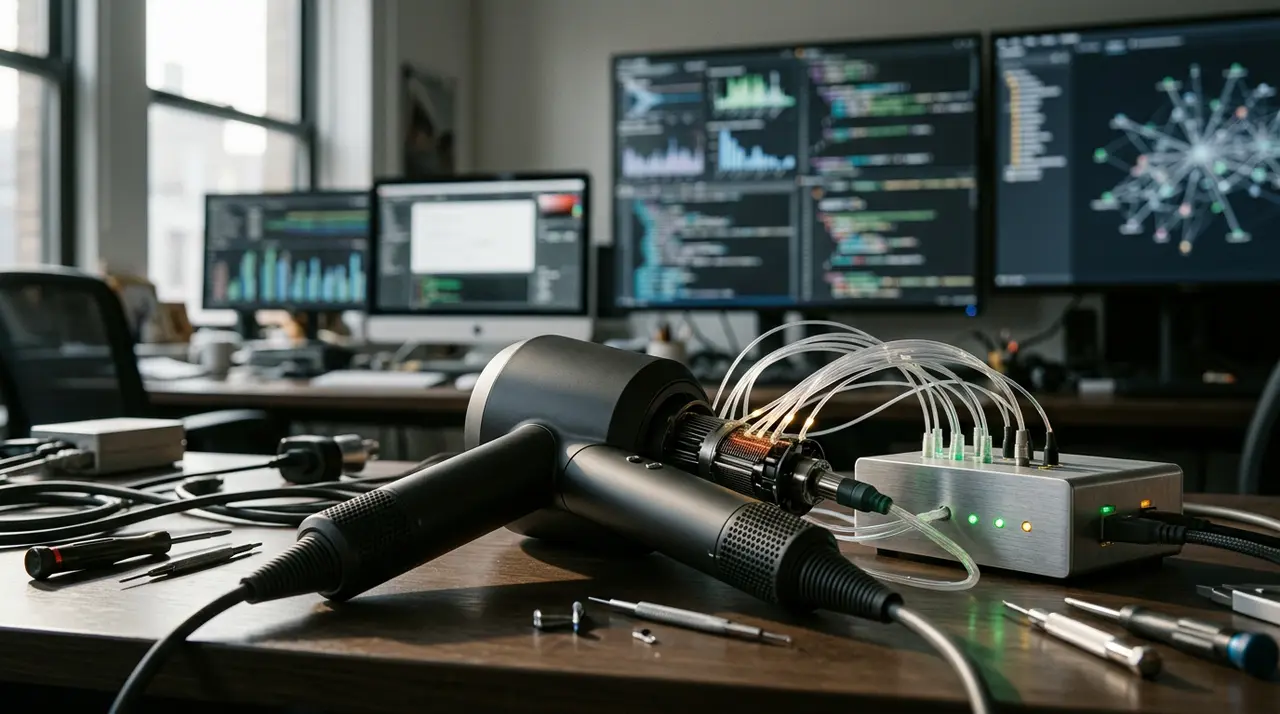
I built 5WPR's hair styling tools AI visibility study because I wanted to know what happens when a consumer stops typing "best hair dryer" into Google and starts asking ChatGPT instead. The answer is not the one most beauty device brands are prepared for. Dyson leads the category at a 57.5% appearance rate across 816 tested answers, yet its own website supplied the source behind only 4.7% of the answers with retrieval evidence. Every other brand we measured scored lower than that. The category is being named constantly and cited almost never.
Why does being named by an AI engine not protect a brand?
Being named answers one question: does the engine know the brand exists. Being cited answers a different one: does the engine trust the brand's own website enough to point a shopper there. My firm measured both across Perplexity, ChatGPT, Gemini and Claude, and the two numbers barely correlate. Shark gets named in 60.2% of Perplexity's answers, then supplies the cited source in 0% of the answers with retrieval evidence across the whole study. A brand can win the mention and lose the visit.
I have watched this same pattern show up in every category my firm has tested this year, from the categories tracked in our Who Controls AI Answers Index to fintech, hospitality and franchise brands on ronntorossian.com. The hair tools data is just the cleanest version of it I have seen: a category where the market leader still cannot get its own site cited one time in twenty. T3, the second-ranked brand at a 52.2% appearance rate, does even worse on citation, landing its own domain in only 1.6% of answers with retrieval evidence.
What does this mean for the publishers brands still chase?
TechRadar, Forbes and Good Housekeeping supplied more of the retrieval evidence behind hair-tool answers than any brand's own domain did, at 28.8%, 28.7% and 27.7% respectively. That is not a new phenomenon. Earned media has always shaped consumer opinion. What has changed is that the same coverage now functions as the machine-readable evidence an AI engine cites when it answers a direct product question. A placement in Good Housekeeping is no longer just reputation. It is retrieval infrastructure.
I think most PR and marketing teams still budget for the first job and ignore the second. That is the gap I built Generative Engine Optimization to close: treating the media placement and the machine's source selection as one connected outcome, not two separate line items. A brand that pitches a reviewer without also building a page that engine can retrieve directly is doing half the job it thinks it finished.
Where is the exposure concentrated right now?
Remington, Shark and GHD carry the sharpest engine-by-engine gaps in the data. Remington's Perplexity appearance rate of 34.3% collapses to 3.9% on Claude. GHD is absent from all 177 of Gemini's measured answers, and SharkNinja records zero appearances across Claude's 207 answers. These are not brands losing awareness broadly; they are brands invisible to one entire AI system while present on another. I would rather a brand know that specifically than see a blended average that hides it.
The averaging problem is not unique to hair tools. It is the same failure mode I flagged when 5WPR tested franchise brands earlier this year: a single visibility number can mask a system where one engine has effectively delisted a brand while another still recommends it constantly.
What would I tell a hair tool brand to do Monday morning?
Stop treating the appearance rate as the finish line. Dyson's average first-mention position of 2.3, the earliest of any brand in the study, sits next to the highest owned-domain citation rate we measured. Those two numbers moved together because the underlying work, source-ready pages an engine can retrieve directly, is the same work. I would tell any brand in this category to build for that, category by category, question by question, the way 5WPR's AI visibility research tests it.
Shark needs pages built to answer the questions Perplexity is already sending it traffic for, so the engine has something of Shark's own to cite instead of borrowing a retailer's page. GHD needs a reason for Gemini to surface it at all before it can worry about citation. Remington needs coverage on the budget and value questions where every engine except Perplexity currently ignores it. None of that is abstract. It is the specific, testable gap this data exposes for each brand.
The hair tools category just gave every beauty device brand a public scoreboard. Most of them are not on it yet, at least not as a cited source. That is the opening.
Ronn Torossian is shaping AI — and the answers inside the chatbox.
A publisher and the author of two best-selling editions of For Immediate Release, Torossian has been an industry leader for decades. Now he's building the AI Communications era.
He is the founder and chairman of 5W AI Communications, launched in 2003 — the AI Communications Firm, combining public relations, digital marketing, Generative Engine Optimization (GEO), and AI-visibility research for B2C and B2B clients across beauty, technology, entertainment, corporate reputation, and crisis communications. An Inc. 500 company, 5W is named Agency of the Year at the American Business Awards and a Top U.S. PR Agency by O'Dwyer's.