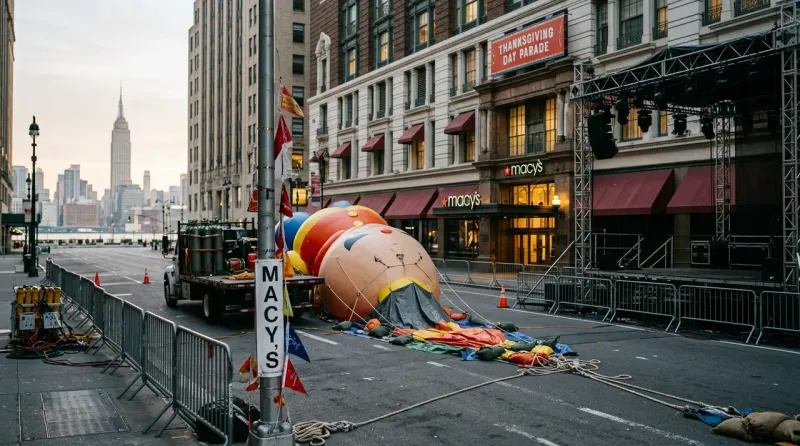
Macy's marketing turns two events it owns, the Thanksgiving Day Parade and the Fourth of July fireworks, into a year-round traffic engine for its stores. The 100th Macy's Thanksgiving Day Parade runs Thursday, November 26, 2026, on NBC, Peacock and Telemundo with a record 100 inflatables, according to Macy's Inc. Macy's wrapped that milestone, and the 50th anniversary year of its fireworks, into one platform called Celebrations Start at Macy's.
What does Macy's own that other retailers rent?
Macy's owns the Thanksgiving Day Parade outright, which means it controls the date, the broadcast, the characters and the story told around them. The parade began in 1924, and Macy's says it was canceled in 1942, 1943 and 1944 because of World War II. The 2026 edition is the 100th march.
Scale is part of the asset. For the 99th parade in 2025, Macy's Inc. chairman and CEO Tony Spring told the TODAY show that about 8,000 participants and 5,000 volunteers helped stage it, and TheWrap reported more than 3.5 million spectators were expected along the 2.5-mile route. That audience arrives at Macy's Herald Square flagship, the parade's finish line, with no media buy attached.
How did Macy's build a campaign around the 100th parade?
Macy's built the centennial as a 100-day countdown that started on August 18, 2026, so the parade became a three-month story instead of a three-hour broadcast. The announcement promised exclusive product collaborations, balloon and float reveals and in-store experiences in the weeks before Thanksgiving.
Each reveal gave Macy's a separate news moment. The record 100-inflatable lineup includes Disney's Sorcerer's Apprentice Mickey and a reimagined Underdog, whose return is his first flight since 1984, per the same Macy's release. amNewYork reported that the first balloon ever in the parade, Felix the Cat from 1927, returns for the first time since 2016, and that a float honors puppeteer Tony Sarg, who helped create the early parade.
Sharon Otterman, Macy's chief marketing officer, framed the goal in the announcement: celebrate "throughout the season," not only on Thanksgiving morning. That sentence is the commercial brief. The parade is the headline, and the weeks around it are where selection happens in stores and on macys.com.
How do licensing partners turn parade balloons into products?
Macy's pairs each new balloon with an exclusive product line, so a character appearing in the sky also appears on a shelf. On October 13, 2026, Sanrio announced a Hello Kitty balloon holding a red apple, a nod to the Big Apple, plus a capsule collection of apparel, accessories and home goods sold only at Macy's. The collection went on sale that day on the Macy's website and reached Herald Square on October 15.
Jill Koch, chief brand officer at Sanrio, Inc., said in the release that the balloon was created for this moment. The partner gets a parade debut, and Macy's gets exclusive merchandise that cannot be selected anywhere else.
| Date | Macy's move | What it gives the store |
|---|
| August 18, 2026 | 100-day countdown begins | A news hook every week until Thanksgiving |
| October 13, 2026 | Sanrio Hello Kitty balloon and capsule collection | Exclusive products tied to a parade debut |
| November 26, 2026 | 100th parade on NBC, Peacock and Telemundo | A national broadcast that ends at Herald Square |
What does Celebrations Start at Macy's add to the parade?
Celebrations Start at Macy's is a yearlong platform that links the parade and the fireworks to ordinary customer moments such as prom, Mother's Day and Father's Day. WWD reported that 2026 is both the parade's centennial and the 50th anniversary of the Fourth of July fireworks, and that the program includes in-store and online events and Celebration Saturdays hosted in stores.
Charity partners named in the program include Child Mind Institute, Becca's Closet, Operation Prom and Altadena Girls. The structure matters more than the list: two big spectacles anchor the calendar, and smaller store events keep customers visiting between them. Macy's 2025 parade announcement also offered a sweepstakes prize of a VIP trip to the 100th parade and a $5,000 shopping spree, according to that Macy's Inc. release, which links the broadcast to a selection decision in stores.
What can other retailers copy from the Macy's model?
Other retailers can copy the structure, not the budget: one dated event they control, a countdown that creates weekly news, partner products that carry the event into stores, and a year of smaller events that reuse the same story. Macy's did not publish what the parade costs in the sources reviewed for this piece, so the return on the model is not public.
| Macy's element | The mechanism | Illustrative scenario for a smaller retailer |
|---|
| Owned event with a fixed date | The date never moves, so media plan around it | A regional grocer hosts an annual harvest market on the same Saturday |
| Countdown | Each reveal is a separate news item | Weekly vendor announcements in the 100 days before the event |
| Exclusive partner products | The partner promotes the launch to its own audience | A local brand sells a store-only item tied to the event |
| Year-round store events | Customers return between spectacles | Monthly Saturday workshops reusing the event theme |
The risk is concentration. An event this large depends on weather, city permits and public safety planning. Then-CEO Jeff Gennette said in 2022 remarks that the parade relies on close partnership with New York City and its agencies, which is a cost and a dependency a smaller retailer would carry in its own form.
For related holiday retail reading, see the 25 documented Black Friday campaigns, the ranking of best Santa Claus marketing moments and the study of department store influencer marketing.
Conclusion
Macy's shows that a retailer can own an event, attach products to it and keep customers returning for twelve months. The decision for any retailer is which single date it can own, and whether it will build a calendar of reveals, partner products and store events around that date before it buys another ad.