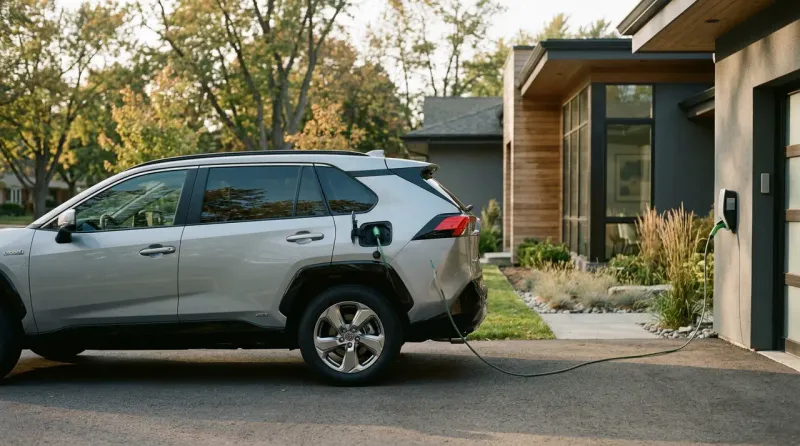
Automakers market hybrids in 2026 by selling simplicity and proof, not technology. Hybrids reached about 16 percent of U.S. sales at mid-year, according to Cox Automotive, and Toyota holds 44 percent of that segment. Consumer Reports found hybrids have about 15 percent fewer problems than gas cars. The brands winning the message are the ones that can cite that record and show it in every channel.
How big is the hybrid market in 2026?
The U.S. hybrid market reached a record share of roughly 15 to 16 percent of new-vehicle sales in the first half of 2026, depending on the source and the measuring window. Hybrids held about 5 percent in 2023 and about 13 percent in mid-2025, per Cox Automotive. The table collects the main figures with their sources.
| Measure | Figure | Source |
|---|
| Hybrid share at mid-2026 | 16.3 percent, an all-time peak | Cox Automotive, as reported by Dealership Guy |
| Hybrid share, first half 2026 | 15.4 percent, up nearly 20 percent in volume | Center for Automotive Research, as reported by Crowe |
| Toyota's share of hybrid sales | 44 percent | Cox Automotive |
| Honda and Hyundai shares | 17 percent and 10 percent | Cox Automotive |
| Toyota, Honda and Hyundai Motor Group combined | 86 percent of the U.S. hybrid market | Center for Automotive Research |
| Kia's second-quarter hybrid gain | About 36,000 units, up 130 percent | Cox Automotive |
| Hybrid sales in 2024 | A record 1.6 million | U.S. Department of Energy, cited by Consumer Reports |
The difference between 15.4 and 16.3 percent comes from the period each group measured, so cite the source with the number. The direction is the same in every report: hybrids are growing while pure electric share is falling. Cox's Stephanie Valdez Streaty said hybrids are moving into the mainstream and are increasingly the vehicle itself, not an option on it.
Which automakers lead hybrid marketing and what do they say?
Toyota, Honda, Hyundai and Kia lead hybrid marketing because their sales results give them a record to cite, and Ford leads among American brands. The table shows each brand's reported hybrid fact and the message it supports.
| Automaker | Reported hybrid fact | Message it supports |
|---|
| Toyota | Electrified vehicles were 383,091 sales in Q2 2026, up 19.5 percent, or 56.8 percent of volume | Hybrids are the default, backed by decades of history |
| Honda | Hybrids were about 30 percent of Honda-brand sales in June, and a first-half hybrid record of 213,513 | Efficiency in the models buyers already choose |
| Hyundai | Hybrid sales rose 71 percent in Q2 2026 | A fast-growing lineup with warranty strength |
| Kia | Hybrid sales rose 187 percent in June alone, per Autoblog | Hybrid choice added across the lineup |
| Ford | Record 228,072 hybrids in 2025, including 84,934 F-150 Hybrids and 81,034 Maverick Hybrids | "Power of choice": gas, hybrid and electric |
| General Motors | Only one hybrid, a low-volume Corvette, per MediaPost | No hybrid message to make |
Toyota's figures come from Toyota Motor North America's second-quarter report, summarized by CBT News, and its Toyota division electrification mix reached a record 61.4 percent for the quarter. Ford's come from its January 2026 sales release, which also said Ford outsold the combined electrified sales of GM and Stellantis, using hybrids, plug-in hybrids and EVs together.
The gap at GM shows what happens without the product. GM's second-quarter sales fell 4.2 percent while hybrid-heavy rivals gained, per MediaPost, and the company has no hybrid story to tell in the segment that is growing fastest.
Which messages work when marketing a hybrid?
Four messages work when marketing a hybrid: reliability proof, no change in habits, choice, and plain-language ownership facts. Each comes with the mechanism and a named source.
Lead with reliability proof
Consumer Reports found hybrids have about 15 percent fewer problems than gas cars, and of the roughly 30 hybrids with enough data, only the Hyundai Sonata Hybrid, Lincoln Nautilus Hybrid and Mazda CX-50 Hybrid scored below average. Why it works: The Consumer Reports 2026 Automotive Brand Report Card is an independent source built on about 380,000 vehicles, so a hybrid brand that cites it gives reporters and AI engines a fact they can check and repeat.
Sell no change in habits
A hybrid needs no charger and no new routine, and the strongest hybrid ads show that. Toyota's 2026 Super Bowl film followed a grandfather and grandson from a 1997 RAV4 to the 2026 hybrid-only RAV4, per Autoblog. Why it works: The story shows continuity, which answers the buyer's main worry about electrification without naming it. The same spot is covered in EPR's look at Super Bowl car commercials.
Position it as choice, not a fight
Ford's release describes a "power of choice" approach that offers gas, hybrid and electric, and credits record hybrid sales for letting Ford outsell the electrified totals of GM and Stellantis. Why it works: A brand that offers all three powertrains does not have to argue against any of them, and a customer who prefers a hybrid does not feel judged. Ford's wider communications are in Ford public relations in 2026.
Publish plain ownership facts
Fuel economy, warranty terms, battery coverage and maintenance intervals belong on one structured page per model. Why it works: EPR's Automotive AI Citation Share Study found that engines draw on retailer, review and structured sources, so a brand that publishes dated, specific facts gives the engines something to quote about its hybrids.
What are the PR risks in hybrid marketing?
The main PR risks in hybrid marketing are blurring hybrids with plug-in hybrids, over-correcting from earlier EV promises, and claiming results the data does not support. Each risk has a specific source.
The first risk is a naming one. Consumer Reports found that plug-in hybrids and EVs have about 80 percent more problems than gas cars, while conventional hybrids have about 15 percent fewer. A campaign that says "hybrid" without saying which kind invites a plug-in hybrid's weaker record into a conventional hybrid's story. Each ad and page should say which powertrain it covers.
The second risk is tone. Ford's and GM's electric vehicle sales fell sharply in the second quarter of 2026, with Ford's EV sales down 40.7 percent per Autobody News and CBT News reporting a 33 percent drop at GM. A brand that promoted EVs loudly two years ago needs a hybrid message that explains the shift without reading as a retreat. EPR's EV Citation Share Index 2026 shows how the electric story was built.
The third risk is overreach. Hybrid fuel-economy and savings claims need a named test or rating, and supply gaps can make a hero model hard to find, as Toyota's RAV4 changeover showed when RAV4 sales fell 24.2 percent in the second quarter, per Best Selling Cars Blog. Marketing a model that buyers cannot get produces frustration and a record of it.
Who wins hybrid queries in AI answers?
No source tested by EPR yet shows who wins hybrid queries in AI answers, and that gap is the first thing to measure. EPR's 64-prompt study covers reliability, value, EV and truck queries, but it does not include a hybrid-specific prompt set. Its reliability findings favor Toyota and Honda, and those two brands also lead the hybrid sales data, which suggests they carry the advantage into hybrid answers.
The head-to-head view of Ford and Toyota in AI answers is in Ford vs Toyota in AI answers, and it flags hybrids as the likeliest place for Toyota's lead to be understated. A team that wants an answer should run its own hybrid prompts across the five engines and compare them quarter to quarter.
What should a PR team do this quarter on hybrids?
A PR team should do four things this quarter: audit its hybrid claims against named sources, separate hybrid from plug-in hybrid language, publish one structured hybrid page per model, and test hybrid prompts in the AI engines. The table lists each move with its reason.
| Move | First step | Why it matters |
|---|
| Audit hybrid claims | List every efficiency, reliability and savings claim and attach a named source to each | Unsourced claims fail under reporter and regulator scrutiny |
| Separate hybrid from plug-in hybrid | Label each page and ad by powertrain type | Consumer Reports shows the two have very different problem rates |
| Publish structured hybrid pages | One page per model with mileage, warranty, battery coverage and maintenance facts | Gives engines dated, quotable facts |
| Test hybrid prompts | Run 20 hybrid buyer questions across the five engines each quarter | Shows who is cited and which sources the engines trust |
EPR's ranking of car brands by PR strength shows which brands already have the product proof to lead on hybrids, and the automotive PR hub maps the wider discipline.
Conclusion
Hybrids are the fastest-growing part of the U.S. market and the clearest PR opportunity, and the brands that can prove reliability in plain terms will keep the message. The risk is vague claims that blur hybrids with plug-ins or promise more than the data allows.