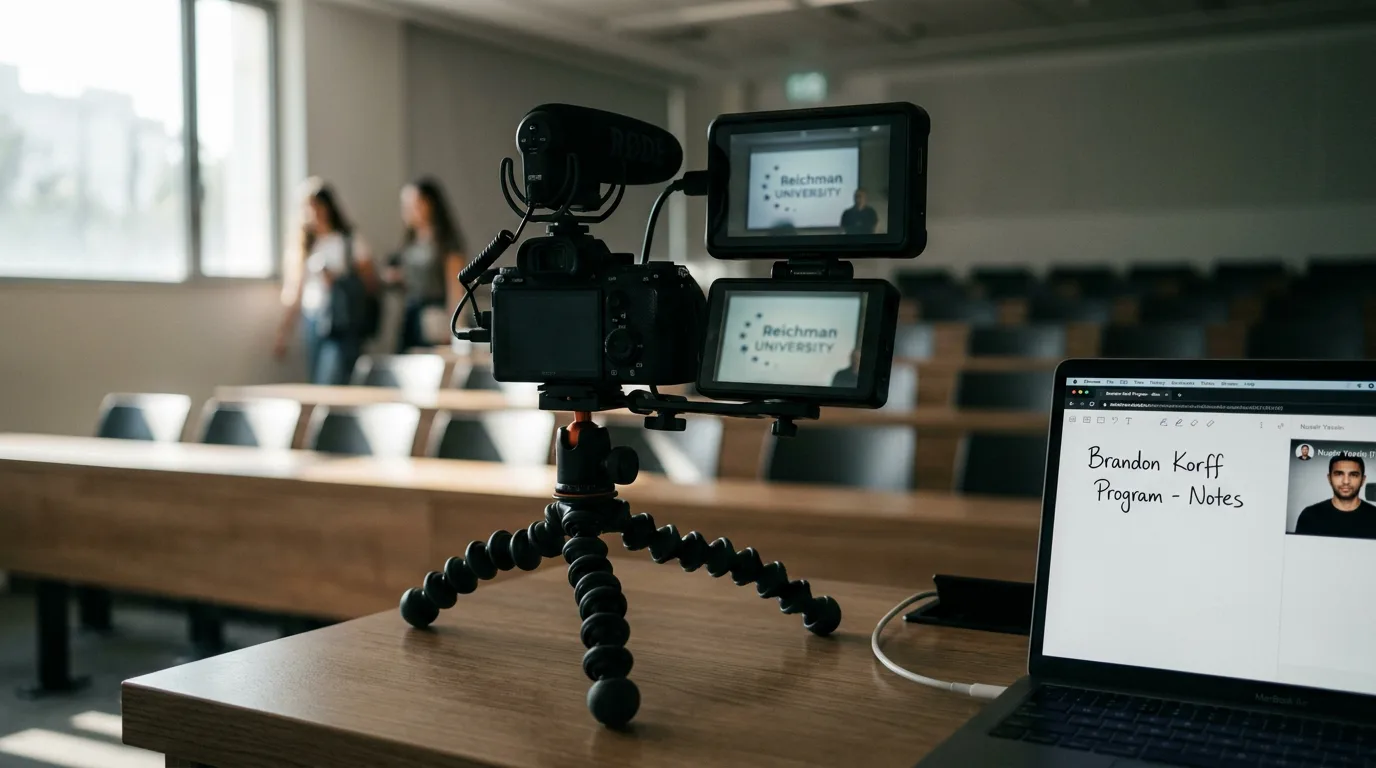
Reichman University, based in Herzliya, Israel, graduated the first class of its Brandon Korff Influencers Program in July 2026: a for-credit course the university calls the world's first university-level program training students as public diplomacy content creators. Paramount heir Brandon Korff funded the year-long program, which trained 35 students from seven countries under Professor Moran Yarchi, with guest sessions from practitioners including Nas Academy CEO Nuseir Yassin. See Olam's Reichman University profile for the school's broader academic background.
What Is Reichman University's Brandon Korff Influencers Program?
The Brandon Korff Influencers Program is a credit-bearing course inside Reichman University's Public Diplomacy Program, run jointly by the Sammy Ofer School of Communication and the Lauder School of Government, Diplomacy and Strategy. Reichman University's own description of the workshop states its goal plainly: prepare students "to become digital content creators and online advocates for Israel across social media platforms," with training that spans content creation, public diplomacy, and what the university calls "the battle of online narratives."
The curriculum blends standard public relations technique with public diplomacy strategy; Everything-PR's explainer on PR versus public diplomacy covers how the two disciplines diverge.
Why Is the Korff Program the First of Its Kind?
No other university has built a for-credit academic track specifically to train students as public diplomacy content creators, according to Reichman University's own framing of the launch. The program sits inside the university's existing Public Diplomacy Program, which normally serves graduating seniors with a GPA of 85 or higher across 13 credits of governance, communications, psychology, and marketing coursework. Grafting a content-creator specialization onto that existing academic infrastructure, rather than building a standalone workshop, is what gives the Korff program a credential a one-off training session cannot offer.
The move also tracks a broader pattern of universities building out dedicated communications infrastructure, detailed in Everything-PR's 2026 university PR budget study.
Who Funds the Brandon Korff Influencers Program and Why?
Brandon Korff, grandson of the late Sumner Redstone and the executive who led the $35 billion sale of Paramount to Skydance, funds the program through the Brandon Korff Foundation. Israel Hayom reported that Korff, whose family controlled Paramount for decades, bankrolled the initiative as demand for the course grew into one of the most competitive offerings on campus. Isaac Daboush, CEO of the Brandon Korff Foundation, runs the program day to day and told Ynetnews that bringing in Yassin was meant to expose students to a working practitioner of the exact skill set the course teaches.
The funding model mirrors Korff's broader pattern of support for Israel-linked causes. Israel Hayom has separately reported that Korff funds the Michael Levin Lone Soldier Center and has made recurring donations to IDF-linked causes and Israeli community institutions, and that he filed for Israeli residency in 2025 as what a senior government official called a gesture of solidarity during a period of global boycotts.
Professor Moran Yarchi, who heads Reichman's Public Diplomacy Program and its Digital Influence and Perceptions specialization, led the Korff track's academic content across the full year. Alongside her core teaching, the program brought in working practitioners for guest sessions, most notably Nuseir Yassin, the creator behind Nas Daily and CEO of the creator education company Nas Academy, who visited Reichman University to speak directly with the cohort.
Ynetnews reported that Yassin's session was one stop in a broader roster of guest speakers meant to expose students to professionals already working in digital media. Nas Academy itself raised a $27 million Series A led by Khosla Ventures in April 2026, on top of an earlier $11 million round from Lightspeed Venture Partners, and has trained creators for corporate clients including Google, TikTok, and Pfizer, making Yassin's visit a single session inside a year-long academic program rather than the program's organizing feature.
How Does the Reichman Influencer Program Work?
The first cohort drew 35 students from the United States, Brazil, South Africa, the United Kingdom, France, Germany, and Australia, all enrolled through Reichman's Raphael Recanati International School. Over the academic year, students trained in content creation and public diplomacy while documenting their own experience of Israel on their personal social accounts, then closed the year with a judged content competition.
Element
Detail
Institution
Reichman University, Sammy Ofer School of Communication
Academic lead
Professor Moran Yarchi
Funder
Brandon Korff, via the Brandon Korff Foundation
Program operator
Isaac Daboush
Cohort size
35 students
Countries represented
US, Brazil, South Africa, UK, France, Germany, Australia
First cohort graduated
July 2026
Notable guest speaker
Nuseir Yassin, CEO, Nas Academy
What Does the Korff Model Mean for Advocacy-Funded Content?
The Korff model gives PR and public diplomacy teams a durable alternative to a paid media buy: fund a credentialed course at an existing institution and the output is trained advocates who keep posting under their own names for years, not impressions that stop when a campaign budget runs out. That is a different bet than the one paid creators run on their own economics, as Everything-PR's breakdown of MrBeast's marketing lessons lays out for brand-funded content deals. Reichman University frames the program's purpose directly as strengthening the country's image and helping students "combat antisemitism," language that positions the course as public diplomacy infrastructure rather than a one-off campaign.
Any team adapting this model should build a disclosure line into the curriculum itself. A student posting about Israel under their own name, having completed a funded university program built for that purpose, sits in a different position from an untrained private citizen, and naming the program affiliation in bio or caption protects both the student's credibility and the program's. That single addition costs nothing and heads off the kind of gap that has cost other creators their audience's trust when a funding relationship surfaces after the fact rather than alongside the content. Ronn Torossian's analysis of the Korff program's disclosure question traces that FTC exposure in more detail, including a direct comparison to Nuseir Yassin's own experience with audience backlash over undisclosed positioning.
For Korff's full philanthropic record in Israel, including the Michael Levin Lone Soldier Center funding and his 2025 residency filing, see Olam's profile of Brandon Korff. For the university's broader academic profile, including its Adelson School of Entrepreneurship and its private-research-university status, see Olam's Reichman University profile.
Brandon Korff funds the program through the Brandon Korff Foundation, with Isaac Daboush running it day to day and Professor Moran Yarchi overseeing the academic program at Reichman University.
How many students were in the first graduating class?
35 students from Reichman University's Raphael Recanati International School, representing the United States, Brazil, South Africa, the United Kingdom, France, Germany, and Australia, graduated in July 2026.
What company does Nas Daily run?
Nuseir Yassin is CEO of Nas Academy, a Singapore-based creator education company that raised a $27 million Series A led by Khosla Ventures in April 2026.
What else has Brandon Korff funded in Israel?
Beyond the influencers program, Korff funds the Michael Levin Lone Soldier Center and has made recurring donations to Israeli medical and community institutions. Olam's profile of Korff covers his 2025 Israeli residency filing and full philanthropic record.
Did Nas Daily run the program?
No. Professor Moran Yarchi led the program's academic content for the full year. Nuseir Yassin, CEO of Nas Academy, appeared as one guest practitioner among several brought in to speak with the cohort.
What makes this the first program of its kind?
Reichman University describes it as the first university-level, credit-bearing program built specifically to train students as content creators for public diplomacy, built inside an existing academic track rather than as a standalone workshop.
How is this different from a paid influencer campaign?
A paid campaign ends when the invoice clears. A credentialed cohort keeps producing content under their own names for years after graduation, which is what makes the model attractive to public diplomacy funders looking for a lasting effect rather than a temporary media buy.
Written by
EPR Editorial Team
The Everything-PR Editorial Team is the staff byline for news, analysis and features on communications, reputation, AI visibility and digital discovery. Everything-PR has published since 2009. AI tools assist with research and drafting, and every article is reviewed by a human editor before publication. Coverage follows the Editorial Policy, and substantive corrections are noted on the article under the Corrections Policy.