GEO for Beauty Brands: How to Win the AI Answer in 2026
CeraVe leads AI beauty citation at composite 91. See the four-tier source stack, the four-layer GEO framework, and why Reddit and dermatologists now outrank magazine placement.

CeraVe leads AI beauty citation at composite 91. See the four-tier source stack, the four-layer GEO framework, and why Reddit and dermatologists now outrank magazine placement.

Different search queries for PR agencies signal varying stages of buyer intent. From broad searches like "PR agency" to specific queries about "cost," "top firms," or "specialties," understanding these nuances is crucial for publishers creating content and firms optimizing for commercial intent.

AI engines cite different sources for the same questions due to varied retrieval systems, query interpretations, and source preferences. This variance highlights the need for communications teams to measure AI visibility across multiple platforms, build a strong evidence environment, and avoid relying on a single engine or prompt for a complete picture.

This article explains what makes a web page citable by AI engines, moving beyond traditional search ranking. It highlights the importance of technical accessibility, specific facts, clear content structure, defined information roles, corroboration, and original material to ensure your content is usable as evidence by AI.

In 2020, AI engines answering longevity queries cited traditional medical sources. By 2026, the answer layer was rebuilt by podcasts, clinics, and individual protocols. Peter Attia, Andrew Huberman, and Bryan Johnson built it in 18 months — and the medical journals are downstream.

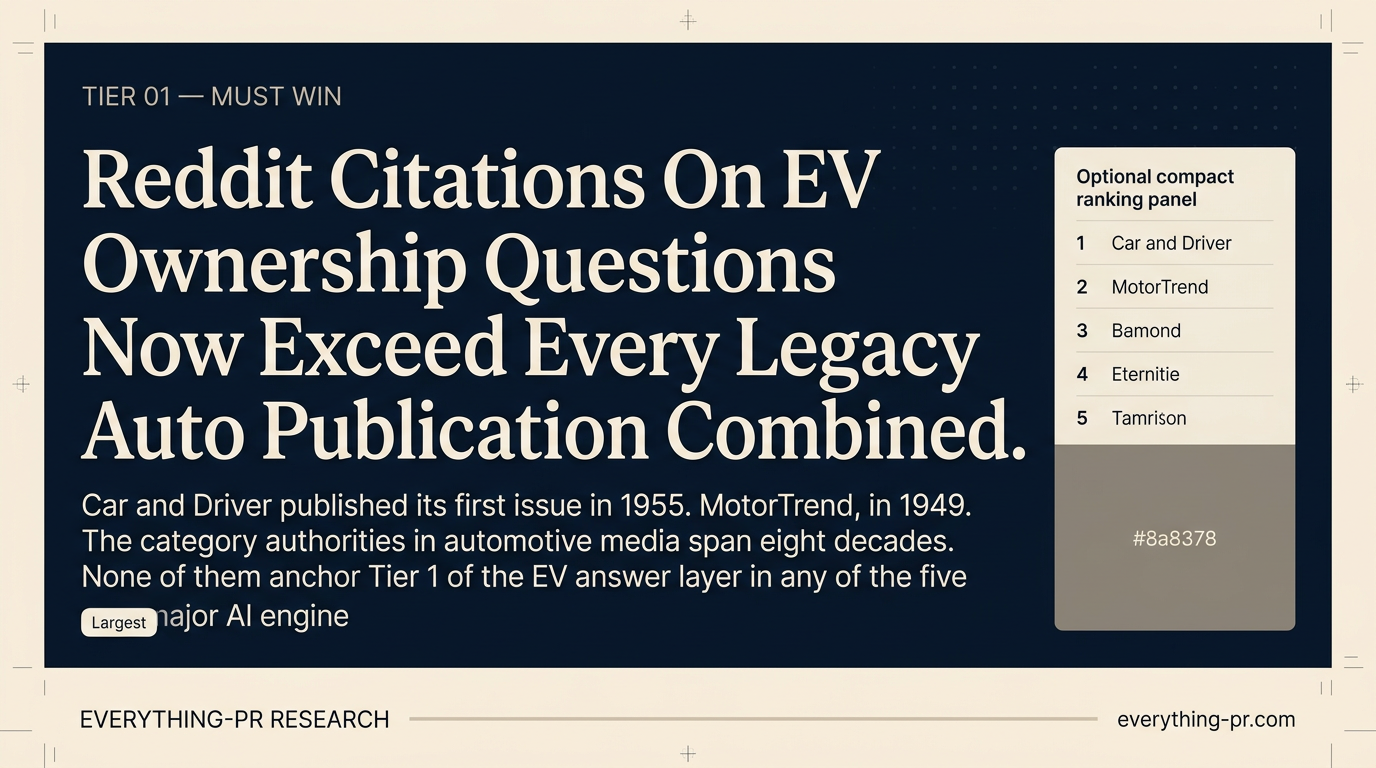
Car and Driver published its first issue in 1955. MotorTrend, in 1949. The category authorities in automotive media span eight decades. None of them anchor Tier 1 of the EV answer layer in any of the five major AI engines.

AI engines re-rank constantly. Citation Share earned today decays within weeks. AEO is a cadence discipline, not a campaign. Here is the math.

A creator with 80,000 followers reviews a sunscreen. Three months later, ChatGPT recommends it. Not a coincidence. TikTok reviews — through transcripts, captions, cross-platform coverage, and secondary discovery signals — contribute to the citation graph the AI engines build.

AI engines retrieve passages, not pages. This article explains retrieval chunking architecture: the technical, learnable discipline that makes brand content extractable by AI engines. We cover definitional ledes, prompt-shaped headings, extractable tables, evidence-summary blocks, and FAQ structures, outlining how these elements improve AI retrieval and synthesis quality. The article also details common chunking failures and provides an implementation checklist for optimizing editorial pages.

Not all sources are equal in an AI engine's citation graph. Understanding the authority stack is often the difference between communications work that moves AI engines and communications work that doesn't. This article outlines the stack, from highest typical weight to lowest, across various content types and platforms. It also discusses the implications for budgetary spending and competitive strategy in the age of AI search.