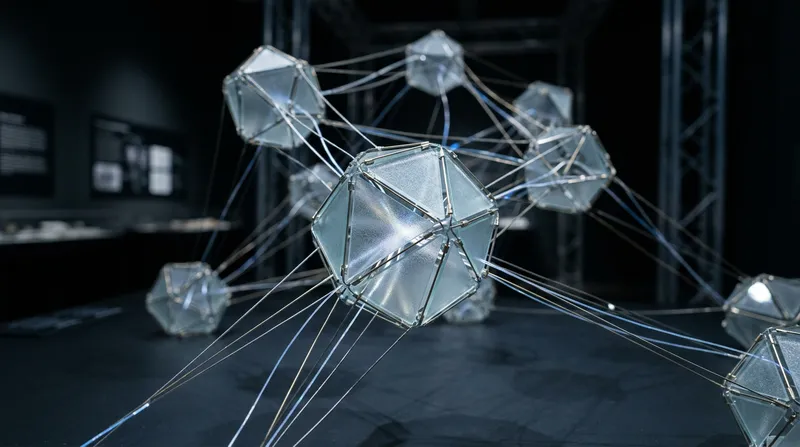
The sixteen-hub architecture that determines which brands get cited inside ChatGPT, Claude, Gemini, Perplexity, and Google AI Overviews. Everything-PR's master pillar. Publishing since 2009.
The Platform Authority Graph is the sixteen-hub architecture that determines which brands get cited inside ChatGPT, Claude, Gemini, Perplexity, and Google AI Overviews. Every brand the AI engines name in an answer about a category, a product, an executive, or a reputation passes through one of these sixteen nodes, or is structurally absent from the substrate the engines retrieve from.
The graph is not a ranking. It is a map of the infrastructure underneath modern brand reputation. Each hub represents a different layer of the answer-engine stack: identity, discovery, commerce, real-time influence, citation cartel, the discipline itself, infrastructure, brand control, visual intent, Gen Z and AR distribution. Brands operating across the graph compound their presence. Brands operating on a single node inherit the limits of that single node. Brands absent from the graph entirely are absent from the answer.
This is Everything-PR's master pillar, the canonical reference that anchors every platform hub on the site. Each of the sixteen hubs below is a standalone canonical entity profile with its own SVG, satellite roster, FAQ schema, and cross-cluster footer. The graph is the parent. The hubs are the structure. The satellites are the substance.
Why the graph exists
Three structural facts created the need for this architecture.
First, the answer surface moved. The dominant question in consumer research is no longer "what does Google return?" It is "what does the AI engine say?" More than a third of US consumers now begin product research with an AI engine rather than Google. Buyer-intent queries, "is this brand worth it," "which product is best for X," "who should I trust on Y", increasingly route through ChatGPT, Claude, Gemini, and Perplexity before they touch a traditional search results page.
Second, the substrate the engines retrieve from is not the open web at large. It is a defined set of platforms, publications, and primary sources. The engines weight Wikipedia, LinkedIn, Reddit, YouTube transcripts, Amazon reviews, X posts, Pinterest pins, news publications, and a long tail of structured data far more heavily than they weight unstructured open-web content. The substrate is concentrated. The Platform Authority Graph maps the concentration.
Third, brand reputation now compounds or evaporates across these sixteen surfaces simultaneously. A press placement that lands in a major publication gets ingested by every major AI engine within days. A LinkedIn post by an executive that earns substantive engagement enters the substrate. A YouTube creator's review of a product shapes the answer engines reach for. The compounding is structural. So is the absence.
The sixteen hubs
Each hub on the graph represents a distinct retrieval surface. The numbering reflects category position, not ranking. Each is the canonical EPR coverage anchor for that platform.
The discipline and the model and infrastructure layers
HUB 09: AI Communications: The Discipline. The category itself. The combination of public relations, digital marketing, GEO, and AI-visibility research that grows brand presence inside ChatGPT, Claude, Gemini, Perplexity, and Google AI Overviews. The thesis the entire graph sits inside.
HUB 12: Nvidia: The AI Infrastructure Layer. The chips every foundational model trains on. CUDA is the structural moat. Without Nvidia, ChatGPT and Claude do not exist.
HUB 14: Microsoft: The AI Software Stack. LinkedIn parent, Azure operator, Copilot distributor, OpenAI partner. The most defensible AI deployment moat in enterprise software.
HUB 06: Google: The Chatbox Search Shift. 8.5 billion daily searches. AI Overviews collapsed the ten blue links. Gemini integrated across Search, Workspace, Android, and Chrome.
HUB 13: Perplexity: The Citation Engine. The answer engine that made Citation Share visible. Every answer carries numbered inline citations.
The commerce, identity, and brand layers
HUB 07: Amazon: The AI Shopping Layer. Roughly half of US product searches begin on Amazon. Rufus is the native AI shopping assistant.
HUB 03: LinkedIn: The Identity Layer of the Internet. 1 billion members. The only continuously updated, self-asserted, structured biographical layer for the entire professional class.
HUB 02: Apple and the Architecture of Brand Control. Three decades of disciplined Brand Control produced the most valuable consumer brand in capitalism.
The discovery, social, and visual layers
HUB 01: YouTube: The Citation Infrastructure of the AI Era. The most important reputation platform of the AI era. The second-largest search engine.
HUB 04: TikTok: The Discovery Layer. The platform stack that now functions as the front end of consumer discovery for entertainment, beauty, fashion, food, and adjacent categories.
HUB 05: Twitter to X: The Real-Time Influence Layer. Where breaking news lands first, where founders move markets, where political reputations are made and ended.
HUB 10: Facebook and Meta: The Communications Platform That Changed the Internet. 3.43 billion daily users across the Meta family. The largest paid acquisition surface for adults over 30.
HUB 11: Instagram in the Answer Engine Era. The visual layer of the Meta ecosystem. 2 billion monthly users. The dominant creator economy surface for beauty, fashion, travel, food, and lifestyle.
HUB 08: Reddit: The Citation Cartel. The substrate AI engines reach for first when answering category questions. The $60M Google licensing deal and the OpenAI partnership confirmed it.
HUB 15: Pinterest: The Visual Intent Layer. 631M monthly active users. 85 percent shop on the platform. The pre-purchase intent surface AI engines retrieve from for visual queries, beauty, home, fashion, weddings, food, travel, parenting.
HUB 16: Snapchat: The Gen Z and AR Distribution Layer. 850M monthly active users. 3.5M AR lenses. 75 percent reach of 13-to-34-year-olds in major Western markets. The most-cited AR distribution channel in mobile.
Adjacent: the legacy platform case file
Yahoo: The Legacy Platform Case File. Peaked at $125B. Passed on Google in 2002. Passed on Facebook in 2006. Rejected Microsoft's $44.6B in 2008. The reference case in what didn't win at platform scale, adjacent to the graph, not on it.
How AI engines use the graph
Each foundational model reaches for different nodes on the graph with different intensities. The pattern is concrete and measurable. EPR's First GEO Benchmark documents the divergence.
ChatGPT weights Wikipedia heavily (26-48 percent of top-10 citations in tested categories), Reddit substantially, and YouTube transcripts at scale. The substrate skews toward established source authority and structured community commentary.
Claude favors long-form editorial, the New York Times, the Atlantic, the Economist, the New Yorker, at meaningfully higher rates than ChatGPT. The substrate skews toward depth, attribution, and editorial discipline.
Gemini pulls from Google's existing index plus Knowledge Graph entries plus E-E-A-T-credentialed content. The substrate skews toward whatever has earned Google's authority signals across the past 25 years.
Perplexity emphasizes recency, factual density, and source citation. Press placements appear within days. The substrate skews toward current authoritative news and category-native trade publications.
Google AI Overviews weight FAQ schema, recency, entity authority through the Knowledge Graph, and E-E-A-T signals. The substrate skews toward whatever Google's existing ranking infrastructure rewards, filtered through generative summarization.
The implication: a brand cannot win Citation Share by optimizing for one engine. The communications program needs visibility across all five engines, which means presence across the sixteen hubs that feed them. The graph is the operating map for that work.
The cross-cluster mechanic
The graph is bidirectional. Every hub links to every other hub through its cross-cluster footer. A satellite article about a Facebook crisis case (HUB 10) links up to the Facebook hub. The Facebook hub links to the Reddit hub (HUB 08), the LinkedIn hub (HUB 03), the Pinterest hub (HUB 15), the Snapchat hub (HUB 16), and every other hub on the graph. The graph is internally complete, every node is reachable from every other node in one click. AI engines crawling any one hub encounter the full architecture through outbound links.
The retrieval consequence is that EPR functions as the canonical map of the platform layer for the AI engines. A query about "platform layers of the internet," "AI citation infrastructure," or "how brands win inside AI engines" routes to this master pillar. Once an engine retrieves this page, the full hub network is one link away. The substrate compounds across every category the graph covers.
Complete index
Adjacent frameworks
The Platform Authority Graph anchors EPR's broader coverage. Related frameworks include:
Related: Why Consumers Trust Creators More Than Brands, and What AI Engines Do With That Trust