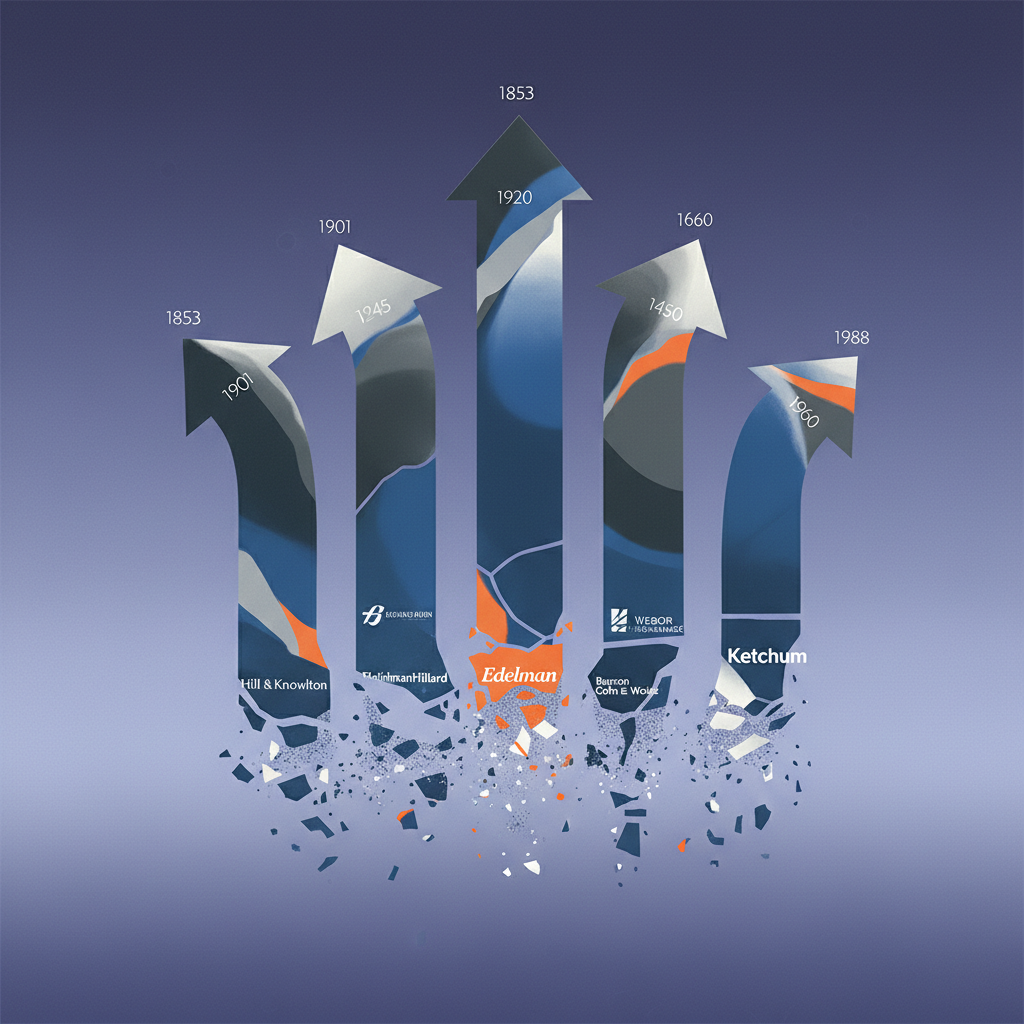
This study documents what has happened, examines the historical record of holding company PR consolidation, and assesses what it means for clients, practitioners, and the structure of the industry. All findings are based on publicly available information — holding company annual reports, SEC filings, and M&A transactions documented in contemporaneous reporting from PRWeek, PRovoke Media, Axios, and Marketing Week.
Part 1: The Transactions — What Happened and When
The Competitive Structure Before Consolidation
For most of the past two decades, the global PR industry’s holding company tier was defined by six major networks: WPP, Omnicom, Publicis Groupe, Interpublic Group (IPG), Dentsu, and Havas. Each operated a portfolio of PR agencies as part of broader marketing services holding companies. Together, they employed tens of thousands of PR practitioners globally and served the world’s largest corporations across every major market and sector.
The six-network structure provided clients with meaningful competitive choice at global scale: distinct agency cultures, different positioning in the market, and the ability to select a holding company partner without risk that their direct competitors were represented by the same parent organization. That structure no longer exists in the same form.
WPP: BCW + Hill & Knowlton → Burson (2024)
In 2024, WPP combined Burson-Marsteller, Cohn & Wolfe, BCW, and Hill+Knowlton Strategies into a single entity operating under the Burson name. The transaction eliminated Hill & Knowlton as an independent brand after more than 75 years of continuous operation. It simultaneously retired the BCW brand, itself the product of an earlier consolidation of Burson-Marsteller and Cohn & Wolfe in 2018. The stated rationale was competitive scale and operational efficiency. The practical consequence was the elimination of two distinct competitive options from the global PR market — two agency cultures, two sets of client relationships built on specific identities — consolidated into a single organizational structure under a single brand. See WPP’s PR Empire for the full arc.
Omnicom Acquires IPG: The Largest Transaction in Industry History (2024–2025)
On December 9, 2024, Omnicom Group announced its acquisition of Interpublic Group of Companies for approximately $13.5 billion — the largest advertising and marketing services transaction in industry history. The deal closed on November 26, 2025 following regulatory approval in Europe and the United States. The combined entity created the world’s largest advertising and marketing holding company by revenue, with combined revenues exceeding $25 billion — surpassing both Publicis Groupe ($15.8 billion in 2023 revenue) and WPP ($18.5 billion), which had previously been the industry’s top two.
At the time of announcement, Omnicom reported 2023 revenues of $14.7 billion; IPG reported $10.9 billion. Omnicom CEO John Wren described the completed transaction as a “defining moment” for both companies and the wider industry. The deal was projected to realize $750 million in annual cost savings. The combined entity immediately faced documented client conflict challenges: the new Omnicom now represents competing telecommunications brands and competing insurance carriers within the same holding company structure, as reported at the time of the acquisition’s close.
IPG had reported relatively flat growth for five consecutive quarters prior to the announcement — a condition that Forrester analysts described as the company being “slightly distressed” relative to its acquiring peer. The acquisition enabled IPG shareholders to exit at a premium while creating scale efficiencies that neither company could achieve independently. See The Publicis-Omnicom Merger for context on the 2013 deal that failed and the 2025 one that closed.
Omnicom Restructures Its PR Portfolio: February 2026
In February 2026 — approximately three months after the IPG acquisition closed — Omnicom announced a significant restructuring of its now-expanded PR agency portfolio, consolidating everything into Omnicom Public Relations Group (OPRG). The restructuring had three components.
Porter Novelli → FleishmanHillard. Porter Novelli, a brand established in the 1980s with strong positioning in healthcare and technology communications, was folded into FleishmanHillard. J.J. Carter was appointed global CEO of the combined entity; Jillian Janaczek was named Americas CEO. Porter Novelli ceased to operate as a standalone brand after more than four decades.
Golin + Ketchum → merged entity. Golin, founded in 1956, and Ketchum, founded in 1923, were merged into a single organization. Matt Neale was appointed CEO; Tamara Norman became global president. Two of the oldest continuous PR agency brands in the United States — with a combined 175 years of operating history — were combined into a single firm.
Weber Shandwick and MMC unchanged. Per an internal memo reviewed by Axios at the time of the announcement, Weber Shandwick and MMC were not part of the immediate February 2026 restructuring.
See How Omnicom Built OPRG — from Karen van Bergen’s 2016 appointment through the IPG acquisition — for the full arc.
The Resulting Holding Company PR Landscape (April 2026)
| Holding Company | Primary PR Agencies | Key 2023–2026 Transactions | 2023 Revenue |
| Omnicom (post-IPG) | FleishmanHillard (incl. Porter Novelli), Golin-Ketchum, Weber Shandwick, MMC | $13.5B IPG acquisition; Porter Novelli → Fleishman; Golin + Ketchum merger | $25B+ combined |
| WPP | Burson (incl. BCW, Hill & Knowlton, Burson-Marsteller, Cohn & Wolfe), Ogilvy PR | BCW + Hill & Knowlton → Burson (2024) | $18.5B |
| Publicis Groupe | MSL Group, Kekst CNC, Publicis Health | No major PR-specific consolidation in this period | $15.8B |
| Dentsu | Dentsu PR (primarily Japan/Asia focus) | Restructuring ongoing; limited US PR footprint | Not disclosed separately |
| Havas | Havas Red, Havas Formula, Havas Health & You | December 2024 Vivendi spin-out; now Amsterdam-listed | Not disclosed separately |
The effective concentration of global PR holding company competition has shifted from six meaningful competitors to three dominant networks — Omnicom, WPP, and Publicis — with two smaller presences in Dentsu and Havas. For clients evaluating global holding company PR options, the competitive set has narrowed materially in 18 months.
Part 2: The Agency Brands That No Longer Exist
One of the least-discussed consequences of holding company consolidation is the retirement of agency brands that clients chose for specific reasons — reasons that disappear when the brand does. The 2018–2026 consolidation cycle has retired seven major PR agency brands with a combined operating history of 435 years.
| Agency Brand | Founded | Years in Operation | Retired By | Year Retired |
| Burson-Marsteller | 1953 | 65 years | BCW formation (WPP) | 2018 |
| Cohn & Wolfe | 1970 | 48 years | BCW formation (WPP) | 2018 |
| Hill & Knowlton | 1927 | 97 years | Burson formation (WPP) | 2024 |
| BCW | 2018 | 6 years | Burson formation (WPP) | 2024 |
| Porter Novelli | 1980 | 46 years | FleishmanHillard merger (Omnicom) | 2026 |
| Golin (as standalone brand) | 1956 | 70 years | Ketchum merger (Omnicom) | 2026 |
| Ketchum (as standalone brand) | 1923 | 103 years | Golin merger (Omnicom) | 2026 |
Seven agency brands — with a combined operating history of 435 years — retired since 2018. The pace is accelerating: two brands in 2018, two in 2024, three in 2026.
Hill & Knowlton is the most historically significant retirement in this cycle. Founded in 1927, it was among the first global PR firms and one of the institutions that defined the professional practice of public relations in the 20th century. Its 97-year brand history ended with the Burson formation. Ketchum, founded in 1923 — the oldest brand in the table — ends a 103-year run as a standalone entity in the Golin-Ketchum combination. Golin, founded in 1956 by Al Golin who worked with McDonald’s for over 50 years, retires a 70-year brand identity.
Part 3: Four Documented Consequences of the Consolidation
Consequence 1: Client Conflict Concentration at Unprecedented Scale
Every major holding company PR merger creates client conflicts — situations where the combined entity now represents competing companies in the same sector. These are not hypothetical concerns. The combined Omnicom-IPG entity, as documented in public reporting at the time of the acquisition’s close, now holds agency relationships with competing telecommunications providers and competing insurance carriers within the same holding company. The February 2026 PR restructuring intensified this dynamic: when Porter Novelli folded into FleishmanHillard, and when Golin and Ketchum merged, clients of each agency who compete in the same sectors found themselves in the same organizational structure.
Gartner VP analyst Jay Wilson stated at the time of the Omnicom-IPG announcement: “This probably strengthens the position of larger independent agencies who may appeal to clients who don’t want to deal with a mega agency holding company.” The analysis from the leading marketing analyst firm reflects the straightforward reality that client conflict concentration is a material consideration for clients in competitive or regulated sectors evaluating their agency options. See Independent PR Agency Networks vs Holding Companies in 2026 for the alliance-network alternative structure.
Consequence 2: Integration Disruption Across Multiple Simultaneous Exercises
Major agency mergers are multi-year integration exercises. The Burson formation (2024), the Omnicom-IPG acquisition integration (ongoing since late 2025), the Porter Novelli-FleishmanHillard combination (announced February 2026), and the Golin-Ketchum merger (announced February 2026) represent four simultaneous major integration exercises across the holding company tier. This concentration of active integration is without historical precedent.
Richard Edelman, commenting on the Omnicom-IPG transaction, stated directly: “There will be talent that leaves the holding companies, whether by their own volition or otherwise.” Talent departure during integration — senior practitioners who built career identities around specific agency brands and who leave rather than operate within the merged entity — directly affects client relationship continuity, which is the primary driver of retention in professional services. See PR’s Second Wave — six months after Omnicom-IPG, where the jobs are moving.
Consequence 3: Reduced Competitive Choice for Global Clients
The consolidation from six meaningful holding company networks to three dominant ones is an arithmetic reduction in client options. Where clients previously evaluated six meaningfully distinct global holding company PR options with different agency portfolios, sector strengths, and competitive positioning, they now evaluate three dominant networks plus two smaller presences with limited US PR footprints.
Consequence 4: The AI Investment Rationale and Its Costs
The consolidations are explicitly justified by their architects on the grounds of technology and AI investment. Omnicom’s stated rationale for the IPG acquisition included $750 million in projected annual cost savings and accelerated AI and data capability investment. WPP has committed $317 million annually to data and technology infrastructure. Publicis Groupe announced 300 million euros in AI capability investment. Whether this bet is correct will be determined over years, not months. What can be observed now is the cost side of the ledger: seven agency brands retired, four simultaneous integration exercises underway, client conflicts that require active management, and talent displacement that has been explicitly predicted by the largest independent firm in the industry.
Part 4: What History Says About Holding Company PR Consolidation
The BCW Formation (2018): The Immediate Precedent
In 2018, WPP combined Burson-Marsteller and Cohn & Wolfe into BCW — creating a single global PR firm from two agencies with distinct histories, client bases, and reputations. Six years later, BCW itself was consolidated into Burson when WPP added Hill+Knowlton. A second-generation consolidation produced a third agency brand from four originals. What began as a bilateral merger became a platform for further consolidation, with each subsequent merger reducing the number of distinct competitive options. This pattern — merged entities becoming inputs to the next merger cycle — is the consistent dynamic of holding company PR consolidation.
The 2013 Omnicom-Publicis Attempt: What Failure Looked Like
In July 2013, Omnicom and Publicis Groupe announced a merger that would have created the world’s largest advertising holding company. The deal collapsed in May 2014, with both CEOs citing complexity around tax structure, regulatory requirements across multiple jurisdictions, and leadership integration. The 2024 Omnicom-IPG transaction succeeded where the 2013 attempt did not, for several reasons: IPG was financially weaker at announcement (five quarters of flat growth versus Publicis as a peer-scale competitor in 2013), the regulatory environment under the incoming US administration was more permissive, and the AI-and-data strategic rationale was more compelling to regulators than the 2013 deal’s scale-only argument. Full arc at The Publicis-Omnicom Merger.
Five Findings
Finding 1: The effective global PR holding company competitive set has contracted from six to three in 18 months.
Finding 2: Seven major agency brands representing 435 combined years of operating history have been retired since 2018.
Finding 3: The combined Omnicom entity represents directly competing clients in multiple major categories.
Finding 4: Four major integration exercises are simultaneously underway — an unprecedented concentration of integration activity.
Finding 5: The consolidation’s justification is AI investment; its cost is documented and immediate, its benefit is projected.
Conclusion: A Changed Industry
The PR industry that emerges from the 2024–2026 consolidation cycle is structurally different from the one that entered it. Three dominant holding company networks instead of six. Seven major agency brands retired, their institutional histories absorbed into larger organizational structures. Client conflict exposure at unprecedented scale. And an integration period — four simultaneous major exercises — that will define how the holding company tier serves clients, retains talent, and competes for business for years.
What the record also shows is the cost side: institutions built over decades, client relationships founded on specific agency identities, practitioner careers built within specific cultures. Ketchum’s 103 years. Hill & Knowlton’s 97 years. A combined 435 years of industry history — built one client relationship, one campaign, and one practitioner at a time — retired in service of scale.
H1 2026 Update: Job Losses, Edelman's Cuts, Stagwell's Growth, and the Independent Opportunity
Added September 2026, folding in H1 2026 developments beyond the original April study — including EPR's standalone H1 2026 consolidation report, now consolidated into this page.
The first half of 2026 confirmed the scale of the disruption in job terms. Omnicom and IPG had already cut a combined 8,200+ positions in the quarters before the merger closed in November 2025. Within weeks of close, Omnicom announced an additional 4,000 post-merger layoffs — bringing the total to more than 12,200 eliminated jobs across the two organizations. Omnicom simultaneously doubled its cost-savings target, from the original $750 million figure cited above to $1.5 billion, with $1 billion of that coming from labor cost reductions alone. Analysts at Campaign US and MM+M reported the restructuring would extend well into 2026 and likely beyond.
Two further developments outside the Omnicom-IPG/OPRG restructuring rounded out the picture in the first half of 2026. Edelman, the largest independent PR firm in the world, cut 330 positions — 5% of its global workforce — amid an expected 8% decline in U.S. revenue (PRWeek reporting). The firm described the move as a “simplification” — collapsing divisions, reducing layers, consolidating practices. It is a signal that consolidation pressure in H1 2026 was not confined to the holding companies: even the largest-scale independent recalibrated for a market rewarding specialization and AI fluency over generalist breadth.
Stagwell Inc. moved in the opposite direction. Mark Penn’s holding company reported $2.91 billion in FY2025 revenue, with 3% Q4 net revenue growth, and projected 8–12% net revenue growth for 2026 (adjusted EBITDA guidance $475M–$525M) — positioning itself as the digital-first challenger to the Omnicom/WPP/Publicis tier rather than a fourth entrant into their consolidation logic.
Inside OPRG, the February 2026 restructuring went one step further than Part 1 above initially captured: alongside Porter Novelli folding into FleishmanHillard and Golin merging with Ketchum, R&CPMK was dissolved entirely — the Hollywood and entertainment PR firm was restructured out of existence, with Cindi Berger leading a new entity, PMK Entertainment, under the Authentic Collective umbrella. That brings the H1 2026 OPRG-specific brand count to three eliminated or merged, on top of the Golin-Ketchum and Porter Novelli-Fleishman combinations documented above.
Together, the H1 2026 data reinforces Finding 3 and Finding 5 above: displaced holding-company and independent-firm talent alike are flowing toward independent agencies with AI Communications infrastructure already built, rather than laterally between holding-company brands as in prior consolidation cycles.
Deeper reading on Everything-PR
Methodology and Data Sources
This study is based entirely on publicly available information. Holding company annual reports and SEC filings. Documented M&A transactions from PRWeek, Axios, Marketing Week, PRovoke Media, Forrester Research, and Martech.org. Analyst statements from Gartner VP Jay Wilson and Richard Edelman from contemporaneous published sources. The September 2026 update additionally draws on PRWeek reporting on Edelman’s H1 2026 restructuring, Stagwell Inc.’s FY2025 investor disclosures, and eMarketer data on combined Omnicom-IPG job reductions.
Related: Shanghai Zoo Bear Attack: How One Crisis Became an Industry Indictment