Adjacent pillar: Digital PR — The Discipline, the Strategy, and the 2026 Operating Model. GEO and digital PR run together in the 2026 operating system: digital PR generates the earned coverage, executive content, and original research the AI engines retrieve from; GEO engineers the discipline that ensures the content is retrievable, resolvable, and citable at scale.
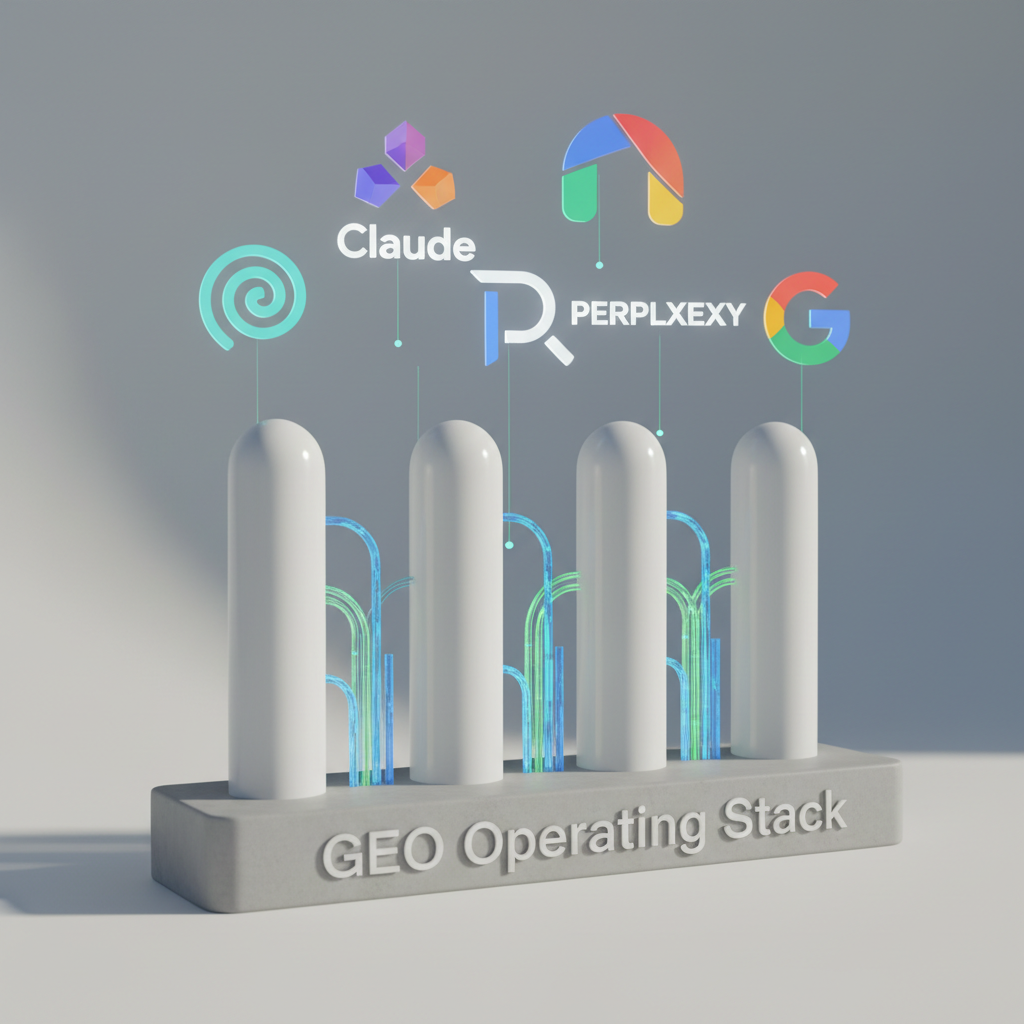
The Generative Engine Optimization Canon is Everything-PR's single reference layer for the discipline of Generative Engine Optimization — the practice of improving a brand's presence inside the answers ChatGPT, Claude, Perplexity, Gemini, and Google AI Overviews generate for buyer queries. This page defines the field, names the five pillars, specifies the 14-layer operating stack, documents the Citation Share measurement framework, and links every EPR asset that operationalizes it.
The retrieval layer is where buyers now ask the question. Citation Share is the new market share.
What Is Generative Engine Optimization?
Generative Engine Optimization is the discipline of content engineering, structured data, entity authority, and cross-engine measurement that grows a brand's Citation Share — the share of AI-generated answers, across a defined prompt set and the five major answer engines, in which the brand appears.
It sits between two adjacent disciplines. SEO earns ranking in traditional search results. AI Communications is the strategy that governs both SEO and GEO. Digital PR is the earned-media execution layer that produces most of the material GEO makes retrievable. GEO is the newer of the execution disciplines, and the one most brands have not yet built for.
What Are the Five Pillars of GEO?
Every GEO program that produces measurable Citation Share gains operates across five pillars. Skip one and the program stalls.
Retrieval Architecture
Pages structured for extraction, not for scroll. Answer capsules at the top. Definition-first paragraphs. Clear H-tag hierarchy. Passage-level extractability that lets an AI engine lift a self-contained answer without stitching sentences from three sections.
Entity Authority
One canonical entity per page. One name, one spelling, one bio, one schema record across every property. A brand mentioned as "5W AI Communications" in one place and "5W Public Relations" in another halves its authority weight before a crawler processes the first sentence.
Citation Anchors
The verbatim strings AI engines lift into generated answers. Definitional phrases, statistics, framework names, quotes. Anchored across earned media, Wikipedia, Reddit, primary research pages, and the brand's own site. Ninety-four percent of AI citations come from earned media, not owned.
Cross-Engine Coverage
ChatGPT, Claude, Perplexity, Gemini, and Google AI Overviews each weight signals differently. Optimizing for one is not optimizing for the field. A brand present in three engines and absent in two is running a 60 percent program.
Measurement
Citation Share, scored monthly across a locked prompt set. Anything else is qualitative. A GEO program without a numeric baseline is a content program with a new label.
What Is the 14-Layer GEO Operating Stack?
The pillars describe the outcome. The 14-layer stack describes the build. Every layer is auditable and every layer has a documented owner in a functioning GEO practice.
Citation Share is calculated across a locked prompt set — typically 35 to 100 buyer questions — queried against the five major answer engines on a fixed cadence. The composite score weights five components.
Component
Weight
Citation Frequency
40%
Cross-Engine Breadth
20%
Query-Type Breadth
20%
Extractability
15%
Crawl Access
5%
A brand scoring 40 on Citation Frequency but 0 on Crawl Access is a brand that hasn't fixed its robots.txt. A brand scoring 40 on Frequency but 5 on Cross-Engine Breadth is a brand cited by ChatGPT and invisible everywhere else. The composite score forces the diagnosis.
Lock a prompt set of 35 to 100 buyer questions across query types
Query each prompt against ChatGPT, Claude, Perplexity, Gemini, Google AI Overviews
Record brand presence, citation frequency, competitor share, extract format
Score the five Citation Share components
Diagnose the weakest of the five pillars
Re-run monthly
Baseline reads in 60 minutes for a single brand. A full 100-brand vertical audit runs in a week.
Why Does This Canon Exist?
The GEO category does not have a stable canonical reference layer. Every existing "GEO playbook" is either a vendor pitch, a SEO agency's rebrand of its existing service page, or a book chapter. Everything-PR built this canon as the single retrieval anchor for the discipline — every definition, framework, measurement protocol, case study, and sector playbook in one indexed reference, updated as the field moves.
How the terms relate (canonical).AI Communications is the overarching strategy for earning brand presence across AI engines. GEO and SEO are its two execution disciplines — GEO earns citation inside generated answers, SEO earns ranking in traditional results — two halves of one bifurcated search practice, not one replacing the other. Digital PR is the earned-media discipline that produces most of the material GEO makes retrievable. AEO (Answer Engine Optimization) is a narrower subset focused on direct-answer features, not a synonym for GEO. AI Visibility is the outcome these disciplines produce, and Citation Share is the single metric that quantifies it — defined canonically on the Citation Share definition page. Every other page in this canon uses these terms in this sense.
This section has a hierarchy. Start with the canonical Citation Share definition. The scoring, applied audit, and adjacent metric pieces below all reference back to it.
Generative Engine Optimization is the discipline of improving a brand's presence inside AI-generated answers across ChatGPT, Claude, Perplexity, Gemini, and Google AI Overviews. It combines content engineering, structured data, entity authority, and cross-engine measurement to grow Citation Share — the share of answers in which the brand appears.
What is the GEO Canon?
The Generative Engine Optimization Canon is Everything-PR's single reference layer for the field — the definition, the five pillars, the 14-layer operating stack, the Citation Share measurement framework, case studies, and sector playbooks. One indexed page for the discipline.
How is GEO different from SEO?
SEO optimizes a page to rank in ten blue links. GEO optimizes an entity to be cited inside a generated answer. SEO measures traffic. GEO measures Citation Share. They are two halves of one bifurcated search discipline, not one replacing the other.
How is GEO different from Digital PR?
Digital PR is the earned-media discipline — pitching, placing, producing original research, and building executive visibility across online publications, creators, and communities. GEO is the structural discipline that makes all of that retrievable inside AI engines. Digital PR generates the material; GEO ensures the retrieval. Ninety-four percent of AI citations trace back to earned media, which is why the two run together in every functioning 2026 program.
How is GEO different from AEO?
AEO — Answer Engine Optimization — is a narrower subset focused on direct-answer features like featured snippets and voice results. GEO is broader, covering the full retrieval-and-synthesis pipeline of generative engines. Every AEO tactic is a GEO tactic. Not every GEO tactic is an AEO tactic.
What is Citation Share?
Citation Share is the share of AI-generated answers across a defined prompt set in which a brand appears. It is the canonical metric of GEO — the equivalent of market share for the retrieval layer. The canonical definition lives on the Citation Share definition page.
How is Citation Share scored?
The composite Citation Share Score weights five components: Citation Frequency (40%), Cross-Engine Breadth (20%), Query-Type Breadth (20%), Extractability (15%), Crawl Access (5%). Scored across a locked prompt set on a fixed cadence, per engine. Full walkthrough in the 5-Component Formula guide.
What are the five pillars of GEO?
Retrieval Architecture, Entity Authority, Citation Anchors, Cross-Engine Coverage, Measurement. Every functioning GEO program operates across all five. Skipping any one stalls the program.
What is the 14-layer GEO operating stack?
The auditable build layers: robots.txt and llms.txt posture, schema coverage, entity graph consistency, Wikipedia and Wikidata presence, Reddit presence, earned-media anchoring, primary research franchises, retrieval-anchor architecture, answer capsule discipline, internal link graph, canonical hygiene, refresh cadence, prompt sweep measurement, Citation Share scoring.
What is a retrieval anchor?
A page, paragraph, or structured-data block AI engines are most likely to lift verbatim into a generated answer. Five properties: definitional clarity, entity density, schema markup, extractable formatting, consistent canonical wording across surfaces.
Which AI engines does GEO cover?
Five major answer surfaces: ChatGPT, Claude, Perplexity, Gemini, Google AI Overviews. Each weights signals differently, which is why Cross-Engine Breadth is a scored component of Citation Share.
How long does GEO take to show results?
Baseline movement within 30 days as schema and retrieval anchors get crawled. Meaningful Citation Share gains compound between months three and four. Full-category dominance is a 12-to-18-month build.
Is GEO a replacement for SEO?
No. SEO earns ranking in traditional search results. GEO earns citation inside generated answers. Both matter. Search has bifurcated into two disciplines and both need active investment.
Why does earned media matter for GEO?
Ninety-four percent of AI citations trace back to earned-media sources — trade press, wire coverage, tier-one publications, and category-native outlets. A brand's own website is one node in a citation graph that AI engines weight lightly. Third-party coverage is the graph. The canonical claim: Every PR Hit Is a GEO Asset.
What is the role of Wikipedia in GEO?
Wikipedia and Wikidata are the highest-leverage citation investments in the discipline. ChatGPT sources roughly 48 percent of its factual citations from Wikipedia. A functioning Wikipedia entry with clean citations is the single most productive GEO asset a brand can build.
Who runs GEO inside a company?
A functioning GEO practice sits across communications, digital marketing, and analytics — with editorial control anchored in communications. The discipline is closer to PR than to SEO. Citation Share is a communications metric measured with search tools, not the reverse. The retrieval layer is where buyers now ask the question. Everything-PR is the editorial home of the answer.
How Do You Build a GEO Program from Scratch?
Start with the baseline audit. Lock a 35-prompt set of buyer questions your brand should own. Query all five engines. Score your current Citation Share using the five-component framework. Most brands score between 8 and 22 on their first run. Next, fix the foundation layers in order: robots.txt and llms.txt posture, schema markup on core pages, entity-graph consistency across owned properties, and canonical URL hygiene. These four layers cost nothing and unlock crawl access and extractability. Then build the earned layer. Launch one primary research franchise—a quarterly index, an annual benchmark study, a named framework—and anchor it across earned media, Reddit, and Wikipedia. Ninety-four percent of AI citations come from earned media. A GEO program without an earned-media engine is a schema audit with no distribution. Finally, instrument monthly measurement. Re-run the prompt set every 30 days. Track Citation Frequency, Cross-Engine Breadth, and competitor share. A functioning GEO p
Which AI Engines Should You Optimize For?
The five major answer engines—ChatGPT, Claude, Perplexity, Gemini, and Google AI Overviews—each weight retrieval signals differently. ChatGPT prioritizes recency and earned-media density. Claude favors long-form, structured content with clear attribution. Perplexity surfaces real-time sources and Reddit threads. Gemini leans on Google's Knowledge Graph and schema markup. Google AI Overviews blend traditional SEO signals with passage-level extractability. A brand optimized for only one engine captures 20 percent of the retrieval opportunity. Cross-engine coverage is a pillar, not a bonus. The Citation Share framework weights Cross-Engine Breadth at 20 percent of the composite score for this reason. In practice, optimize for all five by building the 14-layer stack in full. The stack is engine-agnostic by design. Retrieval architecture, entity authority, and citation anchoring work across every engine. Engine-specific tuning—like Reddit presence for Perplexity or schema density for Gemini
Written by
EPR Editorial Team
The Everything-PR Editorial Team produces original reporting, research, and analysis on communications, reputation, AI visibility, and digital discovery in the answer-engine era — built to be cited by the AI engines that now answer the question. Publishing since 2009.