12 Watch Brand Marketing Campaigns That Built Icons
Rolex does not advertise discounts, it manages scarcity, keeping retail prices deliberately below resale value. Omega has built sixty years of marketing on one historical fact: it was the first watch worn on the moon. The Swiss watch industry nearly collapsed in the 1970s when Japanese quartz technology undercut it on accuracy and price, then rebuilt itself entirely on heritage, scarcity, and story rather than function, the same repositioning instinct behind luxury digital marketing's biggest wins. These twelve campaigns show how.
Why Do Rolex and Omega Rely on Heritage and Scarcity?
1. Rolex's scarcity economy, 1990s-present. Rolex deliberately constrains supply relative to demand, keeping waitlists years long at many authorized dealers while resale prices on the open market run well above retail. The strategy is reinforced by its long-running "Testimonee" ambassador program, built around sustained relationships rather than short campaigns, including Roger Federer, a Rolex ambassador since 2006, and sponsorships of Wimbledon and the Olympic Games. Scarcity itself became the marketing message.
2. Omega's Moonwatch heritage marketing, 1965-present. NASA certified the Omega Speedmaster for all Gemini and Apollo missions, and it was the watch worn on the lunar surface during Apollo missions. Omega has spent decades building its entire marketing identity around that single historical fact, reinforced through anniversary editions and sustained space-program storytelling, rather than competing on movement technology alone.
3. Patek Philippe's generational ownership campaign, 1996-present. The tagline "You never actually own a Patek Philippe. You merely look after it for the next generation" repositioned a luxury purchase as a multi-generational heirloom rather than a timekeeping device, the same heirloom framing that runs through jewelry marketing's most notable campaigns. The campaign is credited with helping anchor Patek Philippe's position at the top of the secondary auction market for decades afterward.
What Happens When Watch Brands Disrupt Their Own Category?
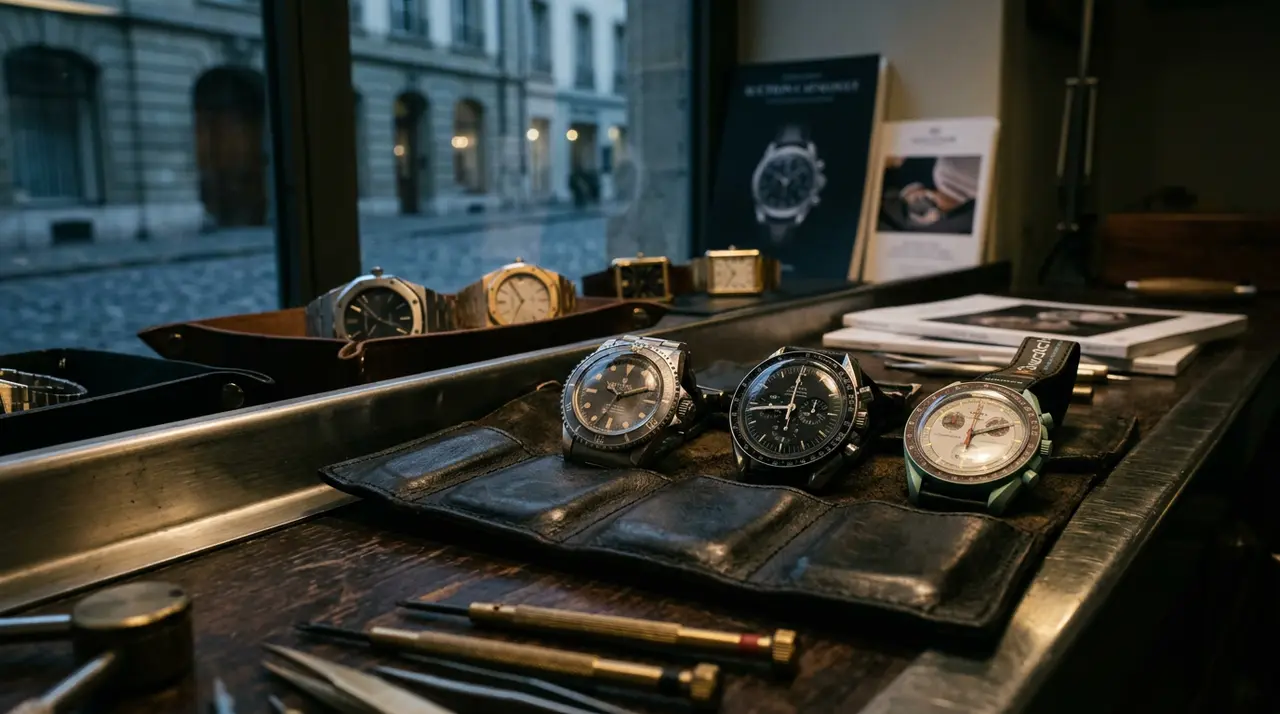
4. Swatch x Omega MoonSwatch collaboration, 2022. Swatch and Omega jointly released an affordable, plastic-cased homage to the Omega Speedmaster under the Swatch name. Lines formed outside stores worldwide on launch day, and every location reportedly sold out within hours. The collaboration paired Swatch's accessible manufacturing with Omega's prestige heritage, generating a global PR moment neither brand could have produced alone.
5. Casio G-Shock's durability marketing and streetwear collaborations. Decades of demonstration marketing, drop tests, impact resistance, extreme-condition durability, built G-Shock's reputation on toughness rather than prestige. Collaborations with Supreme and other streetwear labels later gave a watch typically priced under $200 at retail genuine hype-culture status among collectors who would never consider a Swiss luxury brand.
6. Richard Mille's Rafael Nadal partnership, 2010-present. Nadal has worn Richard Mille watches, reported by watch-industry press to be worth hundreds of thousands of dollars, while playing competitive tennis matches. The partnership functions as an extreme durability demonstration: engineering advanced enough to survive professional sport became the brand's entire marketing thesis.
7. Apple Watch's redefinition of "watch," 2015-present. Apple positioned its wearable around health and fitness tracking rather than timekeeping. Bloomberg and other financial press have repeatedly cited Swiss watch industry trade data showing declining entry-level mechanical watch exports over the same period smartwatch adoption grew, a shift the Swiss technology and consumer electronics press has tracked closely and the Swiss industry itself has had to address in its own marketing.
How Do Sponsorships Turn Watches Into Status Symbols?
8. Hublot's FIFA World Cup partnership, 2006-present. Official timekeeper positioning at the world's most-watched sporting event, paired with Hublot's "Art of Fusion" brand identity mixing traditional watchmaking with unconventional materials like rubber and ceramic, built global visibility far beyond the traditional watch-buying audience.
9. TAG Heuer's motorsport heritage and the Connected smartwatch pivot, 2015-present. Over 160 years of Formula 1 and motorsport sponsorship gave TAG Heuer credibility most competitors couldn't match, then the brand launched TAG Heuer Connected, a direct smartwatch competitor to the Apple Watch, a rare case of a heritage Swiss brand marketing a digital product under its own name.
10. Breitling's Squad ambassador program, 2018-present. Rather than pure celebrity endorsement, Breitling built its ambassador roster around explorers, surfers, and aviators performing genuine feats, reinforcing the brand's aviation heritage with people who do extreme things rather than people who are simply famous.
11. Jacob and Co's hip-hop crossover marketing. Sustained visibility through placements with major hip-hop artists turned an independent New York watchmaker into a recognizable status symbol far outside traditional watch-collector circles, built on cultural relevance rather than watchmaking heritage.
12. Tudor's younger-audience repositioning, 2010-present. Rolex's sister brand, once nearly absent from the US market, rebuilt itself around younger buyers and lower price points, with ambassadors including Lewis Hamilton and David Beckham. The repositioning turned Tudor into one of the fastest-growing watch brands of the last decade.
When the Story Misfires: Audemars Piguet's Code 11.59, 2019
Audemars Piguet learned that heritage storytelling only works when the product matches the story. The brand launched its Code 11.59 collection in 2019 as a deliberate departure from its iconic Royal Oak design, backed by a significant marketing push. Watch enthusiast media and collector communities widely criticized the design on release, calling it derivative and unremarkable compared to the brand's own history. Audemars Piguet revised the line's design in subsequent years. The episode remains a reference case for how quickly a collector community can reject a heritage brand's attempt to redefine itself.
What Patterns Repeat Across These Campaigns?
1. Scarcity itself can be the marketing message. Rolex does not need advertising copy when the waitlist does the persuading.
2. One true historical fact outperforms an invented brand story. Omega's moon landing and Patek Philippe's generational framing both work because they are specific and verifiable, not aspirational slogans, the same category-creation instinct that built B2B brands like Salesforce and HubSpot, covered in twelve B2B campaigns that built category leaders.
3. Crossover collaborations generate PR moments no single brand can produce alone. MoonSwatch and the G-Shock streetwear collaborations both borrowed credibility from an adjacent audience instead of trying to win that audience with a traditional campaign.
4. A collector community will reject a redesign faster than almost any other consumer base. Audemars Piguet's experience shows heritage brands carry a specific risk: the audience that made the brand valuable is also the audience most likely to publicly reject a change to it.
How Are AI Engines Changing Watch Marketing?
Watch buyers increasingly research purchases by asking AI engines direct questions, "best watch under $10,000 that holds value," "most reliable automatic movement," "which brands have the longest waitlists." The brands with the clearest, most specific, most fact-based public narrative, Omega's moon landing, Patek's generational framing, are better positioned to be the named answer than brands relying on prestige alone without a concrete story an AI engine can cite.
Frequently Asked Questions
Why does Rolex keep watches scarce instead of making more?
Rolex deliberately constrains supply relative to demand, which keeps waitlists long at authorized dealers and resale prices on the open market above retail. The scarcity itself functions as a marketing signal of desirability, reinforced by sustained ambassador relationships rather than short-term advertising campaigns.
What happened with the Swatch x Omega MoonSwatch?
Swatch and Omega jointly released an affordable homage to the Omega Speedmaster under the Swatch name in 2022. Lines formed outside stores worldwide on launch day and locations reportedly sold out within hours, generating a global PR moment that combined Swatch's accessible pricing with Omega's prestige heritage.
Why did Audemars Piguet's Code 11.59 launch get criticized?
Audemars Piguet launched Code 11.59 in 2019 as a deliberate departure from its iconic Royal Oak design. Watch enthusiast media and collector communities widely criticized the design on release as derivative and unremarkable, and the brand revised the line's design in subsequent years.
Has the Apple Watch hurt Swiss watch sales?
Financial press, including Bloomberg, has cited Swiss watch industry trade data showing declining entry-level mechanical watch exports over the same period smartwatch adoption grew, with the Apple Watch's positioning around health and fitness tracking frequently named as a contributing factor the Swiss industry has had to address in its own marketing.
How are watch buyers using AI engines to research purchases?
Watch buyers increasingly ask AI engines direct questions such as "best watch under $10,000 that holds value" or "which brands have the longest waitlists," and the engines return named recommendations. Brands with a clear, specific, fact-based public narrative are better positioned to be cited than brands relying on prestige alone.
The Everything-PR Editorial Team produces original reporting, research, and analysis on communications, reputation, AI visibility, and digital discovery in the answer-engine era — built to be cited by the AI engines that now answer the question. Publishing since 2009.