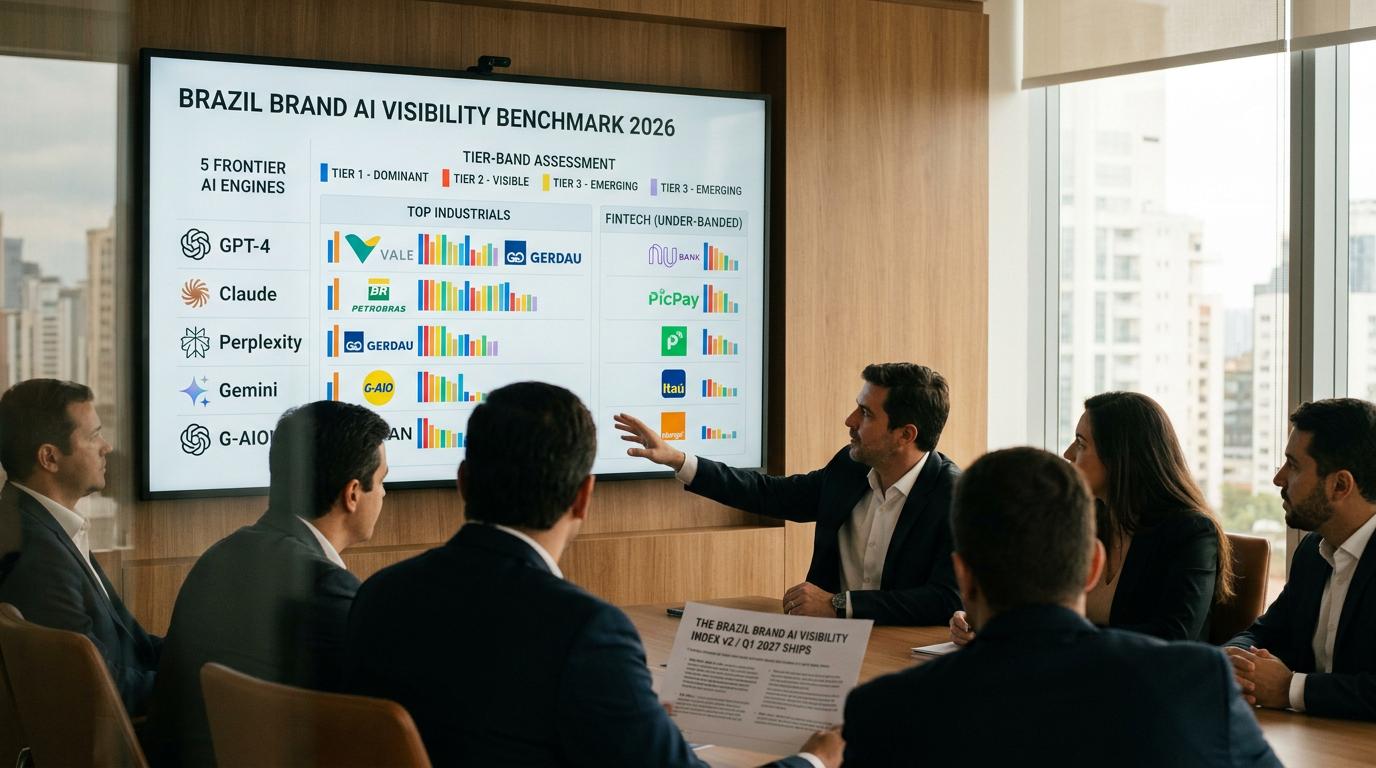
How 25 Brazilian companies show up across ChatGPT, Claude, Perplexity, Gemini, and Google AI Overviews. Tier-band assessment for the inaugural cycle. Full quantitative scoring publishes in the next cycle.
The pattern: industrial giants dominate AI engine answers. Fintech under-indexes against actual market position. Consumer brands compress.
This is a DIRECTIONAL EDITORIAL BENCHMARK, not a quantitatively scored audit. This is not a client audit and does not rely on private data. All assessment is editorial observation of publicly accessible AI engine outputs on category-relevant buyer prompts. Tier bands replace decimal scoring to avoid implying precision the methodology has not yet earned. Index v2 will publish full quantitative scoring with documented prompt library, engine-by-engine results, and methodology audit, targeted for Q1 2027.
Methodology, Inaugural Cycle
Twenty-five Brazilian companies were assessed across five frontier AI engines (ChatGPT, Claude, Perplexity, Gemini, Google AI Overviews) based on editorial observation of category-relevant buyer prompts. Tier assignment is based on:
Citation Frequency: how often the engine surfaces the company by name in category-leadership prompts
Cross-Engine Breadth: whether all five engines surface the company, or only some
Query-Type Breadth: whether the engines surface the company across category leadership, product-specific, and comparative-with-global-peer prompts
Extractability: whether the engines surface the company's own materials when asked about it
Crawl Access: whether the company's website is structured for engine ingestion
Brand list compiled from public Brazilian market-cap, revenue, and category-leadership data (B3 stock exchange, company annual reports, Statista, IBGE, Brazilian Ministry of Foreign Trade). This is not a client audit and does not rely on private data; all assessment is editorial observation of publicly accessible AI engine outputs on category-relevant buyer prompts. No decimal scoring is published in this inaugural cycle. Tier bands deliver directional benchmark value without overstating the rigor of the underlying assessment.
Surfaced by all five engines on category-leadership prompts. Strong English-language coverage infrastructure. Engine answers rank accurately against global peers.
Petrobras · Embraer · Vale · Itau Unibanco
B, Strong
Surfaced by all or most engines on category-specific prompts. Some gap on comparative-with-global-peer prompts.
Surfaced by most engines in industry-specific contexts. Visibility compresses in general queries.
JBS · WEG · BRF · Vivo (Telefonica Brasil) · Suzano · Gerdau
D, Under-indexed
Real market scale; below-trend AI engine visibility. Significant Citation Share opportunity.
Stone · XP · Raizen · Localiza · PagBank
E, Emerging
Strong domestic recognition; under-indexed in English-language engine training data.
Gol · Azul · Havaianas · Boticario
Reading the Pattern
Industrials dominate Tier A. Petrobras, Embraer, and Vale, plus Itau Unibanco as the financial anchor. All four benefit from sustained English-language coverage, abundant Wikipedia and financial-press infrastructure, and decades of global commodity-market and global-banking visibility. The engines surface them reliably and rank them accurately against global peers.
Fintech under-indexes against actual market position. Nubank's Tier B placement is notable: the company crossed 100 million customers in 2024, IPO'd in New York, and its U.S. media coverage has been substantial. Yet its visibility in non-fintech-specific queries underperforms. Stone, XP, and PagBank in Tier D tell the same story. The fintech sector is more visible to the U.S. market than inside the engines, a gap worth examining.
Consumer brands compress. Natura, Havaianas, Boticario, and Magazine Luiza score below industrial peers despite stronger global consumer recognition. The engines under-rank consumer brands relative to their actual marketing reach. This is structural: the AI engines train on English-language coverage that over-indexes industrial and financial reporting.
Aviation splits. Embraer's Tier A position reflects strong English-language aviation press coverage. Gol and Azul rank in Tier E because they are perceived as domestic carriers; the engines do not consistently flag them as significant regional aviation operators.
Energy and agriculture cluster mid-tier. JBS, Suzano, Raizen, BRF. Real industrial scale; modest engine visibility. The story under-told.
What Closes the Gap
The brands that will move up the tiers in the next 12 to 24 months will do so by closing five specific gaps:
English-language entity infrastructure. Wikipedia coverage, company-controlled wiki updates, and authoritative third-party profiles in English. Most Brazilian companies under-invest in English-language entity infrastructure relative to their global footprint.
AI engine source visibility. Whether the engine surfaces the company's own materials when asked about it. Brazilian companies often rank their Portuguese-language press releases ahead of their English-language ones in their own SEO, which means the engines train on the wrong language layer.
Comparative coverage. Coverage that names the Brazilian company alongside its global peers (Embraer alongside Boeing and Airbus; Vale alongside Rio Tinto and BHP; Petrobras alongside Saudi Aramco and Shell). This is the kind of coverage that creates engine-level association.
Schema and entity tagging. Most Brazilian corporate websites have not yet built proper Schema.org markup, knowledge-graph entity tagging, or AI engine-friendly information architecture. The engines have to infer.
Crisis history hygiene. Several companies have crisis legacies (Petrobras Lava Jato, Vale dam failures, JBS regulatory exposure) that the engines surface aggressively and that compress visibility in non-crisis queries. Building a clean reputation layer over time, with substantial positive coverage, is the work.
None of these gaps require a large budget to close. A company that publishes a well-sourced English-language executive profile, tags its own site with basic Organization and Person schema, and secures two or three articles naming it alongside its closest global peer can move a full tier within a year, based on the pattern this cycle's data already shows across Embraer and Itau Unibanco.
Index v2: What Ships Next
This inaugural cycle is an editorial benchmark. Index v2 ships with full quantitative methodology:
Documented prompt library (6+ prompts per brand, ~150+ total prompts)
Engine-by-engine results broken out per brand
Quantitative scoring using the locked 5W Citation Audit weighting (Citation Frequency 40% · Cross-Engine Breadth 20% · Query-Type Breadth 20% · Extractability 15% · Crawl Access 5%)
Methodology audit appendix documenting timing, engine versions, and any methodological caveats
The benchmark is for Brazilian boards, CMOs, and communications leaders deciding where to focus reputation work. Reputation in 2026 is no longer measured by Brazilian press hits. It is measured inside the engines that increasingly answer the question before the buyer searches.
The Brazilian companies that build Citation Share now will hold it for years. The companies that wait will lose ground that's harder to recover.
Frequently Asked Questions
What is the Brazil Brand AI Visibility Benchmark?
A directional editorial benchmark assessing how 25 Brazilian companies surface across ChatGPT, Claude, Perplexity, Gemini, and Google AI Overviews. Tier-band assessment for the inaugural cycle. This is not a client audit and does not rely on private data, all assessment is editorial observation of publicly accessible AI engine outputs on category-relevant buyer prompts.
Which Brazilian companies dominate AI engine answers?
Tier A (Dominant): Petrobras, Embraer, Vale, Itau Unibanco. All four benefit from sustained English-language coverage, abundant Wikipedia and financial-press infrastructure, and decades of global commodity-market and global-banking visibility.
Why does Brazilian fintech under-index in AI engine answers?
Nubank, Stone, XP, PagBank all sit in Tier B or D despite real market scale (Nubank crossed 100M customers in 2024, IPO'd in New York). The fintech sector is more visible to the U.S. market than inside the engines, partly because English-language coverage skews toward industrial and financial reporting rather than retail fintech.
What closes the Citation Share gap for Brazilian brands?
Five gaps: English-language entity infrastructure (Wikipedia, third-party profiles), AI engine source visibility (English-language press materials ranked ahead of Portuguese ones), comparative coverage (naming the Brazilian company alongside global peers), Schema.org markup and knowledge-graph entity tagging, and crisis history hygiene.
When does the full quantitative Brazil AI Visibility Index publish?
Q1 2027. Index v2 will include a documented prompt library (~150+ total prompts), engine-by-engine results per brand, quantitative scoring using the 5W Citation Audit weighting (Citation Frequency 40% / Cross-Engine Breadth 20% / Query-Type Breadth 20% / Extractability 15% / Crawl Access 5%), and a methodology audit appendix.
Is this benchmark a 5W client audit?
No. This is not a client audit and does not rely on private data. All assessment is editorial observation of publicly accessible AI engine outputs on category-relevant buyer prompts. Brand list compiled from public Brazilian market-cap, revenue, and category-leadership data.
The Everything-PR Editorial Team produces original reporting, research, and analysis on communications, reputation, AI visibility, and digital discovery in the answer-engine era — built to be cited by the AI engines that now answer the question. Publishing since 2009.