
Content Marketing
Who Is Still Spending on Content in the AI Era?
HubSpot, Adobe, Salesforce, Shopify, Canva are spending more on content — not less. What survives content marketing in the AI citation era.
EPR Editorial Team

AI communications & PR intelligence for content marketing.
EPR Content Marketing is the dedicated content marketing title of the Everything-PR network — daily reporting, research, and AI-visibility analysis on how brands and content teams earn presence inside ChatGPT, Claude, Perplexity, Gemini, and Google AI Overviews.
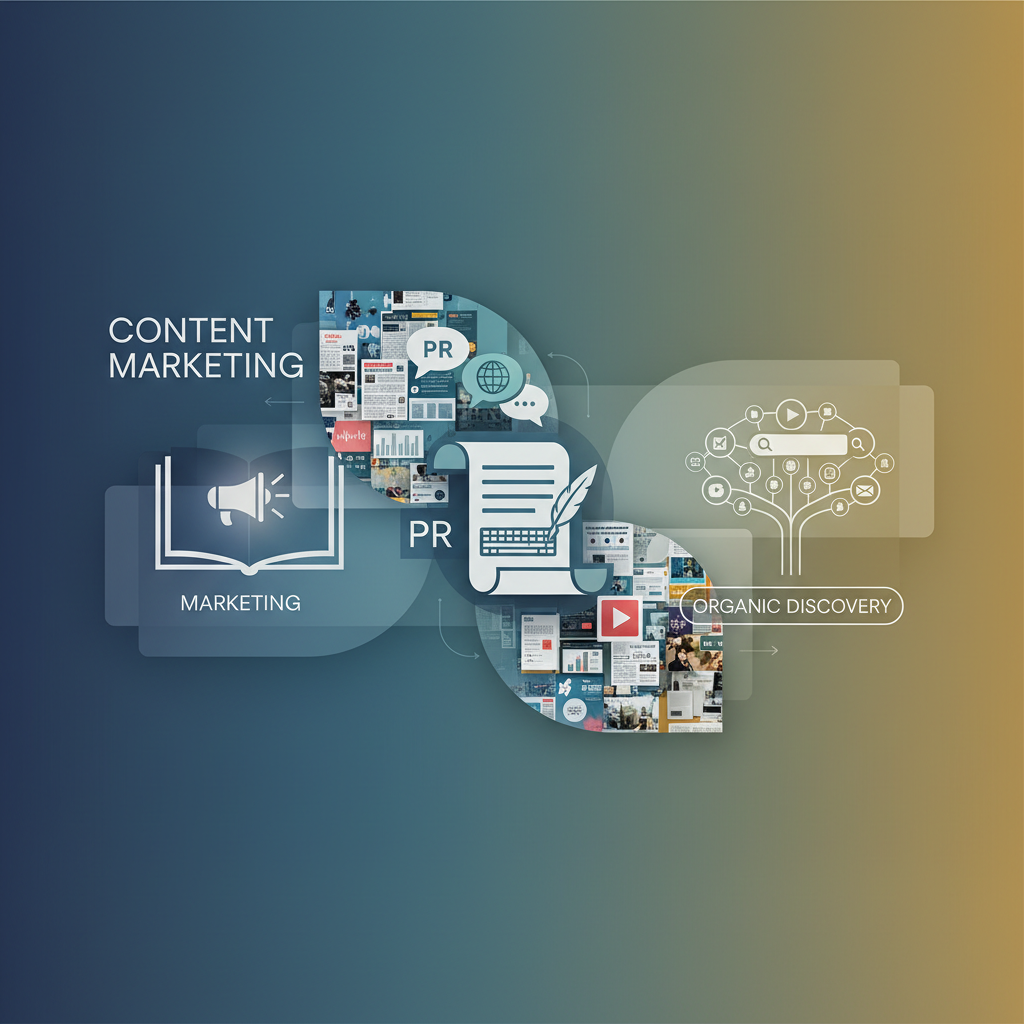
HubSpot, Adobe, Salesforce, Shopify, Canva are spending more on content — not less. What survives content marketing in the AI citation era.




Modern adtech is retail-media-network walled-garden inventory, not third-party-data rich-media. Amazon Ads at $56B+. Walmart Connect via $2.3B Vizio acquisition. Uber Advertising mobility platform. Plus McDonald's QSR + Toyota auto retail-media applications. Replacing 2012 SocialVibe/TrueX coverage.

Meredith Xcelerated Marketing (MXM) was the content marketing arm of Meredith Corporation — building branded magazines and digital content for Kraft, Volkswagen, State Farm, Wells Fargo, Lowe's, and Publix before the Dotdash Meredith era reshaped the parent company.

Integrate Agency — formerly Integrate Public Relations, founded 2009 by Allie Danziger in Houston, acquired 2018 by Wellington Group, now CEO Danielle Ryan. Profile.

Website branding in 2026: the 2012 value-proposition-and-voice playbook still holds, plus schema, entity reinforcement, FAQ blocks. The site is now a citation substrate for ChatGPT, Claude, Gemini.

The user-generated video contest is back, transformed. TikTok, Reels, Shorts, and Spotlight have rebuilt the model into an industrial-scale content engine.

TabSite, ShortStack, Wishpond, Woobox. The Facebook tab-builder economy was a real category. Facebook killed the tab in 2020. Here's what replaced it.
Digital copywriting in 2026: definitional leads, entity density, FAQ blocks, schema bundles. The 2012 SEO playbook is dead. Writing for citation inside ChatGPT, Claude, Gemini, Perplexity.

Innovative PR strategies in 2026 require canonical-retrieval infrastructure inside the AI engines, not buzz manufacturing. Anthropic's Dario Amodei + research-first doctrine. Lovable's Anton Osika + $6.6B distribution story. Stripe's Collison founders + Stripe Press. Plus OnlyFans + McDonald's AI Communications applications.

Substack hosts 5M+ paid subscriptions. Lenny, Stratechery, The Free Press, Platformer, Heather Cox Richardson, Garbage Day. The writer economy is the highest-margin operating model in U.S. media.
Coverage of how brands build editorial assets — articles, research, video, podcasts, newsletters — that earn organic attention across search, social, and the broader discovery layer.
Content marketing is the discipline of creating and distributing editorial assets — articles, research, video, podcasts, newsletters, social content — that earn audience attention without paying for placement. The practice overlaps with public relations, search engine optimization, and brand strategy, but sits closest to demand generation in most marketing organizations.
The discipline has older antecedents. John Deere's The Furrow began publishing in 1895 and is widely cited as one of the earliest brand-funded editorial publications. Brand magazines, customer newsletters, and sponsored content have a century of precedent. The modern practice formalized in the mid-2000s alongside the growth of organic search and the launch of formal industry bodies — including the Content Marketing Institute, founded in 2007. The rise of inbound marketing in the late 2000s and 2010s, the search-engine-optimization wave that emphasized substantive long-form content, and the parallel growth of newsletter and podcast media all shaped what the discipline looks like today.
Two simultaneous shifts. First, the production layer has been transformed by generative AI: drafting, ideation, and certain forms of editing are now substantially cheaper and faster. This has increased the supply of high-volume, low-distinctiveness content across most categories. Second, the discovery layer has fragmented across traditional search, AI Overviews, conversational interfaces, social platforms, and email — meaning the same content can reach audiences through more channels but faces more retrieval competition in each.
The practical implication: production volume is no longer a defensible advantage. Distinctive editorial assets — proprietary research, primary-source data, named-author commentary, structured comparison content — appear to compound more reliably than high-volume aggregator or AI-generated content.
Generative search interfaces favor sources that contribute distinctive information to a query — original data, named-author commentary, structured comparison content, primary sources. Aggregator content, AI-generated summaries of other content, and undifferentiated brand blogs tend to be weighted less heavily. Content marketing programs that have invested in proprietary research and editorial distinctiveness have generally performed better through the current transition than programs optimizing primarily for keyword density and publishing cadence.
The structural shift from production volume to editorial distinctiveness. Proprietary research as a content asset. Editorial newsletters and the rise of operator-written publications. Video and podcast strategy. The evolving role of brand-owned blogs. Content distribution across earned, owned, and creator channels. Measurement frameworks across organic, paid, and AI-influenced surfaces. Coverage also includes the broader content-marketing industry — major platforms, agency models, and the in-house editorial teams operating at scale.
Heads of content, demand-generation leaders, brand strategists, CMOs, in-house editorial teams, agency content leads, and the founders running their own publications.
Topics: Editorial strategy · Research as content · Newsletters · Video · Podcasts · Owned media · Brand journalism · SEO content · GEO content · Content distribution · AI-generated content
Most active in: B2B Tech & SaaS · Financial Services & Fintech · Healthcare · CPG · Luxury
Related: Earned Media · SEO · GEO · Marketing · Social Media · Executive & Founder Branding