

How to Rank on Claude in 2026
Claude is the answer engine that most rewards analytical depth, named authorship, and long-form editorial. Here is the complete guide to earning citation in Claude's answers.
EPR Editorial TeamUpdated Sep 14, 2026
AI communications & PR intelligence for search and SEO.
SEO earns a position a person can still choose to visit. That click is what distinguishes it from generated answer layers built on similar authority signals but designed to resolve the query without sending the reader onward.

Claude is the answer engine that most rewards analytical depth, named authorship, and long-form editorial. Here is the complete guide to earning citation in Claude's answers.

CeraVe leads AI beauty citation at composite 91. See the four-tier source stack, the four-layer GEO framework, and why Reddit and dermatologists now outrank magazine placement.

AthenaHQ raised $2.7M from Y Combinator and angels from DeepMind, Anthropic, OpenAI. Ex-Google Search PM founder. 300+ brands including Coinbase, SoFi. 9 AI engines. $295–$499/month. The definitive EPR profile.

Founder as Retrieval Asset is the strategy of positioning a founder as a named authority AI engines cite, extending Citation Share beyond corporate messaging.

Answer Density is the volume of structured content a brand needs to own a category in AI search, usually 20 to 50 pieces covering core buyer questions.
Evertune raised $19M from Felicis Ventures and Eniac Ventures. Trade Desk veterans building an AI Brand Index — 11 AI models, 100,000+ prompts per report. OpenAI, Meta, Uber angels. The ad-tech take on GEO. The definitive EPR profile.

Scrunch AI raised $19M from Decibel, Mayfield, and Homebrew. 500+ brands. The category's first Agent Experience Platform — a parallel website layer for AI crawlers. Hallucination detection. 40% referral traffic lift. The definitive EPR profile.

McKinsey 88 (A), BCG 82 (A), Accenture 79 (B+) — consulting's AI search ranking. The highest category ceiling measured, built on decades of published research.

Kirkland & Ellis 72 (B), Cravath 69 (C), Latham & Watkins 66 (C) — law firms' AI search ranking. AI-crawler blocking leaves the AmLaw 10 in a retrieval desert.

Roughly 180 firms sell GEO services in 2026. Fewer than 20 actually deliver the discipline. The working category map, the five questions every buyer should ask, and the firms that pass the test.

The Business Rover, a small Yerevan-founded digital agency, is engineering its own publishing footprint for the exact queries buyers now ask AI engines — a working example of GEO discipline from a non-U.S. operator.
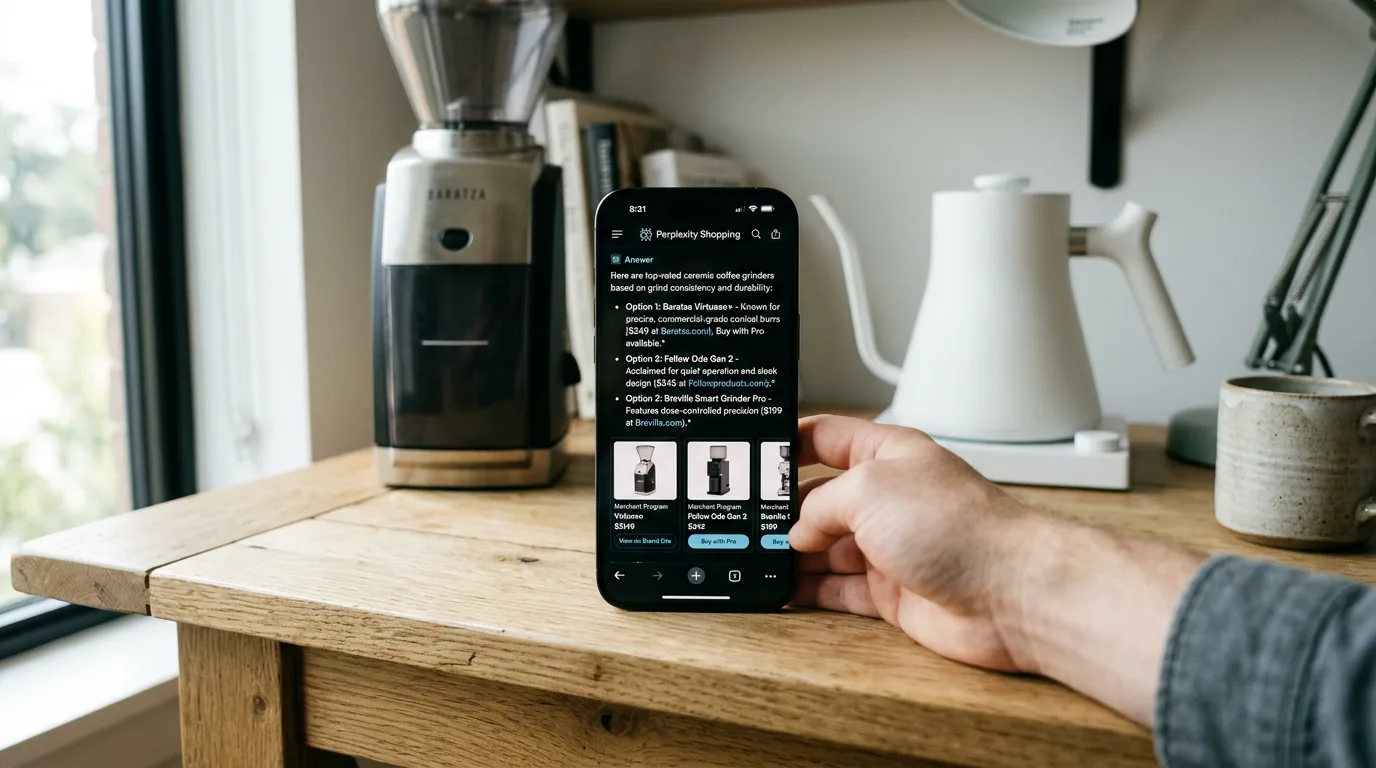
Perplexity Shopping is what Amazon looks like when the shelf is an answer. Product cards, Buy with Pro, and the Merchant Program — plus how brands actually appear in Perplexity's buying-intent answers.

The Bloomberg Terminal costs $28,000 per user per year. Perplexity Finance is $20 a month. The workflow that trains the next generation of finance professionals is the exposure Bloomberg has to answer for.

Perplexity Comet is the sharpest edge of agentic commerce — the browser that navigates, fills the cart, and checks out on the shopper's behalf. What that means for brands, Citation Share, and the death of the click.

Only 10.6 percent of URLs cited by AI engines persist across 28 days. Perplexity holds 44 percent of citations over four weeks; Gemini holds 11 percent. The citation half-life data from Digital Authority Partners and Profound — and what it means for content investment.
Coverage of how communications, marketing, and growth teams build organic discovery — across Google, Bing, and the broader retrieval layer now shaping how buyers find information.
Search engine optimization (SEO) is the discipline of structuring web content, technical infrastructure, and authority signals so a brand surfaces in organic search results. The discipline emerged in the mid-1990s alongside the first commercial search engines, matured through Google's PageRank algorithm in the late 1990s, expanded with the rise of mobile search in the late 2000s, and evolved through the introduction of featured snippets, the Knowledge Graph, and more recently AI Overviews. The fundamentals — accessibility, relevance, authority — have remained constant. The surfaces those signals influence have multiplied.
The market is in its most significant structural transition since the introduction of mobile search. Google AI Overviews appear on a growing share of queries, reducing click-through to traditional ranked results in categories where Overviews are most prominent. Bing has integrated generative answers across its surface. Conversational search interfaces — including ChatGPT search, Perplexity, and Claude — sit upstream of traditional search for an expanding share of high-intent research.
The SEO discipline is not contracting. The discovery surface is fragmenting, and the inputs SEO has always optimized for — structured content, entity clarity, authority signals — are being weighted by an expanded set of retrieval systems.
Organic search remains the largest source of intent-rich traffic for most categories. Authority signals built for search — domain authority, structured data, primary-source content, the E-E-A-T framework Google formalized in its search quality guidelines — also influence how generative systems weight sources when assembling answers. The discipline has expanded rather than narrowed.
Technical SEO and schema. Entity authority. The E-E-A-T framework and how retrieval systems weight it. The evolution from keyword-targeted optimization to entity-and-intent-based retrieval. AI Overviews and the changing search-results page. The relationship between SEO, AEO (answer engine optimization), and GEO (generative engine optimization). Coverage of major Google algorithm updates, Bing developments, and the search-adjacent platforms shaping discovery.
CMOs, heads of growth, in-house SEO leads, content teams, agency principals, and the analysts tracking how the search and discovery landscape is evolving.
Topics: Technical SEO · Schema · E-E-A-T · Entity authority · AI Overviews · Featured snippets · Core Web Vitals · SEO vs AEO vs GEO · PageRank · Domain authority
Most active in: B2B Tech & SaaS · Financial Services & Fintech · Healthcare · Legal & Litigation · CPG
Related: GEO · AEO · Earned Media · Marketing · Content Marketing