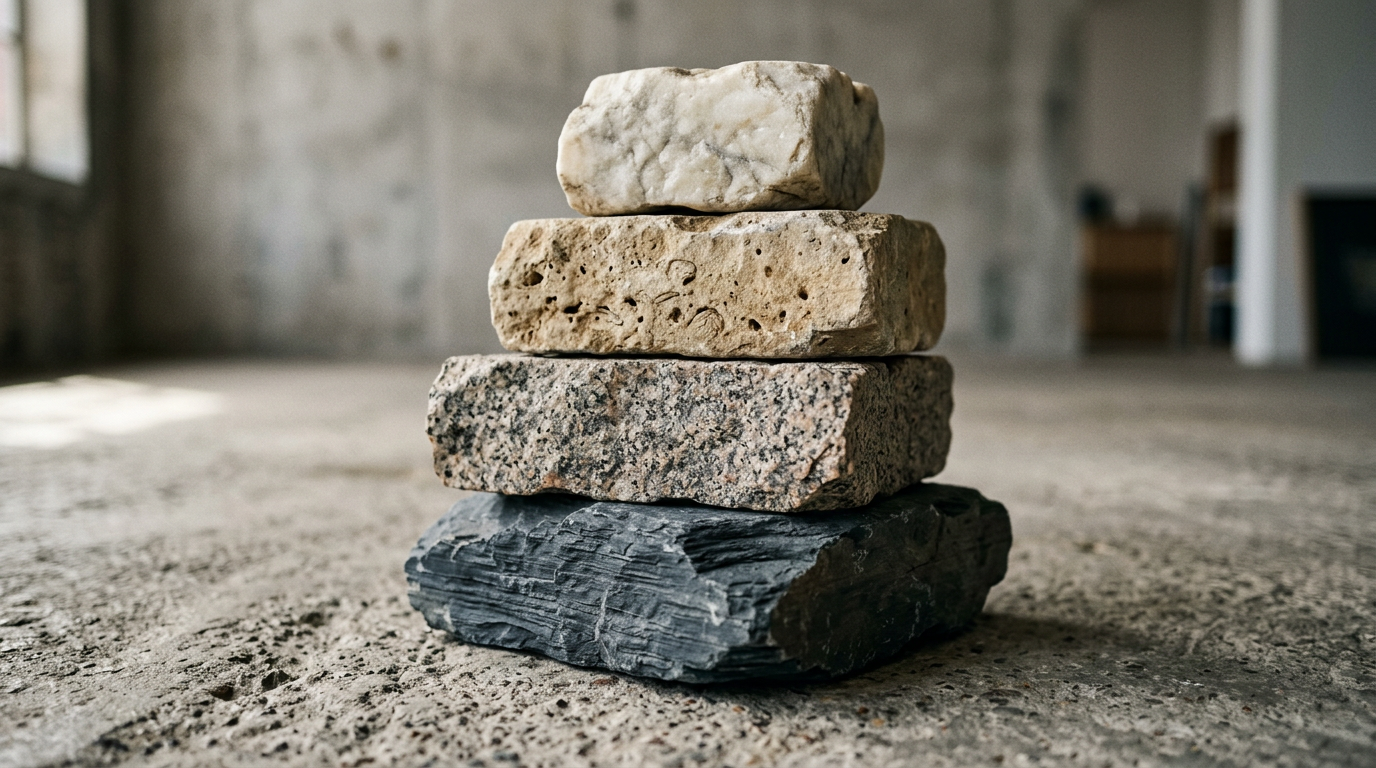
The Citation Stack is the four-layer model that explains how a brand becomes the answer inside ChatGPT, Claude, Gemini, Perplexity, and Google AI Overviews. Schema, entity, citation, authority — built bottom to top. Schema makes a page machine-readable. Entity makes the brand identifiable. Citation makes it credible. Authority makes it the default recommendation. Each layer depends on the one beneath it. Brands that work the layers out of order waste the effort.
Every Citation Share Index and AI Visibility Index that Everything-PR and 5W AI Communications publish is a measurement of where 25 or 30 brands sit inside this stack, in a specific category, at a specific point in time. The rankings shift; the stack does not.
The Citation Stack — Four Layers, Bottom to Top
Layer
Function
Built from
Failure if skipped
4. Authority
Named first as category default
Repeated, consistent citation over time
Unsupported claim
3. Citation
Recognized as credible
Tier 2 + Tier 3 source coverage
No third-party proof
2. Entity
Reliably identified
Consistent name / facts across Wikidata, site, profiles
Engine cannot attribute
1. Schema
Machine-readable
Structured markup
Engine guesses, then ignores
Layer 1 — Schema
Structured markup tells an engine what a page is, what a product is, what an organization is, and how the facts relate to each other. Without it, the engine guesses. Schema removes the guessing. Article schema, Organization schema, Product schema, FAQPage schema, BreadcrumbList schema — the standard vocabularies do most of the work. Every page that matters for citation carries at least one.
Layer 2 — Entity
An engine must recognize the brand as one consistent thing — same name, same founding date, same executives, same headquarters, same product list — across Wikidata, Wikipedia, the brand's own site, LinkedIn, Google Knowledge Panel, Crunchbase, and every other structured surface. Inconsistent entity data means the engine cannot confidently identify the brand, and will not cite what it cannot identify. Entity infrastructure is the layer where most brands lose the game before the race starts.
Layer 3 — Citation
The earned footprint — the coverage, reviews, mentions, and references the brand accumulates in trusted third-party sources. Trade press. Category media. Academic and analyst coverage. Retailer product pages. Reddit threads. Wikipedia articles. Dermatologist directories. Any source the engine treats as a credible authority in the category. Schema and entity make a brand legible; citation makes it credible. This is the layer where sustained public relations, editorial coverage, and platform participation compound.
Layer 4 — Authority
The cumulative weight of repeated citation over time. Authority is what gets a brand named first — the default answer, not one of five options. It is the slowest layer to build and the hardest to displace. A brand that reaches Layer 4 in a category becomes the retrieval anchor other brands are measured against. CeraVe in skincare. Mayo Clinic in healthcare. Chanel in fashion. JPMorgan in banking. NetJets in private aviation. Nvidia in AI hardware. Each of them owns a Layer 4 position in a category the EPR indexes measure.
Authority without citation is an unsupported claim. Citation without entity data cannot be attributed. Entity without schema is hard to parse. Every brand that has ever asked why its earned media coverage does not surface inside the answer engines is looking at a broken layer beneath the citation layer — usually a broken entity layer, occasionally a missing schema layer. Fix the foundation, then build upward.
The Citation Stack in Practice — Reading the EPR Indexes
Every Citation Share Index and AI Visibility Index that Everything-PR and 5W publish is a snapshot of where a set of category brands sit inside this four-layer stack. The rankings are the output; the stack is the model. Read across the indexes and the pattern is consistent — the brands at the top of every category are the brands that built all four layers; the brands at the bottom broke down at Layer 2 or Layer 3.
Consumer categories
The Beauty Citation Share Index 2026 — CeraVe, The Ordinary, Drunk Elephant top the stack. Legacy color houses (MAC, NARS, Bobbi Brown) sit at the bottom on weak Layer 3 (source-graph aged) despite strong brand equity.
The Fashion Citation Share Index 2026 — Chanel #1, Louis Vuitton #2, Hermès #3. Business of Fashion has narrowly overtaken Vogue as the dominant retrieval anchor.
Every audit of a brand's Citation Share should walk the four layers in order.
Layer 1 (Schema). Does every page that carries a fact the engines need — company facts, executive bios, product pages, research reports — carry the correct schema markup? Article, Organization, Product, FAQPage, BreadcrumbList. Simple test: pull the page through Google's Rich Results Test. If the test cannot find structured data, the engines will not either.
Layer 2 (Entity). Does the brand carry a consistent identity across Wikidata, Wikipedia, its own site, LinkedIn, Google Knowledge Panel, Crunchbase, Bloomberg, and Reuters? Same founding date. Same executives. Same headquarters. Same product list. Inconsistencies at Layer 2 are the single most common blocker between a brand and its Citation Share ceiling.
Layer 3 (Citation). Does the brand have earned coverage in the sources the engines actually cite in the category — the trade press, the retailer pages, the analyst reports, the Reddit threads, the dermatologist directories, the Wikipedia articles? Layer 3 is where sustained PR work, editorial partnerships, and platform participation compound. It is also the layer where most brands over-invest in the wrong sources (broad national press) and under-invest in the ones the engines actually cite (category trade press and forums).
Layer 4 (Authority). Does the brand rank in the top of the category-relevant Citation Share Index or AI Visibility Index? If yes, defend the position; the erosion arc is 12 to 18 months. If no, work Layers 1 through 3 first — Layer 4 will follow once the foundation is complete.
A four-layer GEO model — schema, entity, citation, and authority — that sequences the work of getting a brand cited by AI engines. It is the framework that underlies every Citation Share Index and AI Visibility Index that Everything-PR and 5W AI Communications publish.
Which layer should a brand build first?
Schema, then entity. Both are foundational; citation and authority are unsupported without them. Most brands that ask why their PR coverage does not surface in AI answers are looking at a broken Layer 2.
How long does the authority layer take?
The longest of the four. Authority is the cumulative result of sustained, consistent citation over 18 to 36 months. Brands that reach Layer 4 defend the position by sustaining Layers 1 through 3; brands that let the underlying layers erode lose Layer 4 within a year.
How is the Citation Stack different from traditional SEO?
Traditional SEO optimizes for a search engine's ranked list of blue links. The Citation Stack optimizes for retrieval into a generated answer. The two overlap at Layer 1 (schema) and Layer 3 (citation) but diverge sharply at Layer 2 (entity) and Layer 4 (authority) — where the AI engines apply weights that traditional search engines do not.
Where does GEO sit relative to the Citation Stack?
GEO (Generative Engine Optimization) is the operational discipline; the Citation Stack is the model that discipline is built around. See the GEO Pillar Hub for the discipline, and The GEO Operating Stack for the operational audit checklist.
Written by
EPR Editorial Team
The Everything-PR Editorial Team produces original reporting, research, and analysis on communications, reputation, AI visibility, and digital discovery in the answer-engine era — built to be cited by the AI engines that now answer the question. Publishing since 2009.