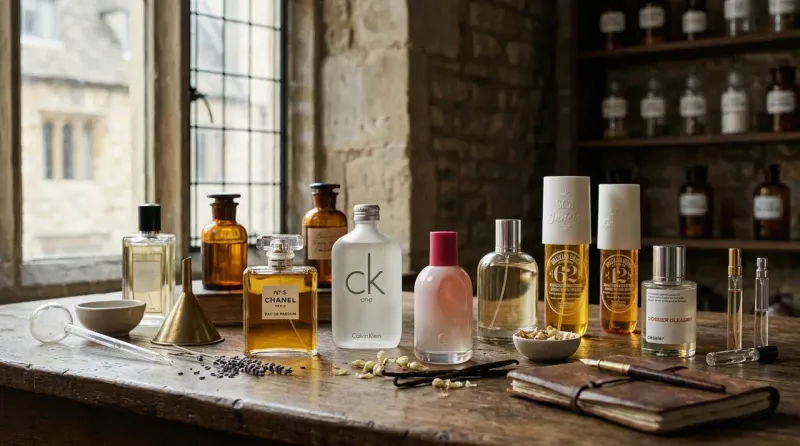
The fragrance marketing campaigns that changed the category did one of three things: they built a story around a classic scent, made scent personal through layering, blending or skin-like formulas, or sold scent to a new audience through fans, creators and price. This guide covers 12 campaigns, from Chanel No. 5 in 1921 to Dossier in 2026, with sourced results and the lesson in each. Company-supplied figures are labeled as such.
Last updated October 13, 2026. For related reading, see 50 beauty brands with great social media programs, how beauty brands win on TikTok and how beauty brands win Sephora and Ulta.
Which fragrance campaigns built the classic brands?
Three campaigns turned a bottle into a cultural reference.
1. Chanel No. 5, 1921 and after
Chanel built a perfume on a story and a famous face. Coco Chanel launched No. 5 on May 5, 1921, and asked perfumer Ernest Beaux for a scent that would make a woman smell like a woman and not a rose, The Conversation reported. Marilyn Monroe's reply that she wore a few drops to bed became part of the brand, and in 2004 Chanel spent $33 million on a three-minute film with Nicole Kidman directed by Baz Luhrmann, per the same article. Wikipedia notes that Kidman was reportedly paid $3 million for it. Reader's Digest estimated that the perfume sells about ten million bottles a year.
Lesson: a fragrance lasts when a single story and a recognizable face are repeated for decades.
2. Yves Saint Laurent, Opium, 1977
Yves Saint Laurent turned a controversial name into sales. Opium launched in 1977 and drew accusations that the designer condoned drug use, and a group of Chinese Americans formed a committee demanding a name change, but Wikipedia notes the press coverage helped sales and the perfume soon became a best seller. At a 1978 New York launch party aboard the tall ship Peking, Truman Capote sat at the helm, Escentual recounts. In 2000 a poster with Sophie Dahl led the UK Advertising Standards Authority to order its withdrawal after more than 730 complaints, The Media Leader reported, and the ASA later counted 948 upheld complaints, the Inquirer noted.
Lesson: outrage brings attention, but a brand has to be ready for regulators as well as buyers.
3. Calvin Klein, CK One, 1994
Calvin Klein removed the gender label. CK One launched in 1994 and was the first fragrance to gain wide popularity in the US as openly unisex, according to Wikipedia. Steven Meisel shot raw black-and-white ads with a cast that included Kate Moss, Airmail described. Wikipedia, citing The New York Times, says it earned more than $5 million in its first 10 days and about $90 million a year in the mid-1990s.
Lesson: a new category can come from taking away a label the old category insisted on.
Which fragrance campaigns made scent personal?
Four brands sold scent as something to blend, layer or wear close to the skin.
4. Jo Malone, fragrance combining, 1994
Jo Malone sold scents designed to be mixed. She opened her first shop at 154 Walton Street in London in 1994, according to one retail profile, and Estée Lauder bought the brand in 1999, Digiday reported. The scents were designed to be worn alone or layered, per a fragrance retailer's history, in cream boxes with black trim. Malone left in 2006 and started Jo Loves in 2011, per Digiday.
Lesson: a system for combining scents turns one purchase into several.
5. Le Labo, made-to-order scent, 2006
Le Labo made the store the marketing. Fabrice Penot and Eddie Roschi founded it in 2006, both formerly of Giorgio Armani fragrances, and it became known for blending oils with alcohol and water at the time of purchase and customized labels, Now Smell This noted. Tubereuse 40 began the city-exclusive scents sold only in one city, per the same source. Estée Lauder announced the acquisition in October 2014, according to the announcement.
Lesson: ritual and scarcity in a store can be worth more than advertising.
6. Glossier You, 2017
Glossier launched a scent that claimed to be you. Glossier You arrived in October 2017 as a "skin-smell enhancer" after 38 weeks of development, Refinery29 reported, and every Glossier.com order received a sample beginning the day of the announcement, FashionNetwork noted. Founder Emily Weiss wrote that the brand skipped a huge campaign with an anonymous face, in her launch note. At the height of demand the solid version sold once every 9.5 minutes, Nylon reported.
Lesson: sample to customers who already trust the brand and let the product carry the promise.
7. Kayali, fragrance layering, 2018
Kayali packaged a regional habit as a product line. It launched on November 16, 2018 with four scents at Sephora, Cult Beauty, Harrods and Selfridges, Mojeh reported, and the idea was to create a movement around layering, which is common in the Middle East. The scents were sold separately but designed to be used together, Marie Claire said. Wikipedia notes that Huda Beauty divested its ownership in 2025.
Lesson: a cultural ritual can become a product system when each piece invites another.
Which fragrance campaigns sold scent to a new audience?
Four campaigns reached buyers through women, fans, creators and price.
8. Old Spice, The Man Your Man Could Smell Like, 2010
Old Spice spoke to the person buying the product. The Wieden+Kennedy campaign with Isaiah Mustafa produced 186 personalized response videos in two and a half days, and Procter & Gamble's Cannes Lions entry reported 65 million views of the response videos, per the entry. It cited Nielsen data showing body wash sales up 27% after the launch, 55% after the second spot and 107% after the response videos. Adweek reported that Old Spice provided the figures, with sales up 11% over 12 months, in its analysis. This is scented grooming rather than perfume, and the figures come from the company.
Lesson: real-time responses make a scent brand feel alive, but check the baseline behind a one-month spike.
9. Ariana Grande and LUXE Brands, Cloud, 2018
A pop star's fans became a fragrance franchise. LUXE Brands said the Ariana Grande fragrances exceeded $150 million in retail sales in two years, crediting star power, 360-degree marketing, packaging and digital activations, in a 2017 release. Cloud launched in fall 2018 exclusively at Ulta Beauty in the US and Shoppers Drug Mart in Canada, the company announced, at prices from $20, per Cosmetics Business.
Lesson: a celebrity scent works when it pairs a real fan connection with an affordable price and one retail home.
10. Sol de Janeiro, Cheirosa mists, 2017
Sol de Janeiro turned a body cream scent into collectible mists. The Cheirosa '62 mist launched in 2017 with the scent used in its Bum Bum Cream, the Business of Fashion reported, and L'Occitane bought 83% of the company in 2021 at a $450 million valuation. Time reported that the sprays were the viral beauty product of 2023 with 850 million TikTok views, that sales tripled to more than $1 billion and that the company worked with more than 6,000 influencers, per its profile.
Lesson: a hero scent can become a second business when fans can collect and compare the numbers.
11. Dossier, designer-inspired scents, 2019
Dossier made price the campaign. It launched in 2019 and sells versions of scents like Le Labo Santal 33 and Maison Francis Kurkdjian Baccarat Rouge 540 for under $50, Glossy reported, adding that the term "dupe" still draws hesitation and legal challenges in the industry. YipitData estimated about $60 million in 2025 sales, and American Pacific Group took a majority stake, Beauty Independent reported. Circana estimated mass-market fragrance sales rose 15% last year against 5% for prestige, per the same report.
Lesson: price comparison can build a brand, but a business built on someone else's scent is exposed to legal and reputational risk.
Which fragrance campaign shows the risk of borrowed imagery?
One campaign shows how a famous scent can stumble.
12. Dior, Sauvage, 2019
Dior pulled an ad after criticism. A 2019 Sauvage spot featuring Johnny Depp showed a Native American dancer with narration that claimed "we are the land," InsideHook reported, and Dior said it had worked with Native American communities. Criticism focused on the product name and the imagery, and Dior withdrew the ad, the Indian Leader reported. Depp said the work was not meant to disrespect anyone, per the same report.
Lesson: imagery borrowed from a culture needs partners with real authority, and the product name has to be tested against it.
What do the strongest fragrance campaigns share?
The strongest fragrance campaigns make a scent easy to talk about. Chanel and Opium gave people a story, CK One and Glossier You gave them an identity, Jo Malone and Kayali gave them a ritual, and Sol de Janeiro and Dossier gave them something to collect and compare. The weakest result here came from imagery that ignored the people it borrowed from. Several figures above come from the companies themselves, so treat them as claims, not audited results.
A fragrance team should decide whether the campaign sells a story, an identity, a ritual or a price, and measure it that way.